Wednesday, March 9, 2022

Irwin on trade reform

Doug Irwin of Dartmouth gave a really informative talk at the Hoover Economic Policy Working Group, based on his paper The Trade Reform Wave 1985-1995, AER May 2022.  Embed (hopefully) below, or go to the link here.  


Doug opened my eyes, hence this post. I love learning something new. I'm a resolute Free Trader. So, naturally, I jump to the answer: Stop protecting industries. Get rid of tariffs. Don't bother with the negotiated mercantilism of trade deals -- the "you can sell to us if our exporters can sell to you" deals. The point of a foreign country's exports is to get dollars, and the point of dollars is for them to buy from the US. Full stop. 

Doug reveals that this story is far too simplistic to understand the closed economies of the 1950s through 1970s, and the great trade liberalization that the world experienced starting in the 1980s -- and which we are very sadly likely to lose in the years ahead. A little reminder of what we gained, and a sad peak: 
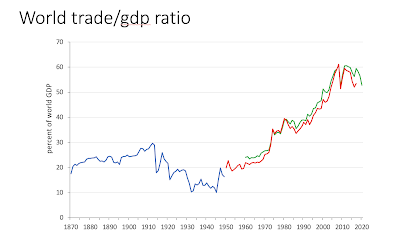


The process of liberalization started with money, not tariffs: Countries first devalued overvalued currency, usually to a floating rate. Then they eliminated quantitative restrictions on imports including import licenses. Then they reduced tariffs. 

In turn, how did they get there, and why did they not reform earlier? The standard story pits domestic industry vs. consumers. Domestic industries have concentrated interest in protection, consumers are diffuse. That accounts for status quo bias, but not why they eventually changed. 

The source of the problem, and reason for the change is different. Countries (especially in the "developing" world) were hit with a "terms of trade" shock -- they exported commodities, say, to import goods; the commodity price went down so they could not buy imports. Many countries were financing imports with foreign aid and borrowing, and those transfers dried up. 

What do they do? They have to choose between deflation, currency depreciation, or import controls.  Deflation at the same exchange rate makes foreign goods more expensive. Depreciation does the same, without changing the domestic price level. Or, stop imports by direct controls, and by rationing foreign exchange leading to a black market. In the early postwar view, consistent with Bretton Woods, they chose the latter. (Why is there so much nostalgia for Bretton Woods? It was a rotten system.) 

Naturally, it didn't work. Eventually they gave up and devalued or floated the exchange rate. Now there is no need to ration foreign exchange or to restrict imports by license. (Tariffs are bad, but quantitative restrictions are worse, since you never know what the cost is, and then imports are allocated by political rather than economic reasons. Just paying a tax is more efficient!) They moved to exports in order to generate foreign exchange to buy imports. 
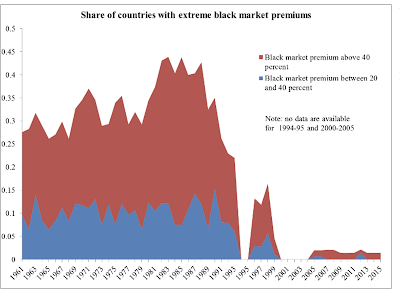


So, Doug answers the central question: 
Why no reform in 1970s? “foreign exchange reserves kill the will to reform” 
Oil and commodity export countries were flush with cash to buy imports. Foreign aid recipients had cash to buy imports. 

Why reform in 1980s?
Era of scarce foreign exchange – all three BOP shocks.
Goal: increase foreign exchange earnings by increasing exports.
Learning from experience – cost of import controls, benefit of exports

Shift from import repression to export promotion to overcome foreign exchange shortage 

And, later, 
Michael Bruno (World Bank): “We did more for Kenya by cutting off aid for one year than by giving them aid for the previous three decades”

Aid lets a country put off reform. 

I asked one question, about the importance of an open capital account. That also used to be gospel, now under debate. Doug's answer was interesting: In these cases, a free currency market was crucial, but free capital markets less so. 

Ideas matter.

This process did not just play out in standard political economy terms, one interest group gains power over another. The shift of ideas in universities, the IMF, central banks, and countries was crucial. I find this heartwarming as a producer of ideas, and terrifying as I watch these successful ideas crumble around me. 

Doug discusses the process of reform in Mexico, (which first had disaster under some bad ideas, then reform when a new group of economists came in), India, South Korea and others. Listen to the talk! 

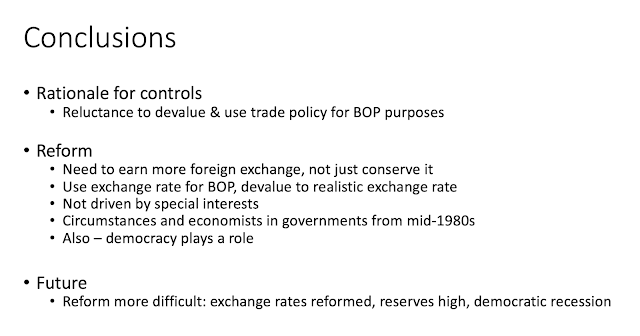
Concluding slide: 


Monday, March 7, 2022

The Biden-Blinken Doctrine

Over the weekend, the U.S. declared a no-fly zone off the table. Secretary Blinken on NBC News with Chuck Todd: 

QUESTION:  ... Why rule out the no-fly zone?  Why not make Putin think it’s possible?

SECRETARY BLINKEN: ...The President’s been very clear... we’re not going to put the United States in direct conflict with Russia, not have American planes flying against Russian planes or our soldiers on the ground in Ukraine, because for everything we’re doing for Ukraine, the President also has a responsibility to not get us into a direct conflict, a direct war, with Russia, a nuclear power, and risk a war that expands even beyond Ukraine to Europe.  That’s clearly not our interest.  What we’re trying to do is end this war in Ukraine, not start a larger one.... 

And by the way, keep in mind what – again, keep in mind what a no-fly zone – just so people understand, too, what a no-fly zone means.  It means that if you declare a space no-fly and a Russian plane flies through it, it means we have to shoot it down.

If country A nakedly invades country B, and country A has the ability to expand to a wider war, especially nuclear, then the US will not fight. Not only we do not fight directly, we do not declare a no-fly zone. If country B has an explicit defense treaty with the US, such as NATO, we might, but otherwise, you're on your own. 

Thursday, March 3, 2022

Time for Supply

At Project Syndicate essay, with Jon Hartley. It's not the first, and it won't be the last on the issue! 

Now that surging inflation has refocused everyone's attention on the long-ignored supply side of the economy, the question is how best to support broad-based growth, efficiency, and innovation. The answer is not necessarily deregulation, but the need for smarter regulation is increasingly apparent – even to progressives.

STANFORD – The return of inflation is an economic cold shower. Governments can no longer hope to solve problems by throwing money at them. Economic policy must now turn its attention to supply and its cousin, economic efficiency. 

The issue is deeper than delayed goods deliveries and a year’s worth of sharp price increases. From the end of World War II to 2000, US real (inflation-adjusted) GDP per capita grew 2.3% per year, from $14,171 to $44,177 (in 2012 dollars). Americans became healthier, lived longer, reduced poverty, and paid for a much cleaner environment and a vast array of social programs. But since 2000, that post-war growth rate has fallen almost by half, to 1.4% per year. And it’s worse in Canada and Europe, where many countries have not grown at all since 2010 on a per capita basis. 

Nothing matters more for human flourishing than long-term economic growth. So, no economic trend is more worrisome than growth falling by half, especially for the well-being of the less fortunate. 

The eruption of inflation settles a long debate. Sclerotic growth is not the result of demand-side “secular stagnation,” fixable only with massive fiscal and monetary stimulus. Sclerotic growth is a supply problem. We need policies to increase the economy’s productive capacity – either directly or by reducing costs. 

How? The simplest and most important thing governments can do is to get out of the way. Byzantine regulations and capricious regulatory authorities stymie business. We do not need thoughtless deregulation, but rather smarter regulation that is simple, effective, avoids disincentives and unintended consequences, and is not distorted to protect current business and prop up regulatory empires. That means adding sunset clauses to regulations, regularly re-evaluating existing measures, and instituting a right to external appeal. 

Monday, February 28, 2022

The U.S. and NATO must fight

The U.S. and NATO must fight

(Coauthored with Elizabeth Fama)

Why are we — the U.S., NATO, the civilized western world — not fighting for Ukraine? If we do not fight in Ukraine now, we will fight there later, or in the Baltics, Poland, or Taiwan, at much greater cost. If we do not forcefully reverse this invasion, larger ones will follow.

The next few days and weeks are vital. If the government of Ukraine falls, President Zelenskyy and other leaders of the legitimate government will be jailed or murdered. Russia will annex Ukraine, or install a puppet government with a defense treaty. It will declare Ukraine under the Russian nuclear umbrella. Freeing Ukraine after the fact, re-creating a government, will be much harder and riskier.

Sanctions will not save Ukraine. Sanctions were intended as a deterrent. Sanctions are a punishment. Sanctions are not an effective way to fight a war. They will do little to stop Russia from winning in the next month or two. Sanctions will not achieve what must be our goal: Russian withdrawal, Ukrainian sovereignty, a return to the borders we pledged to uphold in 1994. Cuba, Iran, and North Korea withstood sanctions for decades. So will Russia. 

Now that sanctions have failed to deter Putin, what is the plan? On the current course, if we don’t provide more help, Ukraine loses, the country is destroyed or partitioned, and we settle in for decades of deciding just how much energy Russia sells to Europe, what Europe sells in return, and how much tut-tutting we do about Russia trading with China, Iran, and others. While Putin turns his roving eye to the Baltics.

To save Ukraine, to save its democratically elected government, to save its people, to stop this from happening over and over, allies must  fight.

We have the means. Russia does not have the power of the old Soviet Union, or of Nazi Germany. Russia spends $62 billion a year on its military. The US spends $788 billion. Germany and France spend $53 each, and the U.K. $59. NATO as a whole spends about $1.2 trillion a year on defense, almost twenty times what Russia spends. Our armies are larger, better equipped, and better trained than Russia’s. We lack only the will.

News from Ukraine already suggests unexpected Russian weakness: deficiencies in advanced weapons, tactics, training, supplies, and intelligence. There is a good chance that Russia needs this to be over quickly. If this is true, it is all the more important for us to help Ukraine to hold on.

What can be done in practical terms? NATO can immediately declare a Russian no-fly zone over Ukraine. Denying Russia the skies would critically hamper their invasion. NATO can launch missiles, drones, and airstrikes at Russian army assets. NATO should move invasion forces to the Ukrainian borders. Allies could work closely and directly with the Ukrainian Army, and support their intelligence. The U.S. could unleash our own cyber capabilities. We should protect President Zelenskyy and his government. (The man is a hero.)


We cannot fight, many say, because any engagement of NATO and Russian forces could provoke a nuclear escalation. It’s a legitimate worry. Putin is already capitalizing on this fear by placing nuclear forces on alert in response to sanctions. First, Putin knows the retaliation that would follow. Second, our goal is freedom for Ukraine, not invasion of Russia or regime change in Russia. Nuclear weapons exist to defend a country, not to prosecute aggressive wars, and even Putin knows that. That’s why the potential for nuclear war is higher if we try to free Ukraine after Russia has already subsumed it into its sovereign territory. Most of all, if we cannot ever use our conventional military to stop an unprovoked invasion, we surrender now and watch the Century of Invasions unfold.

We must not fight, others say, in “forever wars” in far-away countries. But in Ukraine we would not be toppling a regime, or “nation-building.” We would be defending and preserving an elected government and its civil society. 

We did this before. In 1990, Saddam Hussein conquered and annexed Kuwait. A coalition of thirty-five nations fought, forced Iraqi troops back to the border, and left. Why did we fight over such a distant piece of land? To stop the next invasion.

We two are not habitual hawks. We recognize that the history of U.S. foreign interventions has included failures. We know that our military cannot rescue millions of people trapped in misery by despots. But the U.S. and our allies must  send a message to those despots that we will not return to a world of naked territorial aggression, and that we will fight, if need be, to stop it.

****

Update.  Bottom line: We must not let Ukraine lose. Do what it takes, calibrate responses, sure, maybe we don't have the right strategy. Maybe big sanctions will do it. Maybe Putin will be overthrown, But letting  Ukraine lose and then settling in for a sanctions negotiation is an unacceptable outcome. Do not let Ukraine lose. 


Tuesday, February 22, 2022

Important questions unasked of the Fed

This weekend's WSJ essay "How the Fed Averted Economic Disaster"  by Nick Timiraos finally brings into public discussion the second question we should all be asking of the Fed. What happened in the grandest bailout of all time in the covid crisis, and, more importantly, having done it twice, how are we going to avoid massive bailouts becoming the normal state of affairs? (The first question, of course, is "how did you miss inflation so drastically and when are you going to do something about it?") 

They were offering nearly unlimited cheap debt to keep the wheels of finance turning, and when that didn’t help, the Fed began purchasing massive quantities of government debt outright.

Translation: When dealer banks weren't buying treasury debt fast enough, the Fed lend the banks money to buy the debt, and quickly bought up the massive amount of debt themselves. 

The Fed followed by bailing out money market funds, buying state and local government debt, buying exchange-traded funds that held junk corporate debt, and announcing a do whatever it takes pledge to keep corporate bond prices high. It worked

It worked. The Fed’s pledges to backstop an array of lending, announced on Monday, March 23, would unleash a torrent of private borrowing based on the mere promise of central bank action—together with a massive assist by Congress, which authorized hundreds of billions of dollars that would cover any losses.

...Carnival Corp. , the world’s largest cruise-line operator. Its business had collapsed as Covid halted cruises world-wide. Within days of the Fed’s announcement, Carnival was able to borrow nearly $6 billion from large institutional investors...If the hardest-hit companies like Carnival, with its fleet of 104 ships docked indefinitely, could raise money in capital markets, who couldn’t?

Let's be clear who is bailed out here: Creditors. People who lent lots of money to shaky businesses, earned nice high yields in good times, now have the Fed and Treasury bail them out in bad times. 

It worked. 

Today, nearly two years later, most agree that the Fed’s actions helped to save the economy from going into a pandemic-induced tailspin.

I agree. A crisis was imminent, a toppling of a vastly over-leveraged house of cards was in the works. As "just in time" supply chains discovered they needed a bit of extra inventory around, just in time debt financing falls apart at the slightest shock, needing a bit of cash inventory and equity buffer. 

The Fed’s initial response in 2020 received mostly high marks—a notable contrast with the populist ire that greeted Wall Street bailouts following the 2008 financial crisis. North Carolina Rep. Patrick McHenry, the top Republican on the House Financial Services Committee, gave Mr. Powell an “A-plus for 2020,” he said. “On a one-to-10 scale? It was an 11. He gets the highest, highest marks, and deserves them. The Fed as an institution deserves them.”

I also agree, almost. But  

The question now is what will be the long-term costs and implications of that emergency activism—for the Fed, the financial markets and the wider economy. 

This is the question. Why did the economy get into a situation once again, so soon, that the Fed had to engineer this massive bailout? What are you going to do to make sure you don't have to do it again and again? 

Saturday, February 19, 2022

More infrastructure snafu

Just as I hit publish on my last post, the Wall Street Journal publishes a much better essay by Ted Nordhaus on the impossibility of building infrastructure in the US, even if it is green alternative energy climate-change infrastructure.

In Nevada’s Black Rock Desert, local environmentalists and devotees of the Burning Man festival are using the National Environmental Policy Act (NEPA) to oppose a geothermal energy plant. Further south, the Sierra Club has joined with all-terrain vehicle enthusiasts to stop development of what would be the nation’s largest solar farm, which it says threatens endangered tortoises. ... proposals to develop wind energy in American coastal regions have also faced a constant barrage of NEPA and Endangered Species Act (ESA) lawsuits designed to stop them.

The Nantucket wind farms are the classic example. Wind farms, yes, but not if it spoils the view of uber-wealthy greens. Sue! On whale-disturbance grounds. 

Friday, February 18, 2022

Drowning in paperwork

The US, and New York State in particular, are embarked on a decarbonization agenda. Canada has a lot of hydropower to spare, which emits no CO2. (Though large hydropower is rather hilariously not deemed "renewable" by California, among others.) All we need is a big extension cord from Canada down to NYC, and we can save the climate, right? How long can that take? 

More than 17 years, as The Wall Street Journal reports. 

By late 2025, a 339-mile high-voltage transmission line is expected to deliver enough hydropower from Quebec’s remote forests to supply about 20% of New York City’s needs. The first electricity will finally flow 17 years after developers set out to bury a power line along the bottoms of Lake Champlain and the Hudson River, assuming they clear one last regulatory hurdle and encounter no further challenges.

Well, I'm glad climate is not a "crisis," "emergency" or "catastrophe" needing quick attention. 

Thursday, February 17, 2022

Free to transact

What rights do we need to guarantee our political freedom. Well, the right to speak freely, of course. The right peaceably to assemble, and to petition the government for a redress of grievances. Even in trucks. 

But without economic freedom you cannot have political freedom. The right to work, which requires the right to hire. If the government, or political pressure groups, can stop you from being hired, you cannot speak, you cannot assemble, you cannot act politically. Communist countries didn't need to put people in jail. They could just stop them from working. 

And the right to transact, freely and anonymously. If the government can monitor your transactions, freeze your assets, "sanction" you, or freeze your ability to transact, to buy or sell anything, it can quickly silence you, stop your political participation, undermine political movements or even aspiring individual politicians. 

This is playing out in Canada right now. I have stated the principle before, but now we have a good example before us of just what the danger is. I don't care how you feel about the truckers, but look at the power the government has used to silence their political protest. The government can use the same power to silence individuals. Or protests from the left. 

Reports that there are bank runs and outages as Canadians try to quickly take money out of banks are an interesting consequence. 

This is going to be a hard question as we move to electronic transactions, whether fintech or crypto. If we have arbitrary, cheap, completely anonymous transactions, tax evasion, theft (ransomware), fraud, can go haywire. If we have complete surveillance and control, political  liberty goes out the window. 

Friday, February 11, 2022

Is the Fed really clairvoyant?

 Fed Pick Raskin Tries to Mollify GOP Critics on Climate Stance is the Bloomberg.com headline. 

I previously praised Raskin for the clarity of her statements. Unlike most others in this game, she straightforwardly advocated the Fed starve fossil fuel companies of money in the name of climate. For example  

“We must rebuild with an economy where the values of sustainability are explicitly embedded in market valuation,” she wrote. This will require “our financial regulatory bodies to do all they can—which turns out to be a lot—to bring about the adoption of practices and policies that will allocate capital and align portfolios toward sustainable investments that do not depend on carbon and fossil fuels.”

Good. Let's stop pretending there is some "climate risk" and talk honestly. 

As Bloomberg reports, she is furiously backpedaling 

“The Federal Reserve does not engage in credit allocation and does not choose the borrowers to whom banks extend credit,” she wrote.

But she did see some potential for the Fed to act, particularly in analyzing the climate risks facing supervised institutions. 

Those financial risks “might include disorderly price adjustments in various asset classes; potential disruptions in proper functioning of financial markets; and rapid changes in policy, technology, and consumer preferences that markets have not anticipated.”

This seems like more climate-risk boilerplate. 

But the last paragraph here caught my eye, and is the point of this blog post. Read it closely. This is supposed to reassure us? Forget climate. The future head banking regulator thinks the Fed actually has the capacity and mandate to try to foresee and do something about "disorderly price adjustments" in "various asset classes" -- that means all over the financial system including stocks -- "potential disruptions" and best of all  "rapid changes in policy, technology, and consumer preferences that markets have not anticipated"

Really? This is, remember, the same institution that was completely surprised by inflation, completely surprised by a pandemic (we've never had those before, have we?) and completely surprised that mortgages and mortgage backed securities might melt down. 

The gap between aspiring technocrats' view of their all-seeing knowledge, control,  and reality seems pretty large! If the stability of the financial system depends on Fed appointees clairvoyantly foreseeing "rapid changes in policy, technology, and consumer preferences" that banks don't even consider as risk-management possibilities... heaven help us. 

Meanwhile Green Stocks Stumble reports WSJ

Electric-vehicle startups and other green tech companies soared early last year. Now a wave of investigations, outside allegations and growing investor skepticism have sent shares down 75% or more for many of them.

If we were going to be honest about "asset classes" that might have "disorderly price adjustments" due to "rapid changes in policy" (subsidies end, midterm elections,) and consumer preferences, should we just maybe look at vastly over-priced, no revenue in sight, heavily subsidized, ESG labeled, regulator-approved green stocks, bonds, venture, and bank lending? Are we not even possibly heading towards another Fannie and Freddy, only this time subsidized green boondoggles? If "markets" aren't "valuing" green investments correctly, isn't it remotely possible that they are valuing them too much?

Update: 

I should have added: there is no such thing as an "orderly" price adjustment. If you know prices are going down tomorrow, you sell today. One of the most classic policy fallacies is the idea that we can have a slow steady price decline. 

Friday, February 4, 2022

Covid tests parable

The saga (WSJ) [link now works] of "free" Covid testing is a great parable for many things wrong with the American health payments system. 

... On a recent Sunday my family got tested at a pop-up tent outside a gasoline station. The sign on the tent advertised “free Covid testing.”

...The cost is billed to my health insurance. A few days ago, I received a routine letter from my insurance company summarizing what it paid: $1,140 a month for my daughter’s weekly PCR test. That comes to about $285 per test, 20 times the cost of an at-home rapid test.

Policy makers at both the state and federal levels have opted to finance Covid testing through private health insurance. ...Insurers must reimburse testing providers, even out-of-network ones, and the state places no restriction on the amount reimbursed.

"We'll make the insurance companies pay for it," rings the standard-issue progressive policy-maker. Except, as should be obvious to anyone who has ever heard the word "budget constraint," 

...Insurance companies will inevitably pass the costs on to policyholders through either higher premiums or reduced benefits.

Monday, January 31, 2022

Infrastructure does not mean roads and bridges, apparently

Congress passed a much-ballyhooed "infrastructure" bill. "Roads and bridges." Well, not much of it went to roads and bridges in the first place, only $110 billion out of $1.2 Trillion went to roads, bridges "and investments in other major transportation programs." 

But the The Federal Highway Administration (FHWA) decides where to spend the money. The The Wall Street Journal reports  

...Deputy Administrator Stephanie Pollack advised staff on the types of projects they should give the red light.

According to the memo, proposals should be sent to the bottom of the pile if they “add new general purpose travel lanes serving single occupancy vehicles.” She means cars. That includes construction of new roads and highways, or expansions of existing ones. 

In short, how many roads and bridges do you get in the $1.2 trillion dollar bill? Zero. 

The infrastructure bill also included provisions to limit the endless environmental review that is used to block projects. The FHWA undercut that neatly, 

The policy imposes a 90-day limit on approval for projects reviewed under the National Environmental Policy Act (NEPA).

But the FHWA is doubling down on other green restrictions. Its memo declares that any project requiring a new right of way is ineligible for a fast-tracked NEPA review. States planning to widen clogged highways using federal funds could face months or years of scrutiny. 

The WSJ continues on how this memo undermines the clear intent of Congress, an interesting political story. 

I found the original memo here. (WSJ, why do you not link to sources?) 

FHWA will implement policies and undertake actions to encourage -- and where permitted by law, require -- recipients of Federal highway funding to select projects that improve the condition and safety of existing transportation infrastructure within the right-of-way before advancing projects that add new general purpose travel lanes serving single occupancy vehicles. 

Saturday, January 29, 2022

Interest-rate surveys


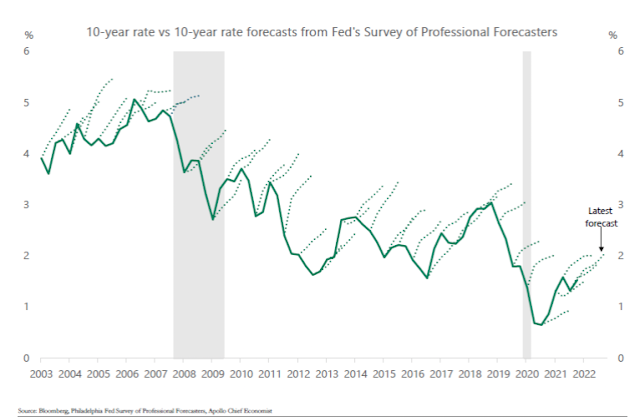
Torsten Slok, chief economist at Apollo Global Management, passes along the above gorgeous graph. Fed forecasts of interest rates behave similarly. So does the "market forecast" embedded in the yield curve, which usually slopes upward. 

Torsten's conclusion: 

The forecasting track record of the economics profession when it comes to 10-year interest rates is not particularly impressive, see chart [above]. Since the Philadelphia Fed started their Survey of Professional Forecasters twenty years ago, the economists and strategists participating have been systematically wrong, predicting that long rates would move higher. Their latest release has the same prediction.

Well. Like the famous broken clock that is right twice a day, note the forecasts are "right" in times of higher rates. So don't necessarily run out and buy bonds today. 

Can it possibly be true that professional forecasters are simply behaviorally dumb, refuse to learn, and the institutions that hire them refuse to hire more rational ones? 

My favorite alternative (which, I admit, I've advanced a few times on this blog): When a survey asks people "what do you 'expect'?" people do not answer with the true-measure conditional mean. By giving an answer pretty close to the actual yield curve, these forecasters are reporting a number close to the risk-neutral conditional mean, i.e. not \(\sum_s\pi(s)x(s)\) but \(\sum_s u'[c(s)]\pi(s)x(s)\). The risk-neutral mean is a better sufficient statistic for decisions. Pay attention not only to how likely events are but how painful it is to lose money in those events. Don't be wrong on the day the firm loses a lot of money. The weather service also tends to overstate wind forecasts. I interpret the forecast of 30 mph winds as "if you go out and capsize your boat in a 30 mph gust, don't blame us." "If you buy bonds and they tank, don't blame us" surely has to be part of a finance industry "forecast." 

If the risk-neutral mean equals the market price, do nothing. And do nothing has to be the advice to the average investor. Reporting the forecast implied by the yield curve directly has a certain logic to it. 

Economists rush too quickly, I think, from surveys where people are asked "what do you expect?" to bemoaning that the answers do not represent true-measure conditional means, and blaming that on stupidity. As if anyone who answers the question has the vaguest idea what the definitions of mean, median, mode, conditional and true vs. risk-neutral measure are. We might have a bit more humility: They're giving us a sensible answer, to a question posed in English, but since we asked the question in a  foreign language, it is an answer to a different question. 

(Teaching is good for you. Most of my students did not understand that "risk" can mean you earn more money than you "expected," at the beginning of the class. I hope they got it by the end! But they were not wrong. In English, "risk" means downside risk. In portfolio analysis, it means variance. Know what words mean.) 

But that also means, do not interpret the answers as true-measure conditional means! 

This graph is particularly challenging since it concerns the 10 year rate only. Similar graphs of short-term rates also show consistent bias toward forecasting higher rates that don't happen. But that is more excusable as a risk-neutral mean, since the yield curve slopes up in the first few years. A rising forecast of 10 year yields corresponds to slope from 10 years to longer maturities, which is typically smaller. Torsten, if you're listening, a comparison to the forecast implied by the forward curve at each date would be really interesting! 


***

Update: The same students who used the English meaning of "risk" to be "downside risk" also used the English meaning of "expected" to be "what happens if nothing goes wrong," somewhere in the 90th percentile. The two meanings do make some sense, properly understood, especially in a world with skewed distributions -- the lion gets you or does not, the plan crashes or does not, the bomb explodes or does not. Many important distributions are not normal, so mean and variance aren't appropriate! 

I don't mean to say that surveys are useless. They are very important data, that can be very useful for forecasting events. If the survey forecast points up, that tells you something. A forecasting regression that includes survey data can be very useful. Just don't interpret it directly as conditional mean and blather about irrationality if it isn't. 

The variation across people in survey forecasts is the really interesting and under-studied part of all this. The graph is the average forecast across forecasters. But individual forecasters say wildly different things. Even these, who are professional forecasters. Why do survey forecasts vary across people so much, though the people have the same information? Why do trading positions not vary over time or across people anything like the difference between survey forecasts and market prices says they should? I think we're missing the interesting part of surveys -- their heterogeneity, with little heterogeneity of actions. 


Thursday, January 27, 2022

The cost of crying wolf

Why do so many Americans believe crazy things? Maybe not "crazy," but beliefs that wildly get wrong factual costs and benefits, such as those of vaccines? 

It does not help that they have been lied to, over and over again. Why should they believe anything now? Our elites, and in particular our public health bureaucrats, though invoking the holy name of "science," have been trying to massage public psychology via deliberate obfuscation for a few years now. There is little science of managing public psychology, and if there is, epidemiologists don't have it. There is some good ancient wisdom, as codified in the story of the boy who cried wolf.  We do know that when lies are exposed, when elites are shown to be disparaging and trying to manipulate average people, trust erodes. 

This thought is boosted by Marty Makary's WSJ Oped "The High Cost of Disparaging Natural Immunity to Covid."

For most of last year, many of us called for the Centers for Disease Control and Prevention to release its data on reinfection rates, but the agency refused. Finally last week, the CDC released data from New York and California, which demonstrated natural immunity was 2.8 times as effective in preventing hospitalization and 3.3 to 4.7 times as effective in preventing Covid infection compared with vaccination.

Yet the CDC spun the report to fit its narrative, bannering the conclusion “vaccination remains the safest strategy.” 

Why? Well, both facts can be true. It can be true that immunity from previous exposure is very powerful, and even more powerful than vaccination, but that vaccination rather than let-it-rip, lockdowns, or masks, remains the safest public health strategy.  Why not say so? Because the CDC thinks we're morons and can't understand that, so it must suppress evidence of natural immunity to scare people into vaccination. Then the word gets out, and people trust the CDC even less. (The rest of the article is great on facts of natural immunity.) 

It's worse.

Monday, January 24, 2022

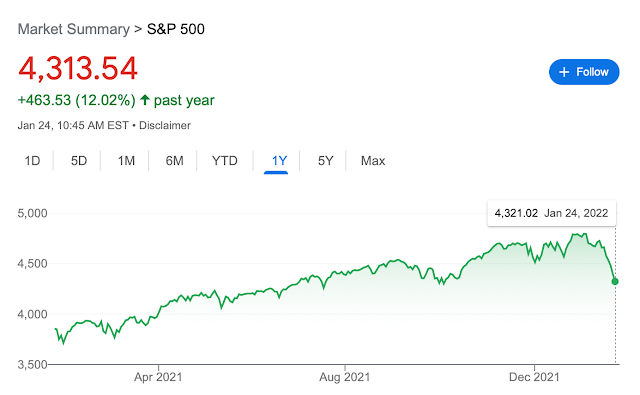
Stock market fall and long-term investors


Having just plugged "portfolios for long-term investors" again, I really should opine on its message about the recent stock market decline. If you didn't see this coming and get out ahead of time, or if it was perfectly obvious to you that this was coming but you didn't get off your butt and do anything about it, preferring to pontificate at the dinner table, just how bad should you feel about it? 

Not as bad as you might think. 

Sunday, January 23, 2022

Portfolios for long-term investors

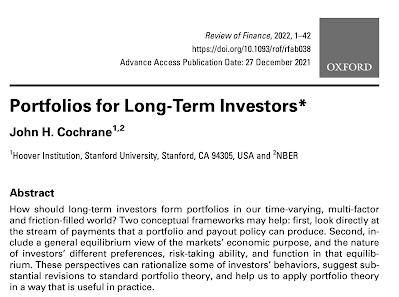
"Portfolios for long-term investors" is published, Review of Finance 26(1), 1-42. (2022). This standard link works if you have institutional or individual access. I am not allowed to post a free access link here, but I am allowed to post one on my webpage where you will find it. 


The theme: How do we account for the vast gulf between portfolio practice and portfolio theory? How do we make portfolio theory useful given that the world has time-varying expected returns and time-varying returns and correlations? I argue for a view more focuses on prices and payouts, as a long-term bond investor should buy an indexed perpetuity and ignore one-period returns. I advise one to think about the market and equilibrium. The average investor must hold the market portfolio. Anything else is a zero sum game. So figure out why you are different than average. (If you think you're smarter than average, note that they think they're smarter than you.) The result encapsulates some ancient advice: Buy stocks for the dividends, broadly interpreted. Take risk you are well-positioned to take. If stocks have great value to other investors for reasons either technical (liquidity, short-sales constraints, etc.) or behavioral, avoid them. 

The paper grows out of the summary I used to give for MBA and PhD students. There aren't any equations, but there are lots of suggestions about how academic portfolio theory might be done better, and connect better to its intended audience. Thanks especially to Monika Piazzesi and Luis Viceira, who invited me to give the talk on which it is based, and Alex Edmans who shepherded it to publication. 

******

Update: I just found that the NBER has posted the original lecture video


Friday, January 21, 2022

Institute for progress

We need to be reminded occasionally that nothing matters but long-run growth, and long-run growth all comes from productivity, better knowledge of how to better serve human needs and desires.  Yet economic policy is almost all not about growth, but rather about redistribution, and in particular propping up old ways of doing things and the rents associated with them. 

Courtesy Marginal Revolution, the Institute for Progress is a noteworthy new effort to produce growth-oriented policy. Institutions are important, to spread the word and create a constituency for tending the golden goose. 

..productivity growth has been in long-term decline since the 1970s. This is supposed to be the age of ambitious infrastructure investments in the battle to fight climate change, but we can’t even build new solar plants without being vetoed by conservation groups. Hyperloops and supersonic airplanes promise to revolutionize transportation, but building a simple subway extension in NYC costs up to 15 times more per kilometer than it does in other cities around the world. ...The pace of scientific progress has been slowing.... 

(Here and elsewhere see the original for links.) Why? 

Over the last 50 years, we’ve increased the number of veto points at nearly every governmental level, failed to invest in state capacity, and raised the stakes of the debate through polarization. So it perhaps shouldn’t be a surprise that the federal government that went to the moon in 1969 botched production of simple diagnostic tests during a once-in-a-century pandemic.

But the potential is there. Maybe we are not running out of ideas after all, but merely on the edge of technical revolutions, like changing from rail to airplanes:    

...there are genuinely exciting — potentially game-changing — discoveries on the horizon. 

Wednesday, January 19, 2022

Accounting for the blowout / Project Syndicate

A Project Syndicate Essay. Before it moves on to climate change, inequality, and racial issues, the Fed should have to think just a little bit about the evident failure of its existing financial regulation. 

Why Isn't the Fed Doing its Job?

The nomination of new members to the US Federal Reserve Board offers an opportunity for Americans – and Congress – to reflect on the world’s most important central bank and where it is going. 

The obvious question to ask first is how the Fed blew its main mandate, which is to ensure price stability. That the Fed was totally surprised by today’s inflation indicates a fundamental failure. Surely, some institutional soul searching is called for. 

Yet, while interest-rate policies get headlines, the Fed is now most consequential as a financial regulator. Another big question, then, is whether it will use its awesome power to advance climate or social policies. For example, it could deny credit to fossil-fuel companies, demand that banks lend only to companies with certified net-zero emissions plans, or steer credit to favored alternatives. It also could decide that it will start regulating explicitly in the name of equality or racial justice, by telling banks where and to whom to lend, whom to hire and fire, and so forth. 

But before considering where the Fed’s regulation will or should go, we first need to account for the Fed’s grand failure. In 2008, the US government made a consequential decision: Financial institutions could continue to get the money they use to make risky investments largely by selling run-prone short-term debt, but a new army of regulators would judge the riskiness of the institutions’ assets. The hope was that regulators would not miss any more subprime-mortgage-size elephants on banks’ balance sheets. Yet in the ensuing decade of detailed regulation and regular scenario-based “stress tests,” the Fed’s regulatory army did not once consider, “What if there is a pandemic?” 

Tuesday, January 18, 2022

Fed Nominees

I salute President Biden's nominations for the Federal Reserve Board, especially Sarah Bloom Raskin and Lisa Cook. (Philip Jefferson seems straightforward and uncontroversial, but other than reading a CV I haven't looked that hard.)

 We can now have an honest conversation about where the Fed is going, and whether and how the Fed should use its tools, primarily regulation, to advance the Administration's agenda on climate, race, and inequality. 

The Wall Street Journal nicely assembled crucial quotes on Ms. Raskin and climate. In 2020,   

The Fed established broad-based lending programs to prevent businesses that were otherwise sound from failing due to the shutdowns. 

Writing in the New York Times in May 2020, 

Ms. Raskin wanted the Fed to exclude fossil-fuel companies from these facilities. “The Fed is ignoring clear warning signs about the economic repercussions of the impending climate crisis by taking action that will lead to increases in greenhouse gas emissions at a time when even in the short term, fossil fuels are a terrible investment,” she wrote. ...

“The Fed’s unique independence affords it a powerful role,” Ms. Raskin added. “The decisions the Fed makes on our behalf should build toward a stronger economy with more jobs in innovative industries—not prop up and enrich dying ones.”  

Monday, January 3, 2022

Fiscal Inflation.

This is an essay, prepared for the CATO 39th annual monetary policy conference.  It will appear in a CATO book edited by Jim Dorn. This is a longer and more academic piece underlying "The ghost of Christmas inflation." Video of the conference presentation. This essay in pdf form. 

FISCAL INFLATION 

John H. Cochrane

From its inflection point in February 2021 to November 2021, the CPI rose 6 percent (278.88/263.161), an 8 percent annualized rate.  Why? 

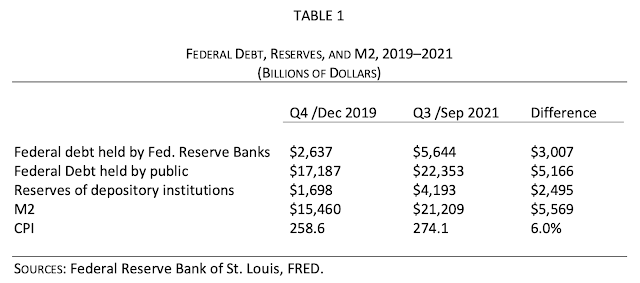
Starting in March 2020, in response to the disruptions of Covid-19, the U.S. government created about $3 trillion of new bank reserves, equivalent to cash, and sent checks to people and businesses. (Mechanically, the Treasury issued $3 trillion of new debt, which the Fed quickly bought in return for $3 trillion of new reserves. The Treasury sent out checks, transferring the reserves to people’s banks. See Table 1.)  The Treasury then borrowed another $2 trillion or so, and sent more checks. Overall federal debt rose nearly 30 percent. Is it at all a surprise that a year later inflation breaks out?  It is hard to ask for a clearer demonstration of fiscal inflation, an immense fiscal helicopter drop, exhibit A for the fiscal theory of the price level (Cochrane 2022a, 2022b).  

What Dropped from the Helicopter? 

From December 2019 to September 2021, the M2 money stock also increased by $5.6 trillion.  This looks like a monetary, not a fiscal intervention, Milton Friedman’s (1969) classic tale that if you want inflation, drop money from helicopters. But is it monetary or fiscal policy? Ask yourself: Suppose the expansion of M2 had been entirely financed by purchasing Treasury securities. Imagine Treasury debt had declined $5 trillion while M2 and reserves rose $5 trillion. Imagine that there had been no deficit at all, or even a surplus during this period. The monetary theory of inflation, MV=PY, states that we would see the same inflation. Really? Similarly, ask yourself: Suppose that the Federal Reserve had refused to go along. Suppose that the Treasury had sent people Treasury bills directly, accounts at Treasury.gov, along with directions how to sell them if people wished to do so. Better, suppose that the Treasury had created new mutual funds that hold Treasury securities, and sent people mutual fund shares. (I write mutual fund as money market funds are counted in M2.) The monetary theory of inflation says again that this would have had no effect. These would be a debt issue, causing no inflation, not a monetary expansion. Really? 

Sunday, January 2, 2022

Weekend reads on the state of America -- and China

Two pieces stood out from some weekend internet meandering. 

Marginal Revolution points to an excellent long letter from Dan Wang on China.

A trenchant part of Dan's essay is, curiously, a few reflections on America. Not bad for living in Shanghai: 

The US, for starters, should get better at reform. The federal government has found itself unable to build simple infrastructure or coordinate an effective pandemic response. Somehow the US has evolved to become a political system in which people can dream up a hundred reasons not to do things like “build housing in growing areas” or “admit people with skills into the country.” If the US wants to win a decades-long challenge against a peer competitor, it needs to be able to improve state capacity. ...

Since the US government is incapable of structural reform, companies now employ algorithm geniuses to help people navigate the healthcare system. This sort of seventh-best solution is typical of a vetocracy. I don’t see that the US government is trying hard to reform institutions; its response is usually to make things more complex (like its healthcare legislation) or throw money at the problem. The proposed bill to increase domestic competitiveness against China, for example, doesn’t substantially fix the science funding agencies that are more concerned with style guides than science; and the infrastructure bill doesn’t seem to address root causes that make American infrastructure the most costly in the world. Congress is sending more money through bad channels.

 Stop and savor.