Showing posts with label Cronyism. Show all posts

Friday, December 15, 2023

Time for a new (?) theory of regulation

What's the basic story of economic regulation? 

Econ 101 courses repeat the  benevolent dictator theory of regulation: There is a "market failure," natural monopoly, externality, or asymmetric information. Benevolent regulators craft optimal restrictions to restore market order. In political life "consumer protection" is often cited, though it doesn't fit that economic structure. 

Then "Chicago school" scholars such as George Stigler looked at how regulations actually operated.  They found "regulatory capture." Businesses get cozy with regulators, and bit by bit regulations end up largely keeping competition down and prices up to benefit existing businesses. 

We are, I think, seeing round three, and an opportunity for a fundamentally new basic view of how regulation operates today. 

The latest news item to prod this thought is FCC Commissioner Brendan Carr's scathing dissent on the FCC's decision to cancel $885 million contract to Starlink. Via twitter/X

Sunday, January 26, 2020

Ferguson and the billionaires at Davos

In my last post, I commented on Joe Stiglitz view, heading to Davos, that billionaires and corporate leaders are anxious to pollute the air.  In my wealth tax series I reported on the popular view on the Warren Sanders Saez Zucman view that corporate leaders and billionaires represent a regressive right wing political force, that must be stopped by any means including expropriation of their wealth, even if that means destroying the businesses that make them rich.

My colleague Niall Ferguson reports from Davos what seems actually to be on billionaires' minds: 
Take the World Economic Forum (WEF), the gathering of billionaires, millionaires, world leaders, do-gooders, busybodies and journalists that takes place each January in the Swiss resort of Davos. The overwhelming majority of people attending this year’s conference would, I have no doubt, affirm their commitment to reducing carbon dioxide emissions to avert catastrophic climate change, even while on board their Gulfstreams and in their Range Rovers.
I doubt if a single chief executive present at the WEF last week would dare publicly to challenge the view that a modern corporation should rigorously measure and regulate its behaviour in terms of its environmental and social impact, as well as its quality of governance (ESG, for short). As the US Business Roundtable declared last August, firms must now be run not only for the benefit of their shareholders but also for all their “stakeholders”: customers, employees, suppliers and communities. Milton Friedman is dead. Long live Klaus Schwab — founder of the WEF — who pioneered this notion of stakeholder capitalism.
“ESG-omania” (or “ESG-apism”) meant Davos 2020 was an orgy of virtue-signalling on climate change and diversity. To walk down Davos Promenade, the main drag, was to run a gauntlet of uplifting corporate slogans: “Sustainable solutions for Earth, for life”; “A cohesive and sustainable world starts with data”; “Let’s bring sea level and C-level together”.
Each year the WEF’s global risks report tells us what the business elite is most worried about. Ten years ago, the top five risks were “Asset price collapse”, “China economic slowdown”, “Chronic disease”, “Fiscal crises” and “Global governance gaps”. This year? “Extreme weather”, “Climate action failure”, “Natural disasters”, “Biodiversity loss” and “Human-made environmental disasters”.
(Related, the Wall Street Journal reported last week that Goldman Sachs will no longer fund fossil fuel development in the Arctic, or any US company that does not have women or "diverse" board members. And Jan 27, quotes "Salesforce chairman and co-CEO Mark Benhoff that "capitalism as we have known it is dead, and this obsession that we have with maximizing profits for shareholders alone has led to incredible inequality and a planetary emergency." ) 

In public, at least. In private, 
In quiet corners of the Davos congress centre you could hear Europeans wishing they could have at least a piece of this American action [Trumpian growth]— and complaining that Greta’s demand for “zero carbon now” was a recipe for zero growth.
... you say one thing in public and another in private. It was once the basis of life in communist systems all over the world. It turns out to be something capitalists can do just as easily, ...
Business people adopt whatever public views are convenient. And their public virtue-signaling means that winds now blow from the left. 
If Davos Man has come around to Trump — enough to expect, if not quite to hope, for his re-election — it is no guarantee that he will win on November 3. If January 2016 is anything to go by, you should probably bet against the Davos consensus and have a flutter on Bernie Sanders.
Niall organizes his thoughts around  "cognitive dissonance." Good old-fashioned "Hypocrisy" might be a more apt word. As in 
Do you give speeches about climate change at international conferences, having flown there by private jet? Do you ever sit in a big black car in a traffic jam, when you could quite easily have walked, despite knowing that this, too, is adding yet more carbon dioxide to the atmosphere?
Exhibit A: 
In this green new world, Davos Man must now prostrate himself before Stockholm Girl: 17-year-old Greta Thunberg, who delivered her latest tirade on Tuesday morning. “We don’t need a ‘low-carbon economy,’ ” she declared. “We don’t need to ‘lower emissions’. Our emissions have to stop. ...
I love Greta Thunberg, because she exposes the immense hypocrisy of the political climate establishment. When she went to school, she received the same alarmist pablum handed out to children around the world -- the climate is a crisis. Civilization is going to end. The world will be a red hot cinder in your lifetime. We have exactly 11 years to stop it. The other children, like those in communist countries including China today, understood the game. Mouth the pieties, get a good grade on the test, don't argue, and go out to play. Greta, who describes herself as neuro-diverse, took it seriously and literally. Well, if the planet is going to fry in exactly 11 years we darn well had better do something about it, and not just virtue-signal in our PR statements and buy some phony carbon offsets when we fly the Gulfstream back from Davos.

Niall's last point is excellent:
In the same way, if it’s climate change the WEF-ers are most worried about, you should probably brace yourself for a coronavirus pandemic. Talking of cognitive dissonance, what the hell were we all doing at a massive global conference last week? Fact: at least three of the WEF attendees were from — you guessed it — Wuhan.
What are the really big risks in the next 10 years? Pandemic, nuclear war, civil war, government collapse. The ones very few people are paying any attention to. The big ones are never the ones conventional wisdom sees coming a hundred years away.

Update:

On reflection, hypocrisy is not a good word either. What do you call the behavior, of mouthing platitudes that you know to be meaningless or false, from good old self interest? You know a Warren or Sanders presidency is a good possibility, and they will use the regulatory and judicial machinery ruthlessly. So let's get those public statements and virtue signals out fast -- support for "stakeholder" capitalism, climate crisis, "ESG" metrics or whatever it takes. You know that social climbing at Davos, your nonprofit boards,  (your hope to become dean someday, in academia) or just avoiding the twitter mob demand conformity. So you mouth the harder and harder to pronounce words, or even convince yourself of the worthiness of it all.  There must be a good word in  Russian, the art of getting along under a communist regime.  We say "virtue-signaling" but that does not cover the self-interest of going along with the crowd. I welcome suggestions for a good word.


Saturday, January 11, 2020

Wealth and taxes -- Overview

I thought that "wealth and taxes" would be a short blog post. It turned in to a 5 part series. Here's an overview, or table of contents in case the whole thing looks a bit indimidating. The most important one, really I think is Part V, "it's all political." The others build bit by bit, well, this can't be the answer and that can't be the answer, so what is the answer, and Part V finds it.

In Part I we met the fact that "wealth" is measured as "capitalized income," Y/r. But only some kinds of income Y and with discount rate choices r that blew up measured wealth inequality. I review the  Smith, Zidar and Zwick paper that finds huge overstatements of inequality because wealthy people have a higher r than you and me.

In Part II we learned that a big reason wealth inequality widened is that interest rates fell and asset prices rose.  If r falls, Y/r rises, but it's the same Y.

In Part III  we noted the distinction between consumption, income and wealth inequality. Wealth is beyond badly measured as a measure of lifestyle. The computations ignore taxes and transfers, wildly blowing up measured inequality and rendering it a "problem" that ipso facto cannot be solved. Why concern ourselves with pre-tax wealth inequality, especially given that most wealth is reinvested in businesses that produce things and employ people?

In Part IV, we met the wealth tax. If the question is, how do we raise revenue for the government, either to spend or to transfer it, the wealth tax is a terrible idea, as it distorts the economy and leads to an evasion industry. A consumption tax is a much better idea.

In  Part V I read Saez and Zucman's opeds, which finally tell us what the question is to which the wealth tax is the answer. Saez and Zucman want to confiscate billionaires' wealth, because they think billionaires have too much political power, billionaires all got their money unjustly, and somehow though big government cronyism is the problem, bigger government is the answer.  The wealth tax is not designed to raise revenue -- it succeeds if it raises no revenue (after perhaps a one-time wealth grab) because the wealth it taxes has vanished. Well, at least it is a consistent view, decide if you buy the premises.

Update  

CATO put out a much-improved version of this series. Html here and pdf here

Thursday, January 9, 2020

Wealth and Taxes, Part IV

(This is Part IV of a series. Part III, and Part V. which has the punchline.  See the overview for a summary.)

The Wealth Tax.

So, if arguing about the ill-defined and ill-measured distribution of wealth lies in service of the wealth tax, what is the question to which the wealth tax is an answer?

Revenue and Redistribution -- good and bad taxes

Preamble: Economists have no real professional expertise to object to redistribution, or argue for it. Swallow hard, you may not like it for political, moral or other reasons -- or you may be all for it for those reasons -- but admit economists economists have no special insights to the right amount of redistribution. Economics has one analysis to offer the world: incentives. (OK, and equilibrium.) If it were possible to take money from A and give it to B without creating any adverse incentives, we have no special standing to cheer or to object. Economics can tell us something about tax rates, but not much about taxes. 

Thus the theory of optimal taxation is straightforward: how can the government raise a given tax revenue while generating the least perverse disincentives? The theory of optimal redistribution offers an additional wrinkle: how can the government give money away while generating the least perverse disincentives to recipients as well as payers?

Tuesday, November 19, 2019

Free market health care

and transparent pricing are  possible. 

Russ Roberts has a great econtalk podcast, interviewing  Keith Smith of the Surgery Center of Oklahoma Click on that link, roll over the areas of your body that hurt, and find out exactly how much it will cost to fix them.

No insurance. Pay a preset transparent surprisingly low price. Get surgery. A great piece of news is that this is actually possible -- you won't go to jail (yet) for just running a hospital like any other business.

Russ and Keith had one particularly good interchange on why regular hospital pricing is so screwed up. I have made the point several times that our government wants to cross-subsidize indigent care, medicare and medicaid, and the insanity of hospital and insurance billing is mostly a reaction to that. I went on to speculate that the government is also restricting competition to uphold these cross subsidies. The existence of the surgery center of Oklahoma says to some extent I am wrong about hospitals, though it raises the question why the model is so scarce.

Russ: A friend of mine recently had back surgery at an academic institution, a nonprofit regular hospital, a very good one with a good reputation. The surgery... was $101,673.77. Seriously. Now, my listeners know that macroeconomists have a sense of humor. We know they do because they use decimal points. But it turns out hospital finance offices do too. ...That is not--repeat--not--what the hospital collected from the insurance company. But that list price, that weird, enormous list price of $100,000--a little over 100,000--was on the form. 
The surgery facility... got $13,000 from the insurer. You charge for that same surgery, I looked it up, a little under [$10,000]. So, they're 30% more than you for what they collect and they're 10 times what you charge on the list price. 
My first question is why did they write down that goofy number of $100,000 on the bill, even though the insurance company only pays [$13,000]? ... 
Keith Smith: Well, I'll back up in time. I was at a meeting where there was some hospital people and they were very angry with me because we put our prices online.... and this angry hospital administrator lost his cool....he asked me what percentage of my revenue at the Surgery Center of Oklahoma was uncompensated care.... that question haunted me, because that is a very bright, very articulate person. And he does not misspeak. I thought very carefully about what he actually said. What percentage of my revenue is uncompensated care?  
[JC, in case you're skimming read the literal words. Normally, uncompensated care might be a big fraction of your costs, but sort of by definition zero percent of your revenue]
...So, I did some checking and indeed hospitals are paid to the extent that they claim that they were not paid. And this is a kickback... Hospitals are paid to the extent that they claim that they were not paid. 
Russ Roberts: So, explain. 
Keith Smith: So, a $100,000 bill, the hospital collects $13,000. They claim that they lost $87,000. 
This $87,000 loss maintains the fiction of their not-for-profit status, but it also provides the basis for a kickback the federal government sends to this hospital in the form of what's called Disproportionate Share Hospital payments. 
So, when you hear uncompensated care, that is the $87,000 that your friend saw written off on the difference between hospital insurance and what insurance paid.
So, the fact is, the hospital made money on that case. But they claimed that they lost $87,000. 
And then that fictional loss provides the basis for a kickback from the federal government, called--it's uncompensated care or DSH, Disproportionate Share Hospital payments. So, as I thought about this, I began to realize that there's a lot of people in on this scam. Including the insurance companies. I mean, why would an insurance company agree to play along with this hospital? Well, the insurance company actually wants an inflated charge because then, for employers they work with, they can show that the savings that dealing with that particular insurance company generates is very, very large.... 
Now, what the insurers actually do is ask the hospital administrators, 'Can you do a brother a favor and actually charge $200,000 for that, so that our percentage savings actually looks larger?'
It goes on like this. A definite must-listen.

In related news, "the Trump Administration Releases Transparency Rule in Hospital Pricing" reported by Stephanie Armour in the Wall Street Journal. The subhead is "legal challenges are likely!"
The final rule will compel hospitals in 2021 to publicize the rates they negotiate with individual insurers for all services, including drugs, supplies, facility fees and care by doctors who work for the facility. 
The administration proposed extending the disclosure requirement to the $670 billion health-insurance industry. Insurance companies and group health plans that cover employees would have to disclose negotiated rates, as well as previously paid rates for out-of-network treatment, in file formats that are computer-searchable, officials said.
...
The requirements are more far-reaching than many industry leaders had expected and could upend commercial health-care markets, which are rife with complex systems of hidden charges and secret discounts. The price-disclosure initiative has become a cornerstone of the president’s 2020 re-election health strategy, despite threats of legal action from the industry. 
Hospitals and insurers typically treat specific prices for medical services as closely held secrets, with contracts between the insurers and hospital systems generally bound by confidentiality agreements. 
All well and good, and a testament to lots of the good  regulatory reform work going on under the radar screen in Washington. In some sense the headline chaos is quite useful. And my personal kudos to the market oriented health economists working on this effort.

But... You have to ask, just why do we need another layer of price-transparency regulations? Why are hospitals choosing such devious schemes, while grocery stores don't? Or, a better analogy, tax lawyers, contractors, car repair, pet repair, lasik surgeons, or anyone else performing complex personal services does not do this sort of thing? Are hospital administrators uniquely devious? Of course not. They are good hard-working men and women trying to do the best they can in a screwed-up regulatory and legal system.

So as long as hospitals and insurers want to play these games, as long as the strong incentives are there to play these games, so long as many arms of the government want to play these games to support medicare, medicaid and indigent care that governments don't want to pay for, I'm less than sanguine about their inability to get around a set of transparency rules. It seems about like bank risk regulation, a game of cat and mouse. It would seem more effective to reduce the government-provided incentive to screw things up in the first place. I guess that if transparency is politically hard and headed to legal challenges, reforming a system that so many people have so much vested interest in -- intellectual as well as financial -- might be even harder.

But, as long as the Surgery Center of Oklahoma is not driven out of business -- which its many competitors would surely like -- maybe there is hope. Free market, cash and carry, competitively priced health care might just upend the ossified current system.

Imagine if there were two Surgery Centers of Oklahoma, competing on price and quality...

Tuesday, May 7, 2019

Ip on carbon tax

Over the weekend, Greg Ip at WSJ wrote a  nice piece on the carbon tax.

Greg addresses some common objections.
This urge to stop at nothing to find an effective solution is understandable. How can you put a price tag on the future of the planet?
..Green New Deal backers make another powerful argument: Global emissions levels are still rising, and to reverse them, carbon prices would have to be so high they’d be politically toxic. Better, the activists argue, to simply go straight to a massive, government-directed transition. 
This attitude is common. But there is no evading economics. Either you have visible economic damage (carbon tax) of $1,000 per ton or invisible economic damage of $10,000 per ton.  Prices are better than restrictions because you can see where you're wasting $10,000 per ton, which money could reduce 9 times as much carbon properly deployed.

There is also a political judgment here that people will not stand for a visible tax, but will stand politically, or perhaps be too stupid to notice, the much larger shadow price of direct controls. They won't pay $5 at the pump for gas, but will stand for banning cars. I don't think that's true. I don't think the left thinks it's true either. The way the Green New Deal and even the IPCC reports now bundle carbon reduction with a vast left-wing political agenda, and a rather Orwellian drive to silence criticism confirms it.

Monday, March 18, 2019

Monopoly in history

Timothy Taylor, the Conversable Economist, tracks down the oft-told story of William Lee and his knitting machine.
...the 2019 World Development Report from the World Bank has a mention near the start of Chapter 1: "In 1589, Queen Elizabeth I of England was alarmed when clergyman William Lee applied for a royal patent for a knitting machine: `Consider thou what the invention would do to my poor subjects,' she pointed out. `It would assuredly bring them to ruin by depriving them of employment.'” 
It's really a lovely story, presaging this fallacy passed down through the ages, to Milton Friedman's famous "let them use spoons" story (on being told a Chinese dam was being made by hand and shovel rather than bulldozers to provide employment) to the current hullabaloo that AI will take all the jobs. (And today. On a KQED (NPR) "forum," show last week, on while I was shaving, a caller expressed just how great it is that Mexico uses people not machines to sweep streets, thereby providing employment, and we should do the same. Fallacies live a long time.)

Lovely as it is, Taylor is "inherently dubious about direct quotations from conversations held in 1589," took a  "journey through libraries and archives," to track down the actual story.  It is an interesting note on the very beginnings of the industrial revolution.

As I read Taylor, it seems the story is actually pretty suspect.
"The underlying source seems to be in an 1831 book, History of the Framework Knitters, written by Gravenor Henson....Henson was an important British trade union leader in the early 19th century. As Stanley D. Chapman notes in his "Introduction" about Henson's purpose in writing the book: "His main theme was that hosiery, lace and all other industries should be regulated by the government so as to maintain a decent living standard for the workers and fair conditions of trade. British industries must be protected from direct foreign competition and, more particularly, from industrial espionage, migration of skilled workmen to other countries, and export of machinery."  
So, as I gather indirectly, the story passed on from a source was definitely trying to make a point, and (again reading only Tim) has precious little primary evidence for the famous conversation.

The first lesson: beware these apocryphal stories passed on through secondary, tertiary and ultimately gossipy sources.  

This lesson was brought home to me by Peter Garber's great "Famous First Bubbles" book (I had a lot of fun reviewing it). Garber went back to look at actual primary sources behind stories that though apocryphal are passed around as true among economists, such as the famous tulip "bubble." They aren't true either. Though they make good stories.

I got a deeper lesson, on just how economies worked in early modern Europe. Early economies were so pervasively regulated, that the only thing to do with an innovation was to run to get a Royal monopoly. 

William Lee invented a stocking-making machine. (Apparently, to put out of employment a woman who spurned his advances while knitting stockings.) So, what does he do with his newfound knowledge?
Having now discovered the method of knitting by machinery, his next effort was directed to obtain the golden harvest which had flattered his imagination. He removed his invention to London for the purpose presenting it to the Queen,...Lee now imagined himself certain of a handsome remuneration,...[but]  she refused to make either a grant of money or secure him a monopoly or patent. 
Here is where the famous quote enters
Her answer is said to have been to the following purport: -- My Lord, I have too much love to my poor people, who obtain their bread by the employment of knitting, to give my money to forward an invention which will tend to their ruin, by depriving them of employment, and thus make them beggars. 
It goes on, interestingly. The Queen was interested in cheaper silk stockings, which she wore:
Had Mr. Lee made a machine that would have made silk stockings, I should, I think, have been somewhat justified in granting him a patent for that monopoly, which would have affected only a small number of my subjects. but to enjoy the exclusive privilege of making stockings for the whole of my subjects is too important to grant to any individual."
But it gets much more s economically interesting
Apparently Lee ran into a different problem: Queen Elizabeth has been granting lots of monopolies to court favorites, and there was a widespread sense that it had gotten out of hand. Thus, the granting of unwarranted monopolies became a reason to deny Lee a monopoly as well. Henson writes:
"The time which Mr. Lee had chosen to make an application to the government, though to his sanguine mind very propitious for remuneration. was in reality the reverse; the treasury of Elizabeth was extremely low, owing to the enormous expenses which she had incurred in preparations to meet the Spanish armada in the preceding year. Already had the Parliament begun to express their decided umbrage at the grant of the privileges of patents for monopolies; which, as they were then conducted, were justly considered national evils, and the most odious means of rewarding court favorites, by an excessively tyrannical mode of private taxation. Nearly all the nobles enjoyed a patent for the most useful and general articles of consumption, such as iron, lead, saltpetre, salt, oil, glasses, &c. &c., to the amount of more than one hundred articles, which were sold, imported, or exported by virtue of letters patent. These patent rights, were sold to persons who farmed the profits, and thus demanded what prices they thought prudent for their commodities. [my emphasis] When the general list was read over in the House of Commons in 1601, a member, indignant at the the extortions, exclaimed, " Is bread amongst the number?" "Bread?" cried the house, with astonishment, "Yes I assure you," he sarcastically replied, "if we go on at this rate, we shall have a monopoly of bread before next Parliament." 
Actually, I believe they did. Most trades were restricted to guild members and you couldn't just bake bread and sell it. (Historians, let me know if I'm confusing place and time here.)  "Patent" in 16th century England also seems to mean more a general monopoly right than our current understanding, as in a "patent" to sell iron. Lee went on to the French court, to try to get a patent and monopoly there too.

Lee never, apparently, made a bundle actually making stockings. He died unhappily in France, though his machine did get adopted. Just how long it took a simple stocking machine to be adopted may tell us something interesting about why economic growth was so slow to break out.

The interesting observation here: it's 1589, and you invent a cool new machine, say for making stockings. What do you do with it? You and I might answer, "start making stockings." You can undersell the competition and make a bundle. Or, we might answer, "start selling stocking-making machines." Sure, others will follow, but you have a big first-mover advantage. Yes, if a modern patent system were up and running it might be useful to get a patent and try to slow down competitors. But first and foremost, get the business going.

That Lee did not do this -- that it seems not even to have occurred to him - is telling about just how controlled and regulated economies apparently were at the time.

It brings to mind two other recent histories I read, Dava Sobel's Longitude and Charles Coulston Gillispies' book on the  Montgolfier Brothers.

Longitude: In the 1700s, it was a major problem to know how far east or west a ship was. After painstaking work, John Harrison came up with a solution: a clock that could tell time accurately, even at sea. What did he do with it? Start selling clocks to ship captains, you might say! And you would be wrong. He spent his life trying to get the prize established for that purpose, mostly unsuccessfully.

Balloons: The Montgolfier Brothers invent the balloon. What do they do with it? Start selling balloons? Start selling balloon rides? No, immediately off to Paris to get royal dispensation.

I don't know enough about these early economies, but that running off to get a Royal monopoly seems to be the only thing anyone even considers to do with a new invention seems interesting evidence on just how rigidly controlled economic affairs were.

Guilds, patents, monopolies, and the primary function of economic regulation being to create rents in return for political support, seems a pattern with deep roots.

Tuesday, December 4, 2018

Flowers not tariffs

I wrote a little commentary on trade for The Hill, which they titled "The US should give China Flowers not Tariffs." Chocolates too.

Source: The Hill
(The facial expressions in the picture are priceless) 

The US should Give China Flowers not Tariffs

Trump and Xi met, and declared a 90 day cease fire. Where will this end? It’s hard to forecast. Our commander in chief is less predictable than the stock market. But we can opine on what should happen. And we can look for interest — what is in everybody’s interest to have happen? 

That answer is clear: Come to a quick deal, declare victory, and get back to work fixing real economic problems. China makes some commitments about intellectual property (reasonably good for both sides, though not as important as all the fuss makes it seem); China makes some promises to buy American goods (crony capitalist mercantilism, but it makes politicians feel good); the US announces the 25% tariffs are off the table. Both politicians announce a great triumph. In sum, roughly what happened with NAFTA. Better still, we could do some reciprocal opening: repeal the 25% tariff on pickup trucks, and our own restrictions on foreign investments.

Large additional tariffs would be terrible for the US economy. Tariffs are taxes. Traditionally anti-tax Republicans, fresh off a hard-won victory to lower corporate taxes, should get that. And these taxes are starting to bite. For just one example, GM’s decision to close car plants was not completely unaffected by the price of steel and aluminum needed to make cars. And the constant threat of tariffs is in some ways worse than tariffs themselves. Companies managing global supply chains need to know where and how to invest. Big uncertainty postpones those investments. The point of the corporate tax cut was to encourage companies to invest. The threat of tariffs undoes that incentive.

Big tariffs, with exemptions granted on a discretionary basis, are corrosive to our political system. The rest of the admirable deregulatory effort is trying to get government agencies out of this racket.  

If it ever was true that China stole our jobs, that’s not today’s problem. With a 3.9% unemployment rate, employers can’t find enough qualified workers. Our economy needs efficiency and productivity to grow, not protection for some and high prices for others.

The US economy is doing well, but it’s an iffy time. When does the long expansion end and the next recession come? Storm clouds are gathering. The stock market is dribbling down. Auto sales, home prices and sales are softening. America remains waist-deep in debt. With split government, there will be no significant economic legislation legislation for the next two years, and the House will do everything they can to stymie the deregulation effort. A big disruption of trade and immigration is a self-inflicted wound at a bad time.

It’s an even iffier time for China. Be careful what you wish for. A major downturn in China, which could well lead to financial crisis, could be just the spark for a global recession. 

What’s the long run goal? The right approach to trade is simple: zero tariffs or restrictions. Americans are free to buy from the cheapest and best supplier. Whether foreigners put in tariffs or not is irrelevant to that conclusion.

Trade is no different than new companies that can produce things cheaper or better. And just as hurtful to old companies and their workers, but we generally see that it’s unwise to stop innovation. Trade between countries is no different than trade between states, and we all recognize that tariffs between states are a terrible idea. 

Any money that goes to China to buy goods must — must, this is arithmetic, not economics — come back. It just comes back to a less politically favored industry. To the extent that trade is “imbalanced,” that means China works hard, puts goods on boats, and takes our government bonds in return. Would we really be better off if we worked hard, put the fruits of our labor on boats, in exchange for Chinese government bonds?  Paper and promises are cheap. 

If China wants to tax her citizens to subsidize goods for US consumers, the right answer is flowers, chocolates and a nice thank-you card, as you would for any gift. Even intellectual property protection is an iffy cause. Theft is bad. But if selling the technology isn’t worth the market access, US companies don’t have to do it. Moreover, much intellectual property protection is the right to just the kind of continuing profits that we bemoan at home, in the new worry about increasing monopoly. Just how enthusiastic are we about defending pharmaceutical companies’ right to charge whatever they want in the US for their intellectual property? 

If one wants to help the US economy, effort is far best spent at home — fix health care, financial regulation, the obscene tax code, zoning, occupational licensing, labor laws and on and on. The rewards are infinitely larger than any imaginable benefit from trade threats. 

US GDP per capita is $60,000. China’s is $9,000. The average American is more than six times better off than the average Chinese.  The air in Beijing is unbreathable. For the US to complain about China hurting us is like the captain of the football team complaining that a six grader cheated him out of lunch money. 

Even in the best case, tariffs and trade restrictions are zero sum — they make the US better off by making China worse off. There is no case that they increase the size of the pie. In fact they make us all worse off. Is this America’s place in the world? Would we send in the marines to take wealth from Chinese people to benefit Americans? That’s the case for tariffs.

The idea that we can use tariffs to threaten China into freer trade is dangerous. It’s hard to credibly threaten to do something that hurts us, without denying that it does hurt us, and then getting trapped doing it. It took decades to get rid of the trade restrictions of the 1930s. 

We should get a grip, set a standard for good self-interested free-trade behavior, and work with our allies to get China to obey the same rules. Such a China is far more likely to cooperate on security issues than one already at war with us over trade.

Update: 

I left out lots of obvious pot shots. An obvious one: Sanctions on North Korea, Iran, Cuba, Russia,  and so forth are designed to.. reduce imports. So we are doing to ourselves exactly what we are doing to them.

Monday, November 19, 2018

Regulatory cost disease

A post on Marginal Revolution is so good, I have to quote in its entirety before commenting.
From my time in both the military and healthcare I can say that the biggest problem are the compliance costs.

For example, I have a phone app that allows me to send texts. We pay very good money to have said app. It does nothing that my phone cannot innately do – except be HIPAA compliant. EMR software is clunky, an active time suck, and adds little or no value … but we are required by law to use it. In each case there are scads of less specific programs out there which are insanely cheaper and more functional, but those programs cannot justify the costs of becoming compliant for a small niche of their business.

In the military we had similar difficulties. If you want systems to be secure, you need to pay extra as the marketplace does not do real security for consumer goods. Likewise, if you worry about logistical tails, building in assured access drastically increases costs.

And I fully suspect that prices will continue to diverge. As ever more of the internet ends up in a giant interconnected mess there will be fewer people able to code in a secure fashion. There will be fewer parts of the ecosystem that can be used by security conscious actors.

Then we get to actual procurement itself. People worry that arcane institutions will somehow make off with lots of money and spend it either poorly or nefariously. Absent easily observed price and cost data in both sectors we began developing rules. These rules drive firms out of the market (e.g. we needed some light interior remodeling to comply with a regulation that specified inches between things, the contractor who has been most affordable and highest quality refused to bid because the hassle on his side was too great). Eventually the rules become too complicated and you start needing specialists to interpret them. Costs skyrocket and firms abuse rules to pad profits. Then the lawyers get involved and things get more expensive. Again, medical and military consumers become a captive market facing greater monopoly as fewer firms can navigate the thicket of rules to even try to make money.

Then we have the problem that people look at these sectors and say that it is public money. All public money should help with goal X (e.g. going “green”, affirmative action, boycotting South Africa/Israel, patriotism, “America first”) and then we become even more overly constrained. Find vendors who meet one hurdle is hard, finding ones that meet 30 is nigh unto impossible unless the vendor is engineering the firm to market solely to this niche – and charging monopoly rates as his reward.

Any single thing would not be too bad for prices, but the marketplace in general is diverging from military and healthcare. Even education is diverging with mandates in FERPA and political business constraints. We have pretty effectively restricted supply, why exactly would we not expect an increase in cost?
This story seems much broader than just healthcare and military procurement. The story also clarifies a bit why it's going to be hard to fix. The thicket of regulations often have a purpose -- security, to protect patent privacy, or more importantly, for military applications. But we do not often ask properly what the cost of extra regulations is. Even well done cost benefit analyses tend to take the supplier network as given, and ask what it will cost them to add just one more step. That the network will shrink and the number of potential entrants shrink more -- the best protection against monopoly power -- is really not part of any cost benefit analysis. The note also points slightly to the public choice problem. The few companies who become specialists at meeting regulations become advocates for the regulations, which puts them in fine position with the army of bureaucrats who promulgate and enforce regulations.  Yes, military text messages probably need high security. Does every doctor's text message to a patient need the same?

It doesn't take long to see in this post a reading of many contemporary economic ills. The perception of increasing monopoly power fits well. The decrease of small business formation and increasing size of businesses fits. And we can think of a number of industries that have the same problem. Banking is obvious.

General aviation is a tiny, but clear example.  Go to your local airport, and contrast the ramp (where planes park) to the parking lot. The ramp is typically an excellent example of a Cuban used car lot. Lovingly maintained aircraft either from the 1950s or designed in the 1950s predominate.  Beautiful, yes, to nostalgic eyes, but not exactly practical. Small aircraft engines are much less reliable than automobile engines. Why? Well, they all must be FAA certified, and it's not worth the cost to certify, say, a new model of spark plug. The parking lot is full of Teslas. Well, in Palo Alto. BMWs elsewhere. But stuffed with the latest technology. Planes are not inherently more durable than cars. They're just regulated differently.

The HIPAA regulations, making electronic medical records every doctor's nightmare, and adding billions to costs, are actually an improvement. We can all remember the not too distant past, and sometimes still present, that doctors needed us to fax things around, because of the same regulations.

The central point of the story is the interplay of new technology and regulation. Our technology has huge fixed costs.  Commercial off the shelf technology, usually "pretty darn good" is amazingly cheap and effective. Specialized technology written to constantly evolving regulation is nightmarishly expensive, and usually not very good. And leads to cronyism and monopoly. The cost of regulation is higher than you think. Make sure the benefits are appropriate.


Monday, August 13, 2018

Trade uncertainty and investment

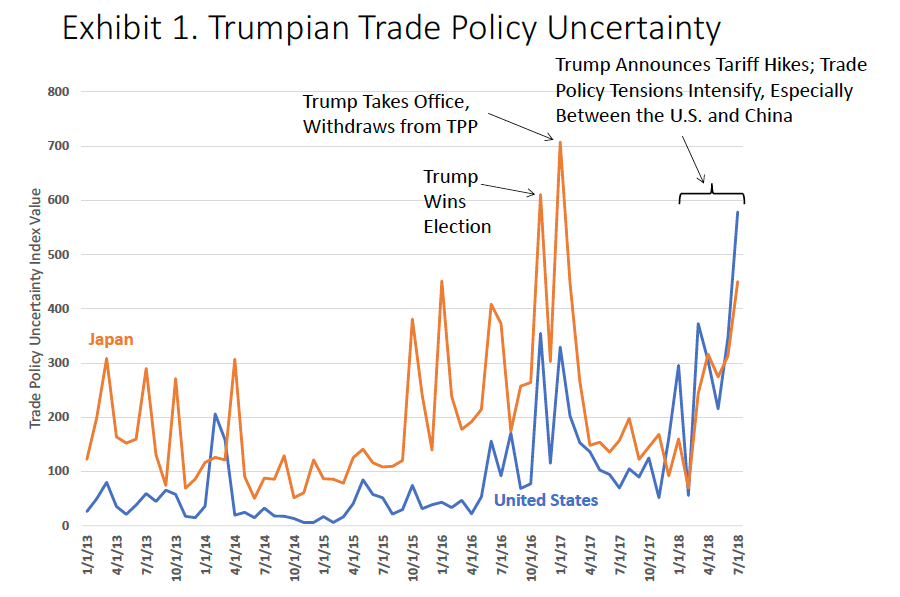
My colleague Steve Davis has a nice post quantifying economic uncertainty due to the trade war, and its emerging impact on investment.

Steve (and Nick Bloom) have done a great job quantifying policy uncertainty over time. To be clear, policies can have two effects -- there is the certainty of damaging policy, but there is also the damaging uncertainty of what policy will be. If a trade war seems to be looming, and you don't know if you will get tariff protection (raw steel) or be hurt by the tariff (steel users, competing with tariff-free steel products from abroad), that's uncertainty. Businesses hold off investing when they know things will be bad. But they also hold off when they're not sure what will happen. That's uncertainty.

Our little (so far) trade war is full of uncertainty
Trade policy under the Trump administration also has a capricious, back-and-forth character... Less than three months after withdrawing from the TPP, the President said he would consider rejoining for a substantially better deal, only to throw cold water on the idea a few days later. Initially, the administration justified steel tariffs on the laughable grounds that Canada, for example, presents a national security threat. Later, President Trump tweeted that tariffs on Canadian steel were a response to its tariffs on dairy products. Some countries get tariff exemptions, some don’t. Exemptions vary in duration, and they come and go in a head-spinning manner. Two days ago (August 10), the President tweeted that he “just authorized a doubling of Tariffs on Steel and Aluminum with respect to Turkey” for reasons unclear. For a fuller account of tariff to-ing and fro-ing under the Trump administration, see the Peterson Institute’s “Trump Trade War Timeline.”
The arbitrariness, including the waivers, means
Crony capitalism, political favoritism, and extra sand in the gears of commerce – here we come!
But to the point, what's the Davis-Bloom quantitative measure of uncertainty doing? Answer: it is higher than even around the election -- whose outcome, and the nature of the Trump presidency certainly led to a vast amount of uncertainty.


As of July, this uncertainty is only having a small effect on investment, and the economy is still booming -- in my view from the corporate tax rate cuts and deregulation efforts. It is true that the US is so big that most of the economy does not live on exports or directly compete with imports.
Let’s sum up the U.S. survey evidence: About one-fifth of firms in the July 2018 SBU say they are reassessing capital expenditure plans in light of tariff worries. Among this one-fifth, firms have reassessed an average 60 percent of capital expenditures previously planned for 2018–19. ..Only 6 percent of the firms in our full sample report cutting or deferring previously planned capital expenditures in reaction to tariff worries. These findings suggest that tariff worries have had only a small negative effect on U.S. business investment to date.
But it could get worse. Steve closes with a nice list of recent trade outbursts from our part of the economics blog world:
In closing, I should note that the harmful consequences of tariff hikes and trade policy uncertainty extend well beyond short-term investment effects. For other critiques of the Trumpian approach to trade policy, see the worthy commentaries by Robert BarroAlan BlinderJohn CochraneDoug IrwinMary Lovely and Yang LiangGreg Mankiw and Adam Posen, among others.

Friday, July 27, 2018

Trade war off?

Events move quickly in the Trump era. Since my last post, President Trump met with European Commission President Jean-Claude Juncker and announced a cease-fire with Europe.  A correspondent sends this link to Marc Thiessen at Fox news on the subject
it appears Trump is being proved right. On Wednesday, he and European Commission President Jean-Claude Juncker announced a cease-fire in their trade war and promised to seek the complete elimination of most trade barriers between the United States and the European Union. "We agreed today ... to work together toward zero tariffs, zero non-tariff barriers, and zero subsidies on non-auto industrial goods," declared the two leaders in a joint statement.   
.... contrary to what his critics allege, Trump is not a protectionist; rather, he is using tariffs as a tool to advance a radical free-trade agenda.
... during the G-7 summit he made a sweeping proposal. "I said, 'I have an idea, everybody. I'll guarantee you we'll do it immediately. Nobody pay any more tax, everybody take down your barriers. No barriers, no tax. Everybody, are you all set?' ...
Now Trump's hard-line trade strategy is being vindicated. Not only is the E.U. negotiating zero tariffs, but also it agreed to immediately buy more American soybeans -- which helps Trump in his trade battle with China.
If Trump succeeds in using trade wars to bring down European and Chinese trade barriers, he may end up being one of the greatest free-trade presidents in history.
The question always remains with our President's dramatic moves. Crazy like a fox or just plain crazy?  To his credit, it helps if your opponents think the latter.

Could this trade war really be in the service of a completely free trade agenda -- either very well hidden, or newly discovered? There is nothing I would like to see more than a pure free trade world, and it is heartening to see this president or any president come close to endorsing such.

"Non-auto industrial goods" is already a big qualifier. US' 25% import tax on pickup trucks remains, and Europe's auto protection as well. Europe's big barriers against agricultural goods remain, along with the US' too. (Sugar quotas on and off since the 1790s, lots of Mexican produce barred even under Nafata.) Services, more important in the modern world than industrial goods,  are off the table. So pure free trade this is not.

"it [europe] agreed to immediately buy more American soybeans -- which helps Trump in his trade battle with China." Free trade this is not. In a free trade world, European governments do not stop private European people and companies from buying US soybeans. In a free trade world, government ministers do not agree to buy more American soybeans! That's government run trade 101. Especially to gang up on a third party.

Valentina Pop and Vivian Salama at the Wall Street Journal add some reporting
Mr. Juncker stuck closely to the negotiating mandate handed to him by leaders of big EU countries including Germany, France and the Netherlands. Germany, which is heavily dependent on exports, was from the onset open to a trade arrangement, including abolishing EU tariffs on U.S. car imports. France, meanwhile, was vehemently opposed to opening EU agricultural markets.
Mr. Juncker told Mr. Trump and Mr. Lighthizer that any talk of including agriculture would kill prospects of a deal. He countered with a threat to drag public procurement into negotiations, which would question the Buy American Act, a nonstarter for the U.S. side.
Well so much for unfettered free trade. Plus, as widely reported, this was a cease fire. There is no schedule for talks or any other implementation of the free trade niravna.

"We can do stupid too" said Mr. Junckers, and he is right. This is stupid. We can shoot holes in the bottom of the boat to try to get you to stop shooting holes in the bottom of the boat. But if this is going to work, it had better work darn fast before the boat sinks.

Does President Trump really believe in a free trade world? Is this where it is all heading? In my last post I questioned the lack of a public goal to all this. Only two days ago -- yes, an eternity in Trump time, but fairly recent for the rest of us, the President tweeted


$817 seems to represent the overall trade "deficit" (I hate that word!) and Mr. Trump has consistently labeled trade deficits a "loss" for the US. (No, just as your trade deficit with the grocery store is not a loss -- you get the food!) If his hope is that the point and success of completely free trade is to eliminate trade "deficits," Mr. Trump will be sorely disappointed, as will any of his supporters who view this as a goal.

Completely free trade will open up many slowly dying industries to quick death from international competition. It will open up many new industries to tremendous growth. But is Mr. Trump really prepared to accept the former? In his tour through steel country, he did not say, "In six months I hope to see you all unemployed and this mill shut down again. But the opportunities for the country in software development, banking services, and intellectual property are so huge, I want you to support it."

The big question is, when does this stop? If it stops when we have global free trade, great. If we are going to keep plowing forward with tariffs, managed trade, countervailing subsidies, and so on until the trade "deficit" is eliminated, not so good.

OK, skepticism aside, yes he has twice said that the goal is totally free trade. I suggest the rest of the world call the bluff, if it is one, or give him what he wants, if not, immediately!

Tariffs, quotas, managed trade, arbitrary waivers, will damage the economy and our political system quickly. If this is going to work, it had better work fast.


Friday, December 29, 2017

MR wisdom

Best sentence award:
"It will not escape notice that New York buys subway construction the way all of America buys health care."
-Alex Tabarrok, Marginal Revolution, covering an excellent New York Times article on why subway construction in New York is so insanely expensive.

France -- supposedly bureaucratic, dirigiste, labor-protected France -- builds subways and high speed trains for far less than we pay. Something about the US government makes us singularly inefficient in public expenditures. Don't expect the French health care model to cost the same here either.

A prime candidate, in my view, is the US habit of federal financing plus state and local decision making. Local politicians who are spending national taxpayer money have very little incentive to reduce costs.

Friday, December 15, 2017

Hazlett on Spectrum

The public and media discussion of "net neutrality" seems to have degenerated to "we want stuff for free." In the end, it does cost something to deliver internet, and the bandwith is limited.

The (artfully named) "net neutrality" regulation was really a return to utility rate regulation, in which the regulators say who gets what, and how much they can charge. Just what a rosy success that was not, seems to have been forgotten.

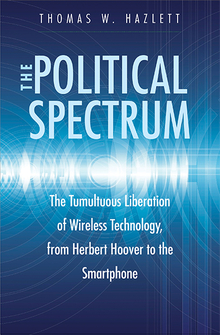
In this context, it seems especially worth reporting on an event from last week. Tom Hazlett, former Chief Economist of the FCC, came to Hoover  to discuss his new book "Political Spectrum,"  which covers the history of the US government regulation of radio (TV, and cell phone) waves, largely through the same FCC that was in charge of "net neutrality." (I haven't read the book, this is a summary of the seminar discussion.)

Contrary to conventional wisdom, the market for spectrum worked well until 1927, in just the way economists might expect. Property rights to spectrum emerged, evolved, and worked well.

Radio was, at first, considered only for point to point communication. It stayed that way until 1920, when the first broadcast occurred.  Within 2 years there were 500 broadcasters.

Contrary to the common allegation of “etheric bedlam” the market was actually orderly through 1926.  Under the 1912 radio statute, the Department of Commerce enforced first-come first-serve rules, basically homesteader rights to spectrum in a geographic area and time. Those emergent property rights were registered with Department of Commerce, and easily bought and sold. If a new station encroached on your frequency/geography, you could quickly sue and stop it.

Regulation emerged in much the way a public choice economist might predict. The regulators wanted much more discretion — they wanted to control who got to broadcast and what was said. The  large commercial stations wanted to limit entry and competition. The National Association of Broadcasters quickly became a lobbying group and advocated “public interest, convenience, and necessity” to regulate. [Yes, in only 5 years an industry that nobody had ever heard of or thought of became an incumbent lobbying force for regulation to stop entry and competition.]  Herbert Hoover, (sadly) the commerce secretary at the time stopped enforcing enforcing first-come first-serve rights in 1926. Now there was indeed chaos, the “breakdown in the law.” According to Hazlett, this was a strategic breakdown to get regulation going. That regulation was formalized in the 1927 radio act. The first sentence of the act preempted private rights to spectrum.

Now, rather than property rights, spectrum was allocated by a “mother may I” system.  In 1932 FCC,  took over authority of wires to.

Regulation was quickly captured to stop competition and innovation.

Thursday, December 14, 2017

Exceptionalism

Law and the Regulatory State is a little essay, my contribution to American Exceptionalism in a new Era, a volume of such essays by Hoover Fellows. It takes up where Rule of Law in the Regulatory State left off.

A few snippets:
To be a conservative—or, as in my case, an empirical, Pax-Americana, rule-of-law, constitutionalist, conservative libertarian—is pretty much by definition to believe that America is “exceptional”—and that it is perpetually in danger of losing that precious characteristic.  
So why is America exceptional, in the good sense? Here, I think, economics provides a crucial answer. The ideas that American exceptionalism propounds have led to the most dramatic improvement in widely shared well-being in human history.... Without this economic success, I doubt that anyone would call America exceptional. 
Despite the promises of monarchs, autocrats, dictators, commissars, central planners, socialists, industrial policy makers, progressive nudgers, and assorted dirigistes, it is liberty and rule of law that has led to this enormous progress. 
I locate the core source of America’s exceptional nature in our legal system—the nexus of constitutional government, artfully created with checks and balances, and of the rule of law that guides our affairs. And this is also where I locate the greatest danger at the moment. 
The erosion of rule of law is all around us. I see it most clearly in the explosion of the administrative, regulatory state.
This is the main theme:
the rules are so vague and complex that nobody knows what they really mean..  the “rules” really just mean discretion for the regulators to do what they want—often to coerce the behavior they want out of companies by the threat of an arbitrary adverse decision.
The basic rights that citizens are supposed to have in the face of the law are also vanishing in the regulatory state.
Retroactive decisions are common,..
I fear even more the political impact. ... The drive toward criminalizing regulatory witch hunts and going after the executives means one thing: those executives had better make sure their organizations stay in line.
The key attribute that makes America exceptional—and prosperous—is that candidates and their supporters can afford to lose elections. Grumble, sit back, regroup, and try again next time. They won’t lose their jobs or their businesses. They won’t suddenly encounter trouble getting permits and approvals. They won’t have alphabet soup agencies at their doors with investigations and fines... We are losing that attribute.
In many countries, people can’t afford to lose elections. Those in power do not give it up easily. Those out of power are reduced to violence. American exceptionalism does not mean that all the bad things that happen elsewhere in the world cannot happen here.
Always be optimistic though:
The third article in exceptionalist faith, however, is optimism: that despite the ever-gathering clouds, America will once again face the challenge and reform. There is a reason that lovers of liberty tend to be Chicago Cubs fans.
The other essays are great. Niall Ferguson basically thinks exceptionalism is over.

Saturday, March 18, 2017

Trade insight

Daniel Hannan, a (soon to be unemployed?) UK member of the European Parliament, writes insightfully about trade in the Saturday Wall Street Journal.
It is telling that neither of the Obama administration’s flagship trade deals—the Transatlantic Trade and Investment Partnership, or TTIP, and the Trans-Pacific Partnership—even had “free trade” in the title. Although they had liberalizing elements, they also contained a great deal of corporatism.
Monitoring TTIP as a member of the European Parliament, I saw plainly enough what was going on: Big multinationals in Europe were getting together with big multinationals in the U.S. and lobbying for more regulation. By combining the most restrictive rules in the EU and the U.S., they aimed to raise barriers to entry and to give themselves an effective monopoly.
There is a deep point here. Our trade treaties have strong elements of managed mercantilism, not free trade, and can serve the interests of global corporations. There is a "better" trade that is also freer trade, and may address some of the political unpopularity of trade deals. Hannan has in mind a very open US-UK bilateral deal, but more deeply states clearly and concisely how better trade deals could work in general
A British-American deal should avoid that danger. How? By focusing on mutual product recognition rather than on common standards. If a drug is approved by the U.S. Food and Drug Administration, it should automatically be approved for sale in the U.K. If a trader can practice in the City of London, he should automatically be licensed to practice on Wall Street. And so on.
A commercial deal, in this case as in any other, should have nothing to do with human rights or child labor or climate change. Important as those issues are, they are separate from the free exchange of products.
... Once Britain no longer has to worry about the protectionism of French filmmakers, Italian textile manufacturers and the rest, we should reach a comprehensive agreement covering services as well as goods. If we make sure that the resulting deal is in the interest of consumers rather than producers, we could revive the whole notion of free trade, which is something the world very much needs just now.


Saturday, December 10, 2016

Trump Taxes Two

Source: Wall Street Journal
"President-elect Donald Trump owns a helicopter in Scotland.
To be more precise, he has a revocable trust that owns 99% of a Delaware limited liability company that owns 99% of another Delaware LLC that owns a Scottish limited company that owns another Scottish company that owns the 26-year-old Sikorsky S-76B helicopter, emblazoned with a red “TRUMP” on the side of its fuselage."
So write Jean Eaglesham, Mark Maremont, and Lisa Schwartz in the Wall Street Journal

"WTF?" wonders the incredulous reader. Why does Mr. Trump structure his finances with such mind-boggling complexity, to say nothing of astronomic legal costs? The article is pretty thin on explaining the logic of all this.

You can see the Journal writers struggling for a narrative. Is this about Mr. Trump's "conflict of interest" issues? Is this something nefarious about Mr. Trump, efforts to hide something? (You can be sure earnest investigative reporters at the Times will be beating both drums for the next four years. And just as sure that nobody will pay much attention unless they can tempt Mr. Trump into saying something stupid about it all.)

Let me suggest a productive narrative. Mrs. Clinton's email saga laid bare for all of us to see the financial arrangements of prominent public figures -- "charitable foundations" to funnel money around, all "legal." In my view, rightly felt disgust at that look into our political system had a lot to do with the election. Mr. Trump's financial arrangements lay bare for all of us to see the financial arrangements of the super-wealthy in this country, also massively complex, perfectly "legal," and smelling equally of last week's fish. The right response is equal disgust at the obscene tax code and crony capitalist system that produces this mess.  Mitt Romney's taxes were 550 pages long, and he only had investments, not operating companies! Fellow peasants, get out your pitchforks!

Thursday, December 8, 2016

Growth full oped

Source: Wall Street Journal

On November 7 I wrote "Don't believe the economic pessimists," an oped about growth in the Wall Street Journal. Now that 30 days have passed, I can post the whole thing here. pdf here (my webpage).

Don't Believe the Economic Pessimists

No matter who wins Tuesday’s presidential election, now ought to be the time that policy makers in Washington come together to tackle America’s greatest economic problem: sclerotic growth. The recession ended more than seven years ago. Unemployment has returned to normal levels. Yet gross domestic product is rising at half its postwar average rate. Achieving better growth is possible, but it will require deep structural reforms.

The policy worthies have said for eight years: stimulus today, structural reform tomorrow. Now it’s tomorrow, but novel excuses for stimulus keep coming. “Secular stagnation” or “hysteresis” account for slow growth. Prosperity demands more borrowing and spending—even on bridges to nowhere—or deliberate inflation or negative interest rates. Others advocate surrender. More growth is impossible. Accept and manage mediocrity.

But for those willing to recognize the simple lessons of history, slow growth is not hard to diagnose or to cure. The U.S. economy suffers from complex, arbitrary and politicized regulation. The ridiculous tax system and badly structured social programs discourage work and investment. Even internet giants are now running to Washington for regulatory favors.

If you think robust growth is impossible, consider a serious growth-oriented policy program—one that could even satisfy many of the left’s desires.

Saturday, December 3, 2016

Carrier Commentary

When Paul Krugman, Larry Summers,  Sarah Palin, and the Wall Street Journal all agree on something -- that presidential deal-making and strong-arming over plant location is a terrible idea -- it's worth paying attention to.

I think Tyler Cowen did the best job of describing what's wrong with the deal, interviewed on NPR. (Transcript, Highlights and audio link).

(This is an impressive radio interview. I long to be able to express something that quickly clearly and coherently on radio. Tyler must have really prepared hard for it.)
INSKEEP: Don Evans says this is a way for the president-elect to send a strong message to workers and to corporations about what his priorities are. What's wrong with that?

TYLER COWEN: We're supposed to live under a republic of the rule of law. Not the rule of man. This deal is completely non-transparent. And the notion that every major American company has to negotiate person-to-person with the president over Twitter is going to make all business decisions politicized.

Wednesday, November 23, 2016

Exceptionalism

For Thanksgiving, I offer a rumination.

Last month, the Hoover Institution's fall retreat was organized around the theme of American Exceptionalism. See here for podcasts of talks from the stars -- really good. I talked about the nexus between economics, rule of law, regulation, and exceptionalism.

This was before the election, but two themes strike me as especially important still.

First: America needs rule of law, regular order, a partisan truce, even more than it needs my particular free-market policy preferences.

If Republicans overturn Obamacare in their first 100 days, with no Democratic votes; if President Trump picks up his phone and pen, undoes 8 years of Obama in the first day, and starts writing his own; and sends the agencies after his critics and enemies, we are headed for disaster.  Future president Elizabeth Warren, or President Malia Obama with Vice President Chelsea Clinton, will just do the same. There is an anectdotal story of early 20th century Chicago mayors, who alternated between German and Irish. Each one's first act in office would be to overturn the ban on whiskey (beer), and impose a ban on beer (whiskey). (Too good a story to check the facts!) Let's not do that.

Second, we must not become a country where you can't afford to lose an election. The criminalization of politics has already gone too far. If you can't afford to lose an election -- if losing or supporting the losing party or speaking out on policy issues that lose gains you the tender attentions of the FBI, the IRS, the DOJ, the NLRB, and the EPA, if you lose your job and your business -- then people in power will fight to the end not to lose that power. Though I'm no fan of the Clinton foundation shenanigans, the noises coming out of the Trump transition not to push that issue are hopeful. Losing an election, a 95% reduction in speaking fees, and the public attention that investigative journalists can bring are enough. Putin can't retire and stay out of jail -- or alive.

A last thought for Thanksgiving. The Pilgrims were all illegal immigrants -- violating their charter from the English King, and the natives' longstanding ban on white settlement. Thank the Wampanoag's tolerant attitude for your turkey.


Economics, Rule of Law, and American Exceptionalism
(Talk given at Hoover retreat October 2016) 

To be a conservative — or, in my case an empirical, pax-americana, rule-of-law, constitutionalist conservative libertarian — is pretty much by definition to believe that America is “exceptional” — and that she is perpetually in danger of losing that precious characteristic. Exceptionalism is not natural or inborn, but must be understood, cherished, maintained, and renewed each generation — and her garden is always perilously unattended.

Thursday, November 17, 2016

Yglesias discovers rule of law

Matt Yglesias (HT Marginal Revolution) writes well of the danger facing America in the era of the regulatory state.
Those who support the regime will receive favorable treatment from regulators, and those who oppose it will not. Because businesses do business with each other, the network becomes self-reinforcing. Regime-friendly banks receive a light regulatory touch while their rivals are crushed. In exchange, they offer friendly lending terms to regime-friendly businesses while choking capital to rivals. Such a system, once in place, is extremely difficult to dislodge precisely because, unlike a fascist or communist regime, it is glued together by no ideology beyond basic human greed, insecurity, and love of family.
He's talking about the Trump administration.  Matt, where have you been these last 8 years? Well, better late then ever, but wow those partisan glasses make the mirror hard to see. (I might add that this is exactly how fascist and communist regimes work in reality. Ideology is easy to find.)

Update for Fire Man (I try not to endlessly push my previous work.) The Rule of Law in the Regulatory State

Update 2. A little less snarky. Still, the danger is real. Will Republicans, now in power, say thank you very much, pick up the phone and pen, and do unto D like D did unto R? Or will they be the ones to undo tit-for-tat, shove-it-down-their-throats policy, and reestablish executive restraint at least by custom if not by statute? That will take losing or delaying some policy fights, and foregoing the delicious irony of revenge. President elect Trump did threaten to use the IRS against political enemies. Let us hope that like much else was campaign rhetoric. Will the repeal and replace Obamacare happen strictly along party lines in 100 days -- and then be overturned itself by President Warren or Chelsea Clinton? Or will they take the time and effort to get a significant Democratic buy in? Time will tell.

I did not mean to say that the worry is unfounded, only that it goes back a ways in US politics,  and the  fight would now be oh so easier if people like Yglesias had kept true to principle while their policy priorities were being shoved down people's throats, and their political antagonists were the victims of the politicized regulatory state.

Good commentary from Glenn Greenwald on the Inspector-Renault quality of this outrage.