Don't piss people off unless you have to. Over at Substack.
Showing posts with label writing. Show all posts
Showing posts with label writing. Show all posts
Sunday, December 31, 2023

Thursday, July 13, 2023
Writing tidbit
From Joseph Epstien's oped in the July 13 WSJ on Biden v Trump (please, dear Lord, no)
Each man has risen to the presidency thanks, mostly, to the unattractiveness of his electoral opponent. Each man was elected as a lesser-evil choice, yet both have succeeded in vastly polluting the tone of our country’s political life. Lesser-evil choices sometimes turn out to be evil enough.
Low and seedy are the corruptions of which Messrs. Trump and Biden have been accused: molesting women, entering into dubious financial dealings with foreign corporations and governments, cavalierly mishandling important documents, and more.
My italics. I'm not here today on content, but just on writing. I make mental notes of little writing tricks that might embellish my prose.
I liked the first one, just because it's such a beautiful catchy phrase. I'm not sure what the general principle is, but I'd like to come up with more prose like that.
The second one has a clearer lesson. The usual rule is, write your sentences forward. Or, more likely, edit your sentences to be forwards. You should quickly turn that one around to "The corruptions of which Messrs. Trump and Biden have been accused are low and seedy." Or, better, through it changes the subject a bit, "Messrs. Trump and Biden have been accused of low and seedy corruptions." 99% of the time you should do that.
But not this time. Look how beautiful that backward sentence is. There must be some biblical quote it refers to. Maybe readers can come up with the allusions.
Don't do it all the time. But rules are made to be broken, if you really know what you're doing. Which Epstein clearly does.
Sunday, June 18, 2023
The perennial fantasy
Two attacks, and one defense, of classical liberal ideas appeared over the weekend. "War and Pandemic Highlight Shortcomings of the Free-Market Consensus" announces Patricia Cohen on p.1 of the New York Times news section. As if the Times had ever been part of such a "consensus." And Deirdre McCloskey reviews Simon Johnson and Daron Acemoglu's "Power and Progress," whose central argument is, per Deirdre, "The state, they argue, can do a better job than the market of selecting technologies and making investments to implement them." (I have not yet read the book. This is a review of the review only.)
I'll give away the punchline. The case for free markets never was their perfection. The case for free markets always was centuries of experience with the failures of the only alternative, state control. Free markets are, as the saying goes, the worst system; except for all the others.
In this sense the classic teaching of economics does a disservice. We start with the theorem that free competitive markets can equal -- only equal -- the allocation of an omniscient benevolent planner. But then from week 2 on we study market imperfections -- externalities, increasing returns, asymmetric information -- under which markets are imperfect, and the hypothetical planner can do better. Regulate, it follows. Except econ 101 spends zero time on our extensive experience with just how well -- how badly -- actual planners and regulators do. That messy experience underlies our prosperity, and prospects for its continuance.
Starting with Ms. Cohen at the Times,
The economic conventions that policymakers had relied on since the Berlin Wall fell more than 30 years ago — the unfailing superiority of open markets, liberalized trade and maximum efficiency — look to be running off the rails.
During the Covid-19 pandemic, the ceaseless drive to integrate the global economy and reduce costs left health care workers without face masks and medical gloves, carmakers without semiconductors, sawmills without lumber and sneaker buyers without Nikes.
That there ever was a "consensus" in favor of "the unfailing superiority of open markets, liberalized trade and maximum efficiency" seems a mighty strange memory. But if the Times wants to think now that's what they thought then, I'm happy to rewrite a little history.
Face masks? The face mask snafu in the pandemic is now, in the Times' rather hilarious memory, the prime example of how a free and unfettered market fails. It was a result of "the ceaseless drive to integrate the global economy and reduce costs?"
Thursday, May 6, 2021
Weisbach advice
I got a chance to see the page proofs of Michael Weisbach's upcoming book, "The Economists' Craft." This leapt out at me from the preface:
A second observation I have made over the years is that, perhaps because of a lack of good advice, many scholars, both doctoral students and faculty members, constantly make the same mistakes. Far too many publicly circulated papers contain incredibly long, mind-numbingly dull literature surveys; introductions that go on and on before they tell the reader what the point of the paper is and why the reader should bother to waste her time on it; data descriptions containing insufficient detail for a third party to replicate the results; tables that are unnecessary, badly labeled, or hard to understand; or overly dry prose written in the passive voice and apparently designed to put the reader to sleep. In addition, many scholars manage their time so badly when giving presentations that they do not get to the main results of their paper until the last five minutes of the talk. Their presentations are often poorly designed, with slides that are incomprehensible or even unreadable owing to their use of fonts so small that participants sitting more than a few rows back cannot read them. Young faculty routinely mismanage their career by not having a coherent research agenda, not getting their papers to journals, or not making connections with people in their field who teach at other universities. Sometimes they do not even bother to show up for seminars in their field at their own university.
So true. This book's contrary advice will be very useful.
Saturday, December 19, 2020
Bisin on MMT Rhetoric
Alberto Bisin has written an intriguing short review of Stephanie Kelton's The Deficit Myth. Alberto focuses on the rhetoric of MMT and the book. (My review here FYI.)
MMT's rhetoric is surely its most salient feature. It has been phenomenally successful in terms of gaining attention, and it has eschewed all the traditional rhetoric of economics -- academic articles, conference presentations, monographs full of equations, econometric estimates and tests, or even mountains of charts and graphs, PhD students fanning out to develop it.
[In response to JZ comment, that is not necessarily good or bad, it's just a fact. The conventional economic rhetoric produces a lot of garbage, too. Bryan Caplan has a point. The major distinction may be engagement with critics, which happens in conventional discourse and so far has been largely absent with MMT.]
Kelton's book is unusual in MMT rhetoric for appearing to be one definitive source that would lay it out, following standard rhetoric. The trouble with writing a book is that sometimes people read it carefully, and are emboldened that they aren't missing something in the usual flurry of blog posts tweets and videos. Then the world finds out the ideas in it are empty, the rhetoric artifice rather than explanatory.
(NB, "rhetoric" has gained an unfortunate pejorative in common usage. I mean no such pejorative. How we structure economic discussion is hugely important. If you have not read Deirdre McCloskey's Rhetoric of Economics article or subsequent books, do so immediately.)
Alberto:
The book should be seen as a rhetorical exercise. Indeed, it is the core of MMT that appears as merely a rhetorical exercise. As such it is interesting, but not a theory in any meaningful sense I can make of the word. The T in MMT is more like a collection of interrelated statements floating in fluid arguments. Never is its logical structure expressed in a direct, clear way, from head to toe.
Friday, January 17, 2020
Great Society Review

The US is debating a fourth great wave of US government expansion. Theodore Roosevelt to Wilson the original progressive era and WWI; Frankin Roosevelt's new deal; and the Kennedy-Johnson-Nixon "great society" of this book came before us.
Plus ça change, plus c'est la même chose, is in many ways the theme of the book. The Great Society offers lots of parallels to our time, and a cautionary tale that it will all end badly once again. But not all is the same, and the many ways our time is different from the 1960s is also good to ponder -- for better and for worse.
Amity is a gifted writer and storyteller. Pay attention to her books also for how they are written. How do you tell the story of an era in a way that is comprehensible and memorable? Amity picks a few central (and now often overlooked) people, a few programs, and a few benchmarks (the Dow, the price of gold), and tells the story of the era through their eyes. It's the Game of Thrones approach to the Great Society. Do not expect even a comprehensive list of all great society programs, diff in diff regression discontinuity estimates of their causal effects, or even charts and graphs (all curiously packed in an appendix and never referred to in the text) or the customary eyeball-glazing recitations of statistics. This was her approach to the Great Depression in Forgotten Man, equally effective. It complements, but does not substitute for that more structural work.
Introduction
In case you don't get the point, Amity starts right off in the introduction with Michael Harrington who wrote "a then-famous bestseller called The Other America" and who worked for Sargent Shriver, which is one of the main characters of the book (Daenerys Targaryen?)
Why not socialism? The president had been in office three months, and he wanted new ideas to distinguish himself from his predecessor. Could the author bring up socialism at the lunch? The very word “socialism” had been toxic until recently. ... The taboo was weakening, though.
..“socialism” might sound too controversial for the White House. The writer could, however, pitch ideas that took the country toward socialism. ... Laws that backed up organized labor so it might represent a greater portion of the American workforce... Higher minimum wages... Minimum wages that covered more workers, even those who did not work in an office or full-time. A dramatic change in the training of bigoted policemen in the big cities. ... The money was simply in the wrong hands. ... a tax system that captured the elusive wealth of the superrich. The moment had come to level incomes in a systematic fashion.
..The story sounds like something that could happen today."The 1960s and early 1970s included a huge expansion of programs. And the results were in the end mostly abject failure.
Today
progressive proposals that bear a strong resemblance to Michael Harrington’s, from redistribution via taxation to student debt relief to a universal guaranteed income, are becoming popular again. Once again, many Americans rate socialism as the generous philosophy. But the results of our socialism were not generous. May this book serve as a cautionary tale of lovable people who, despite themselves, hurt those they loved. Nothing is new. It is just forgotten.It is also a refreshing reminder of just how old most of the "new" ideas we are being bombarded from on the left are -- and a warning of how long they will pester us, at least as long as we are unwilling to learn.
From an SDS (students for democratic society) manifesto:
"The wealthiest 1 percent of Americans own more than 80 percent of all personal shares of stock"The capsule stories of the 1960s focus on the civil rights triumph, the remaining politically successul programs such as medicare and medicaid, the vietnam war, and a vague hippy nostalgia. Shales' story, and the central roles of the forgotten (largely) men she tracks are a novel tonic.
Stories
Walter Reuther, head of United Auto Workers, is a central figure, and the fight between the old-left unions and the new-left students epitomized by Tom Hayden, for the soul of the Democratic party.
Sargent Shriver, and the Office of Economic Opportunity are the stand-in for many ill fated programs. It starts with the predictable story of chaos that results from a flood of federal money. The flood of federal money did not stop the cities from burning. The OEO is the beginning of Federal support for "community action" programs, including political activity.
"Community action programs, the authors [of the Community Action Program Workbook—262 pages on how to apply for and run a federally funded program] wrote, should provide the “stimulation of change.” One marker of a successful community action group was that it “increased competence in protest activities.” The OEO ... welcomed experiments, including those where community action organizers paid by Washington were “facilitating the opportunities for the poor to participate in protest actions.”
That kind of language was enough to send mayors like Dick Daley through the roof.In the end, the cities went up in flames. The OEO morphed in many ways. One interesting almost afterthought of the original program, legal aid to the poor -- who can obect to that, helping poor people who can't afford lawyers? -- ballooned the way all such programs do,
"the governor [Reagan] was after the lawyers again, assailing California Rural Legal Assistance. The nonprofit should have stuck to individual legal aid cases for rural indigents, Reagan said, but instead had “converted itself into a vehicle for class action lawsuits against various government agencies.” Reagan told the crowd that his staff had reckoned that if the CRLA won all its suits in California, the cost of welfare there would increase by $1 billion—the same amount Johnson and Shriver had first set as the budget for the entire War on Poverty."Here was where the government started paying lawyers to sue the government for more government.
Amity tracks disastrous housing policies through the life of the Pruitt-Igoe housing project in St. Louis, begun in earnest but remote social-planner hope, though destroying the community where it sat, and ending in controlled demolition.
"In some cases, only welfare families were entitled to the lowest rents at Pruitt-Igoe. And to receive welfare under Missouri’s rules, a family could have only one parent—the mother. So families considering life in the towers had to make a terrible choice: stay together or take the apartment. ..Families who moved into Pruitt-Igoe often lost a father. ...The social workers even policed apartments at night, checking to see if fathers had secretly returned, grounds for eviction. "The consequences of which are predictable.
"Pruitt-Igoe elevators, which stopped only every few floors, were muggers’ traps. Poor maintenance meant the elevators often jammed, leaving gangs’ victims in with them for long extra minutes. The gangs lurked in the halls and made tenants “run the gantlet” to get to their doors. Young men threw bricks and rocks at windows and streetlamps; the activity was a regular sport..... Because there were no toilets on the ground floor, children had accidents there and in the elevators, and the elevators gradually became public toilets. The community area was a sorry joke... No one seemed able to stop the decay. "I love this:
"Social scientists were descending on the complex to conduct multiyear investigations, and that irritated the tenants further."we've been at it a long time, missing the ends of our noses.
"At Pruitt-Igoe, rents were scaled to income. Every time the Straughters’ wages went up, their rent went up, a tax on striving"Income-capped rent subsidies are with us today.
"After tens of millions and decades of urban renewal spending, Detroit did not look renewed. Detroit looked, Mayor Cavanagh said, like a city that now did need a Marshall Plan, like “Berlin in 1945.” Almost three thousand businesses had been sacked, with damage many times greater than in Watts just two years before. "In the end
"There was hypocrisy [and I would say a great deal of paternalistic disdain] in the different treatment of the middle class and poor. For the middle class, the government had aimed to re-create and sustain the world of Alexis de Tocqueville, subsidizing home purchasers for suburban settlers. For the poor, however, the government had operated in the world of Karl Marx: government-sponsored housing blocks with tenants, not owners. Black citizens—Pruitt-Igoe was now all black—had been ripped from their roots when they moved North, uprooted again when they were moved for urban renewal, and then placed in high-rise rentals where putting down new roots was impossible."
"How might neighborhoods like this one have turned out if local companies, local authorities, and local individuals had led in the 1950s and 1960s, building their own Great Society? How might St. Louis have looked if the jobs had stayed? No one knew. But here in the shadow ofPruitt-Igoe, Father Shocklee and Pruitt-Igoe tenants had discovered one possibility. With his small housing program, Father Shocklee had shown that “the poor” were more like the middle class than people supposed. They gained from something only when they had a chance to own it."
Daniel Patrick Moynihan is a second central character in Amity's story (Tyrion Lannister?) Moynihan was a Democrat, but wrote the important and controversial "The Negro Family: The Case For National Action," pointing out, among many other things, the perverse incentives of welfare.
"From his work at Harvard and in Washington, Moynihan thought he had learned what was wrong with American welfare. The first trouble was that poverty funding tended to flow to bureaucrats—social workers, not poor people. “Feeding the horses to feed the sparrows,” Moynihan called it. In many states, those social workers spent their time in perverse endeavors: inspecting apartments at Pruitt-Igoe to make sure no fathers were present, for example. Taxes hit people when they entered the workforce, reducing the appeal of working just as Eartha Kitt said. ...In some states, for example, a welfare mother working at the same job as a family father not on welfare took in 50 percent more than the man, because she was entitled to keep a portion of her welfare. Why not bypass the bureaucrats and send the money to families, regardless of whether fathers were present?"And then he took a job with Nixon, and became one of Nixon's main advisers. He nearly got passed a negative income tax, the equivalent of today's universal basic income. In his grudging New York Times review, Binyamin Applebaum finds this story "curious," because it did not pass in the end. But it nearly did, which makes it important. Amity covers well the failed attempt to over rule right to work laws, which also nearly passed. Near failures good and bad are equally instructive to our current situation, no matter the flap of butterfly wings that determines their fate. (The quick review of the UK's longer experience starting p. 335 is well worth it too.)
I found this amusing
"The crowd at Harvard had held even Hubert Humphrey, and at times Robert Kennedy, in contempt. Any interest in Nixon Harvard rated worse than reprehensible
The schoolmates of Moynihan’s children stopped talking to them. Alan Rabinowitz, a fellow academic, wrote a satirical poem chiding Moynihan for his betrayal, “The Knight Before Nixon.”Plus ça change in academia, and much Trump-deranged society.
Fairchild semiconductor plays a small but significant role. It's good to remember how different the US economy of the 1950s was. There really were a few very large companies in most industries, and most technology came out of defense. The emergence of an innovative private tech sector is one of those many ways we are not replaying exactly the same song. The slow emergence of Toyota and VW, selling better cars and forcing change in Detroit is another.
Money and gold
A minor story for the book caught my eye, and I pass it on first as many blog readers are interested in monetary issues. One of the themes of the book -- the snow level on the great white wall -- is the price of gold, and the US continuing problems of gold outflow, the emergence of inflation, and the eventual collapse of the Bretton Woods system. This is an event much too little studied by macroeconomists, though my international and economic history friends tell me that shows just how parochial we are and we should start reading their papers.
In macroeconomics perhaps we are too influenced by Milton Friedman's great called home run, the 1968 presidential address, where he forecast inflation would emerge along with unemployment. But Friedman's story was told entirely in terms of the money supply and to a lesser extent interest rate targets, the one too large and the other too low. And that is how the stylized history has come down to us: Fiscal deficits from the Great Society and Vietnam war, combined with too loose monetary policy, set off inflation.
That story leads to the puzzle of our age: If the (by current standards) comparatively minor Johnson-Nixon deficits set off a grand inflation why do our huge deficits have no such effect now, despite many officials stated desire for more inflation?
The story of the book reminds us that the mechanics were quite different then, and leads me to the speculative thought that the gold standard mechanism brought on inflation much more quickly than our current arrangements. In part, it may have been designed to do so -- to force governments to make fiscal adjustments quickly rather than let the problem get so big the fiscal adjustment will be immense, much as Doug Diamond and Raghu Rajan model short term debt and its runs as a disciplining device to managers.
The world was different then. We had fixed exchange rates, and it was difficult to move capital from country to country -- to buy foreign stocks, for example. Bretton Woods was not really set up to handle today's large trade deficits financed by large capital account surpluses. When the US started running trade deficits, other countries piled up dollars, and the main thing they could do with those dollars was to turn them in to their central banks, who in turn used them to drain gold from the Fed. So, it strikes me that open capital markets that allow us to finance large trade deficits are an important reason our system has held up so long.
Amity tells the sad tale of stopgap measures -- bans on using dollars for foreign travel, half-hearted interest rate increases, looney schemes for the Federal Government to mine gold, and of course the tragedy of price controls.
In any case, the remaining gold standard between central banks, not very open capital markets, not very open currency markets and fixed exchange rates were a crucial part of the inflation dynamics in this period, not just bad money supply or interest rate rules.
The episode also raises the counterfactual question why the US did not use the many devices used to defend the gold standard through the centuries. Borrow gold. Temporarily suspend convertibility.
Coda
At the end of a review that had to be negative, though he had to admit the quality of the book, New York Times review, Binyamin Applebaum writes
"Half a century later, in the midst of a revival of interest in ideas like Moynihan’s basic income proposal, readers may find themselves wondering whether the nation’s problem is really too much government — or, perhaps, not enough."One wonders just what it would take to ever change his mind on that one. Were the 60s riots, the 70s economy, and the evident pathologies of the welfare system not bad enough, or do we have to go full Venezuela first? After all these years, and with the same policies on agenda, with the same predictable disincentives and unintended consequences, could not his call be at least for smarter government, not just more? For a larger government that learns from rather than repeats this sad history?
Tuesday, December 26, 2017
The Buyback Fallacy
Many commenters on the tax bill repeat the worry that companies will just use tax savings to pay dividends or buy back shares rather than make new investments.
Savannah Guthrie, interviewing Paul Ryan on the Today Show, thought she had a real gotcha with
Peggy Noonan, in an otherwise thoughtful column, echoed the same worry:
So, having established that this is a bipartisan worry, let's put the fallacy to bed. It is the fallacy of composition, that actions of one company mirror actions of the economy as a whole. It is the fallacy of "paper investments" vs. "real investments." That distinction can apply to a company, but not to the whole economy.
No, companies do not sit on vast swimming pools of gold coins, like Scrooge McDuck. One company's "cash" is a short term loan to another company, which the latter uses it to make real investments. Every asset (paper) is also a liability, backed by an investment. The charge fails to track the money. One of the few things economists know how to do is always to ask, "OK, and then what do they do with the money?" Money is a veil, and real decisions are (to first order) independent of financial decisions. (I use italics to suggest some ways to remember these basic economic ideas.)
Savannah Guthrie, interviewing Paul Ryan on the Today Show, thought she had a real gotcha with
"What they [CEOS] are planning to do is stock buybacks, to line the pockets of shareholders."(She then moved on to a question most guaranteed to produce retweets of partisan admirers, and least likely to produce an interesting answer,
"I'll ask you plainly, are you living in a fantasy world?"NBC then wonders that it is charged with partisan bias.)
Peggy Noonan, in an otherwise thoughtful column, echoed the same worry:
"Big corporations can take the gift of the tax cut ... and do superficial, pleasing public relations sort of things, while really focusing on buying back stock and upping shareholder profits."(Just how taking less of your money is a "gift" is a question for another day.)
So, having established that this is a bipartisan worry, let's put the fallacy to bed. It is the fallacy of composition, that actions of one company mirror actions of the economy as a whole. It is the fallacy of "paper investments" vs. "real investments." That distinction can apply to a company, but not to the whole economy.
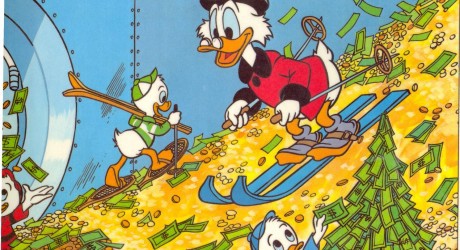 |
| What corporate cash is not. |
Monday, September 5, 2016
Rosenberg in New York Times
Naomi Rosenberg's Op-Ed in the Sunday New York Times is the best piece of writing I have had the painful pleasure to read in a long time. The title is How to Tell a Mother her Child Is Dead. Warning: this is not an easy piece to read.
Read it. Read the whole thing. Read it again. There is no excerpt I can offer.
Why is it so good? She does not clear her throat. She does not introduce the subject -- the title did that. She dives right in: "First you get your coat." She uses short, declarative, active sentences. The absence of contractions is powerful.
She does not beat us over the head with the obvious, or fill it with policy-blather. She reminds us of the daily tragedy in many cities, like my hometown of Chicago, that we must no longer ignore.
She reminds us of the deep humanity of doctors who pick up the pieces. The emergency room doctor who took care my mother could have been Dr. Rosenberg, and I will forever be thankful for her consideration. "You use the mother’s name and you use her child’s name." Yes. Too often in our many doctor visits raising four children, someone addressed us as "Mom" and "Dad." We're not dumb. We know that means you can't bother to look down at the sheet in front of you to read and pretend to know who we are.
She reminds us to treat people in awful circumstances with the same humanity and respect as she treats her patients, not as numbers, abstractions, easy categories or talking points for longstanding policy arguments.
Had she said any of that, it would have been much weaker. She didn't need to say it. In all likelihood, neither do I.
Let us remember Dr. Rosenberg and her colleagues this labor day, as they will be at that painful work while we barbecue.
Read it. Read the whole thing. Read it again. There is no excerpt I can offer.
Why is it so good? She does not clear her throat. She does not introduce the subject -- the title did that. She dives right in: "First you get your coat." She uses short, declarative, active sentences. The absence of contractions is powerful.
She does not beat us over the head with the obvious, or fill it with policy-blather. She reminds us of the daily tragedy in many cities, like my hometown of Chicago, that we must no longer ignore.
She reminds us of the deep humanity of doctors who pick up the pieces. The emergency room doctor who took care my mother could have been Dr. Rosenberg, and I will forever be thankful for her consideration. "You use the mother’s name and you use her child’s name." Yes. Too often in our many doctor visits raising four children, someone addressed us as "Mom" and "Dad." We're not dumb. We know that means you can't bother to look down at the sheet in front of you to read and pretend to know who we are.
She reminds us to treat people in awful circumstances with the same humanity and respect as she treats her patients, not as numbers, abstractions, easy categories or talking points for longstanding policy arguments.
Had she said any of that, it would have been much weaker. She didn't need to say it. In all likelihood, neither do I.
Let us remember Dr. Rosenberg and her colleagues this labor day, as they will be at that painful work while we barbecue.
Friday, June 17, 2016
Syverson on the productivity slowdown
Chad Syverson has an interesting new paper on the sources of the productivity slowdown.
Background to wake you up: Long-term US growth is slowing down. This is a (the!) big important issue in economics (one previous post). And productivity -- how much each person can produce per hour -- is the only source of long-term growth. We are not vastly better off than our grandparents because we negotiated better wages for hacking at coal with pickaxes.
Why is productivity slowing down? Perhaps we've run out of ideas (Gordon). Perhaps a savings glut and the zero bound drive secular stagnation lack of demand (Summers). Perhaps the out of control regulatory leviathan is killing growth with a thousand cuts (Cochrane).
Or maybe productivity isn't declining at all, we're just measuring new products badly (Varian; Silicon Valley). Google maps is free! If so, we are living with undiagnosed but healthy deflation, and real GDP growth is actually doing well.
Chad:
Background to wake you up: Long-term US growth is slowing down. This is a (the!) big important issue in economics (one previous post). And productivity -- how much each person can produce per hour -- is the only source of long-term growth. We are not vastly better off than our grandparents because we negotiated better wages for hacking at coal with pickaxes.
Why is productivity slowing down? Perhaps we've run out of ideas (Gordon). Perhaps a savings glut and the zero bound drive secular stagnation lack of demand (Summers). Perhaps the out of control regulatory leviathan is killing growth with a thousand cuts (Cochrane).
Or maybe productivity isn't declining at all, we're just measuring new products badly (Varian; Silicon Valley). Google maps is free! If so, we are living with undiagnosed but healthy deflation, and real GDP growth is actually doing well.
Chad:
First, the productivity slowdown has occurred in dozens of countries, and its size is unrelated to measures of the countries’ consumption or production intensities of information and communication technologies ... Second, estimates... of the surplus created by internet-linked digital technologies fall far short of the $2.7 trillion or more of “missing output” resulting from the productivity growth slowdown...Third, if measurement problems were to account for even a modest share of this missing output, the properly measured output and productivity growth rates of industries that produce and service ICTs [internet] would have to have been multiples of their measured growth in the data. Fourth, while measured gross domestic income has been on average higher than measured gross domestic product since 2004—perhaps indicating workers are being paid to make products that are given away for free or at highly discounted prices—this trend actually began before the productivity slowdown and moreover reflects unusually high capital income rather than labor income (i.e., profits are unusually high). In combination, these complementary facets of evidence suggest that the reasonable prima facie case for the mismeasurement hypothesis faces real hurdles when confronted with the data.
An interesting read throughout.
[Except for that last sentence, a near parody of academic caution!]
Tuesday, October 6, 2015
Lazear on Dodd-Frank and Capital
Ed Lazear has a nice WSJ oped, "How not to prevent the next financial meltdown." (Also available here via Hoover.) The main points will not be new to readers of this blog, or my much longer essay but the piece is admirable for putting the basic points so clearly and concisely.
The core problem of focusing on institutions not activities:
The core problem of focusing on institutions not activities:
The theory behind so-called systemically important financial institutions, or SIFIs, is fundamentally flawed. Financial crises are pathologies of an entire system, not of a few key firms. Reducing the likelihood of another panic requires treating the system as a whole, which will provide greater safety than having the government micromanage a number of private companies.A crisis is a run:
The risks to a system are most pronounced when financial institutions borrow heavily to finance investments. If the value of the assets falls or becomes highly uncertain, creditors—who include depositors—will rush to pull out their money. The institution fails when it is unable to find a new source of funds to meet these obligations.
Monday, July 27, 2015
Ben-Gad and the Minotaur

"The idée fixe that dominates The Global Minotaur, and apparently dominated Mr Varoufakis’s squabbles with the other Eurogroup ministers of finance, is that some countries are inherently more productive than others and therefore always generate current account surpluses, while others always generate deficits, and fixed exchange rates or monetary unions only exacerbate this imbalance. Hence, for the world economy to function, the surpluses need to be recycled though a system of regular transfer payments from the core to the periphery.
Why do these imbalances emerge? According to the theory of comparative advantage as formulated by David Ricardo in the early 19th century, different countries specialise in the production of particular goods and then exchange them for others, and trade is mutually beneficial even if some countries are more efficient at producing all goods. Mr Varoufakis’s theory rejects all this. Instead, he argues, some countries are destined to specialise in the production of goods and services, while others on the periphery will forever specialise in consuming them. Put into layman’s terms, what this means is that the people of Germany, the Netherlands, and Finland produce cars, wooden clogs, or mobile phones and sell them to the people of Greece, who pay for it all with money – and to make this trade sustainable the cash needs to be regularly replenished in an endless loop by the people of Germany, the Netherlands, and Finland.This is a story we hear quite often beyond Mr. Varoufakis -- that a currency union requires countries to be similar, with similar productivity. I'm glad to see it so effectively skewered. In Ricardo's famous example, Portugal sells wine to Britain, which sells wool to Portugal, even if one is better at both than the other. They were on a common currency, gold.
Wednesday, June 17, 2015
Noah Smith Writing Lesson
 |
| Source Noah Smith |
A lesson for students learning to write papers: Don't needlessly annoy readers before you get to your point. If a reader disagrees, finds something wrong, or insufficiently documented, of if you offend a reader, he or she will leave without getting to the main point. Once a reader finds one thing he or she thinks is wrong, he or she will distrust the rest of the argument. Grand methodological statements and criticisms of swaths of literature are especially dangerous.
Noah's post is a great example. As you can see, Noah never got to the main point of McCloskey's review, and happily admits it.
Monday, March 30, 2015
Adam Davidson on Immigration
 |
| Illustration by Andrew Rae, source New York Times |
Adam Davidson has a very nice New York Times Magazine article, "Debunking the Myth of the Job-Stealing Immigrant", in favor of "radically open borders."
Here's how a top professional journalist and writer puts together the central argument, so much more cleanly than I can do it:
So why don’t we open up?
Subscribe to:
Posts (Atom)