Post over at Substack. Firing Gay over plagiarism will not fix Harvard.
Showing posts with label Cancel culture. Show all posts
Showing posts with label Cancel culture. Show all posts
Friday, December 29, 2023

Wednesday, December 13, 2023
A Vision for the University of Pennsylvania
A group of faculty at Penn have written A Vision for a New Future of the University of Pennsylvania at https://pennforward.com/. They encourage signatures, even if you're not associated with Penn. I signed.
Big picture: Universities stand at a crossroads. Do universities choose pursuit of knowledge, the robust open and uncomfortable debate that requires; excellence and meritocracy, even if as in the past that has meant admitting socially disfavored groups? Or do universities exist to advance, advocate for, and inculcate a particular political agenda? Choose.
Returning to the former will require structural changes, and founding documents are an important part of that rebuilding effort. For example, Penn and Stanford are searching for new presidents. A joint statement by board and president that this document will guide rebuilding efforts could be quite useful in guiding that search and the new Presidents' house-cleaning.
There is some danger in excerpting such a document, but here are a few tasty morsels:
Principles:
Penn’s sole aim going forward will be to foster excellence in research and education.
Specifics:
Friday, December 8, 2023
Sociology Meetings
When Jukka Savolainen wrote about it in the Wall Street Journal I couldn't quite believe it, so I had to go look. Indeed, on the website of the American Sociological Association describing its 2024 annual meeting we have the official "theme" of the meeting
"..sociology as a form of liberatory praxis: an effort to not only understand structural inequities, but to intervene in socio-political struggles."
"To intervene." "Political struggles."
Friday, October 20, 2023
Bhattacharya on Covid censorship
A week ago Jay Bhattacharya gave a great talk at the weekly Stanford Classical Liberalism workshop. (Link in case the embed doesn't work.) He detailed the story of government+media Covid censorship, along with the dramatic injunction in the Missouri v. Biden case. The discovery in that case alone, detailing how the administration used the threat of arbitrary regulatory retaliation to get tech companies to censor covid information -- along with other matters, including the Hunter Biden laptop -- is astonishing. We now know what they did, no matter what judges say about its technical legality.
Monday, June 5, 2023
Stephens at Chicago; effective organizations
Brett Stephens gave a great commencement speech (NYT link, HT Luis Garicano) at the University of Chicago. One part stood out to me, and worthy of comment. Bret starts with the problem of Groupthink:
Why did nobody at Facebook — sorry, Meta — stop Mark Zuckerberg from going all in on the Metaverse, possibly the worst business idea since New Coke? Why were the economists and governors at the Federal Reserve so confident that interest rates could remain at rock bottom for years without running a serious risk of inflation? Why did the C.I.A. believe that the government of Afghanistan could hold out against the Taliban for months but that the government of Ukraine would fold to the Russian Army in days? Why were so few people on Wall Street betting against the housing market in 2007? Why were so many officials and highly qualified analysts so adamant that Saddam Hussein had weapons of mass destruction? Why were so many people convinced that overpopulation was going to lead to catastrophic food shortages, and that the only sensible answers were a one-child policy and forced sterilizations?
Oh, and why did so many major polling firms fail to predict Donald Trump’s victory in 2016?
Conspicuous institutional failures are the question of our age We could add the SBV regulatory fiasco, the 2007 financial regulatory failure, the CDC FDA and numerous governments under Covid, and many more. Systemic incompetence doesn't just include disasters, but ongoing wounds from the Jones act to California's billions wasted on obviously ineffective homeless spending.
Friday, December 23, 2022
Stanford hates fun
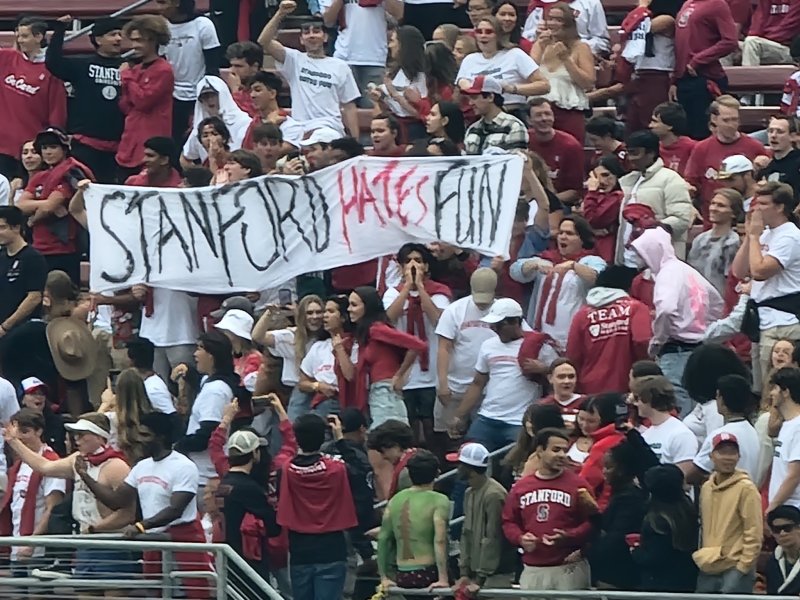 |
| Source: Stanford Daily |
Stanford hates fun is the title of the second Stanford article in the Wall Street Journal this week. (On the first, Stanford's guide to acceptable words, enough said already.)
This has been bubbling up for a while. Last June, Ginevra Davis wrote a powerful article in Palladium, "Stanford's war on social life." She recounted how the slightly transgressive Stanford atmosphere in the 90s, which seeded the slightly transgressive get it done attitude of tech in the early 2000s, is being smothered by the Administration. For example, back in the early 90s,
...The brothers were winding down from Kappa Alpha’s annual Cabo-themed party on the house lawn.... a day-to-night extravaganza that would start sometime in the morning and continue long after midnight. The girls wore bikini tops and plastic flower leis, and the boys wore their best Hawaiian shirts.
Uh-oh, I can already smell trouble if you tried that today. But the point,
That year, the brothers had filled the entire main level of Kappa Alpha’s house with a layer of sand six inches deep. The night was almost over; the guests were leaving and the local surf rock band had been paid their customary hundred dollars in beer. The only question was what to do with all the sand.
No one remembers who had the idea to build the island. A group of five or six brothers managed the project. One rented a bulldozer...
Later that year, the brothers installed a zipline from the roof of their house to the center of the island. They also built a barge, which they would paddle around the lake on weekends and between classes.
More generally
Through the late 1990s, Stanford ... featured a wacky campus culture that combined collegiate prep with West Coast laissez-faire. Stanford was home to a rich patchwork of wild and experimental campus life. Communal living houses (“co-ops”) encouraged casual nudity, while fraternities threw a raucous annual “Greek Week” and lit their houses on fire. Until 2013, Stanford hosted a fully student-run anarchist house, where residents covered the walls with eccentric murals.
Today,
The Kappa Alpha boys have been kicked out of their old house. Lake Lagunita was closed to student activities in 2001,...
...In less than a decade, Stanford’s administration eviscerated a hundred years of undergraduate culture and social groups. They ended decades-old traditions. They drove student groups out of their houses. They scraped names off buildings. They went after long-established hubs of student life, like fraternities and cultural theme houses...
Thursday, December 15, 2022
CDC, more on politicized agencies
Continuing a series on rot and politicization in administrative agencies... "Sure" comments on Marginal Revolution are fascinating. My excerpts:
The reasons you cannot change the CDC have little to do with remote work. The major issues are:
2. It is overrun with academics....Many look at the CDC as complementary to an academic career and even the lifers have CVs at least compatible with going academic. This means a lot of the work product and setup is geared more toward publication, conference presentation, and deliberative work rather than rapid response.
A similar culture pervades the Fed. Fed researchers primarily regard the Fed as a home to write publications that will advance an academic career, with "policy work" culturally degraded. Both Board and regional Feds have developed into quite good centers for academic economic research, which seems overall a good thing, but one wonders just why the central bank should funnel what is in the end taxpayer money to this endeavor. However it also means that when inflation surges to 8%, nobody saw it coming, and we wonder why.
3. The place has gone monocultural. ...Since 2015, their political donations have been 99.94% to Democrats. This means that they get bogged down in the latest vanguard concerns of the Democratic base and that they are increasingly ignorant about and isolated from the bulk of the populace. Things that make some sense in dense urban corridors where few people get dirty at work make little sense in sparsely populated areas with significant morbidity burdens from work.
Wednesday, November 2, 2022
Academic Freedom Letter
Some colleagues and I created an open letter on Academic Freedom. If you share our views, you are invited to sign.
The bottom line: we call for universities and professional associations to adopt and implement the Chicago Principles of free speech, the Kalven Report requirement for institutional neutrality on political and social matters, and the Shils report making academic contribution the sole basis for hiring and promotion.
We include professional societies. That means you, American Economic Association and American Finance Association: With all your committees on improving the profession, you need one big one to defend the most important and imperiled part of the scholarly enterprise, academic freedom.
The letter, below, is not as comprehensive and detailed as you might like, but we worked to keep it short.
The official letter and list of signatories lives here. If you would like to sign, you can do so by filling out this form. It's moderated so may take a day or two for your signature to show.
We are up to 626 signatures (11/3). When the number stabilizes we'll try to make a public fuss about the letter.
Update: A special plea. I have several responses from left/liberal/democrat colleagues who say they would sign, but don't want to have their names on a letter that doesn't have enough other left/liberal/democrat names on it and does have well known deplorables. (How you know 626 people's politics is beyond me, but ok.) That reaction tells us a big part of the problem. All along we have tried very hard to reach out to self-described left/liberal/democrat colleagues, who privately bemoan what's going on but are too afraid to be seen in public. But why not fix it: if some of you sign perhaps that will give courage for more of you to sign. Take it over, get together with your friends, add lots of signatures, make this your cause, prove that we can stand together for freedom!
Restoring Academic Freedom
The mission of the university is the pursuit of truth and the advancement and dissemination of knowledge. A robust culture of free speech and academic freedom is essential to that mission: Intellectual progress often threatens the status quo and is resisted. Bad ideas are only weeded out by unfettered critical analysis.
Unfortunately, academic freedom and freedom of speech are rapidly declining in academic institutions, including universities, professional societies, journals, and funding agencies. Researchers whose findings challenge dominant narratives find it increasingly hard to get published, funded, hired, or promoted. They, and teachers who question current orthodoxies, are harassed in person and online, ostracized, subjected to opaque university disciplinary procedures, fired, or canceled by other means. Employment, promotion, and funding are increasingly subject to implicit or explicit political litmus tests, including approval from bureaucrats seeking to impose a social agenda such as specific views of social justice or DEI principles. Activism is replacing inquiry and debate. An increasing number of simple facts and ideas cannot even be mentioned without risk of retribution.
Sunday, July 10, 2022
Woke week
Two readings from last week, in the self-destruction of American academia and other institutions.
***********
The Nature of the Beast
Bari Weiss writes another powerful essay, from a talk given at the new University of Austin. Really, you should read the whole thing, but here is one particularly delicious excerpt:
The ideology that is trying to unseat liberalism in America begins by stipulating that the forces of justice and progress are in a war against backwardness and tyranny. And in a war, the normal rules of the game must be suspended. Indeed, this ideology would argue that those rules are not just obstacles to justice, but tools of oppression. They are the master’s tools. And the master’s tools cannot dismantle the master’s house.
So the tools themselves are not just replaced but repudiated.
By ``liberalism'' Bari means the philosophy of freedom, spanning classical liberalism to the traditional American left. She does not say, but could go on, that this is a fundamentally anti-democratic authoritarian movement. When you are in the right, and the opposition is wrong, evil, racist, and so forth, and the world faces crisis after imagined crisis, we have no time for dissenting views and procedural niceties.
Persuasion—the purpose of argument—is replaced with public shaming. Moral complexity is replaced with moral certainty. Facts are replaced with feelings. The rule of law is replaced with mob rule.
Ideas are replaced with identity. Forgiveness is replaced with punishment. Debate is replaced with disinvitation and de-platforming. Diversity is replaced with homogeneity of thought. Inclusion with exclusion. Excellence with equity.
In this ideology, disagreement is recast as trauma. So speech is violence. But violence, when carried out by the right people in pursuit of a just cause, is not violence at all—but in fact justice.
(Savor a bit Bari's delicious writing. Night is day, truth is falsehood, good is evil -- sonorous repetition is a great tool.)
In this ideology, bullying is wrong, unless you are bullying the right people, in which case it’s very, very good. In this ideology, information that does comport with The Narrative is recast as disinformation, its proponents as conspiracy theorists. In this ideology, education is not about teaching people how to think, it’s about re-educating them in what to think. In this ideology the need to feel safe trumps the need to speak truthfully.
In this ideology, if you do not tweet the right tweet or share the right slogan, your whole life can be ruined. Just ask Tiffany Riley, a Vermont school principal who was fired—fired—because she said she supports black lives but not the organization Black Lives Matter.
In this ideology, the past cannot be understood on its own terms, but must be judged through the morals and mores of the present. It is why statues of Grant, Lincoln and Washington were torn down. It is why William Peris, a UCLA lecturer and an Air Force veteran, was investigated because he read Martin Luther King’s “Letter from Birmingham Jail” out loud in class.
In this ideology, intentions don’t matter. That is why Emmanuel Cafferty, a Hispanic utility worker at San Diego Gas and Electric, was fired for making what someone said they thought was a white-supremacist hand gesture. In fact, he was fidgeting with his fingers out of his car window.
In this ideology, you are guilty for the sins of your fathers. In other words: you are not you. You are only a mere avatar of your race or your religion or your class. That is why third graders in Cupertino, California, were asked to rate themselves in terms of their power and privilege. It is why an elementary school in Washington, D.C. gave kindergarteners a “fistbook” asking them to identify racist family members.
In this system, we are all placed neatly on a spectrum of “privileged” to “oppressed.” We are ranked somewhere on this spectrum in different categories: race, gender, sexual orientation and class. Then we are given an overall score, based on the sum of these rankings. Having privilege means that your character and your ideas are tainted. This is why, one high schooler in New York tells me, students in his school are told “if you are white and male, you are second in line to speak.” This is considered a normal and necessary redistribution of power.
Victimhood, in this ideology, confers morality. “I think therefore I am” is replaced with: “I am therefore I know.” Or: “I know therefore I am right.”
This ideology says there is no such thing as neutrality, not even in the law, which is why the very notion of colorblindness—the Kingian dream of judging people not based on the color of their skin but by the content of their character—must itself be deemed racist.
In this ideology, the equality of opportunity is replaced with equality of outcome as a measure of fairness. Racism is no longer about individual discrimination. It is about systems that allow for disparate outcomes among racial groups. If everyone doesn’t finish the race at the same time, then the course must have been flawed and should be dismantled.
(Savor that sequence of topic sentences.)
Thus the efforts to do away with the SAT, or the admissions test for elite public schools like Stuyvesant and Lowell—for decades, the engines of opportunity that allowed children of poor and working-class families to advance on their merit, regardless of race. Or the argument made by The New York Times’ classical music critic to do away with blind auditions for orchestras.
(Blind auditions were put in place as an effort to remove prejudice in favor of white male performers. They have not produced the desired demographic effect.)
In fact, any feature of human existence that creates disparity of outcomes must be eradicated: The nuclear family, politeness, even rationality itself can be defined as inherently racist or evidence of white supremacy. The KIPP charter schools recently eliminated the phrase “work hard” from its famous motto “Work Hard. Be Nice.” Why? Because the idea of working hard “supports the illusion of meritocracy.”
In this revolution, skeptics are recast as heretics. Those who do not abide by every single aspect of its creed are tarnished as bigots, subjected to boycotts and their work to political litmus tests. The enlightenment, as the critic Edward Rothstein has put it, has been replaced by the exorcism.
What we call “cancel culture” is really the justice system of this revolution. And the goal of the cancellations is not merely to punish the person being canceled. The goal is to send a message to everyone else: Step out of line and you are next.
It has worked.
A recent CATO study found that 62 percent of Americans are afraid to voice their true views. Nearly a quarter of American academics endorse ousting a colleague for having a wrong opinion about hot-button issues such as immigration. And nearly 70 percent of students favor reporting professors if the professor says something that students find offensive, according to a Challey Institute for Global Innovation survey. Think about that. A majority of students in America think it is a virtue to inform on their wrong-thinking professors.
Bari goes on to tell her young audience, take your country back, found institutions again.
*********
DEI at UC
I saw this week an article on how the University of California's DEI bureaucracy is destroying the institution, by Steven Brint and Komi T. German, professors at UC. (I hate to use the Orwellian term DEI -- it is really Conformity, Preference and Exclusion. But we'll suffer through.) It's a year old, but still vibrant.
The use of mandatory DEI statements as initial screening mechanisms in faculty hiring is the most dramatic of the new administrative policies...
...By 2019, eight of the ten UC campuses mandated that ladder rank faculty recruitments require candidates to submit diversity statements. These statements ask candidates to discuss what they have contributed to the University’s goals of diversity, equity, and inclusion. The rubric used by the UCs to evaluate diversity statements...delineates criteria for scores ranging from 1 (“poor”) to 5 (“excellent”). An applicant who “doesn’t discuss gender or race/ethnicity” should receive a “poor” score, as should an applicant who sees DEI as “antithetical to academic freedom or the university’s research mission.” By contrast, an applicant who discusses DEI as “core values that every faculty member should actively contribute to advancing” should receive an “excellent” score.
It is the naïve candidate who simply discusses his or her efforts to encourage and recruit students or faculty members of color. These efforts are considered minimal. As UC Merced sociologist Tanya Golash-Boza counseled applicants in the pages of Inside Higher Ed, do not worry about coming across as “too political,” because such fears might lead them to write a “blasé statement.” Instead, she recommends that they demonstrate their “awareness of how systemic inequalities affect students’ ability to excel” and their commitment to “activism.” She encourages applicants to “tell your story”—that is, to point out the obstacles they have faced, or, alternatively, to “acknowledge your privilege.” She also recommends that applicants focus on “racial oppression, sexism, homophobia, transphobia, ableism, or some other commonly recognized form of oppression.” When it comes to teaching, she encourages applicants to express their commitment to “antiracist pedagogy” (Golash-Boza 2016).
My emphasis. I'm all for a diverse faculty and student body, on dimensions including but also beyond skin color and sexual identity and preferences. But the point here is forced political speech and activity, most of all to supporting the DEI office!
But here comes the good part:
In 2018, the University began to experiment with the use of diversity statements as the initial screening device in faculty searches, .... In a presentation prepared by the UC Davis vice provost for academic affairs search committee members were instructed to review a candidate’s “Contributions to Diversity” statement before any other part of an application, and that candidates who do not “look outstanding with regard to their contributions to diversity” would not advance for further consideration in the hiring process. Reiterating this message, the vice chancellor explained at a conference that “in these searches, it is the candidate’s diversity statement that is considered first; only those who submit persuasive and inspiring statements can advance for complete consideration.” ...(Ortner, 2020).
Jaw drops.
UC Berkeley has published information about the effects of the policy mandating the use of diversity statements as an initial screening device. In one faculty search, less than one quarter of otherwise qualified candidates had submitted diversity statements that were sufficient for advancement to the next hiring stage.
The constraint binds. This is not a form to fill out with boilerplate.
The files for these 214 candidates were then sent to the appropriate departmental search committees to create a short list for interviews (these are typically 3-6 candidates per job).
Note here it is clear -- the departmental search committee does not even get to see the file until the DEI bureaucracy blesses it!
During their job talks and interviews, candidates were asked to explain their ideas about diversity, and their responses determined whether they were eligible to be hired in this late stage. Thus, at every stage of the hiring process, candidates were eliminated because they were perceived as being insufficiently committed to DEI, regardless of their academic qualifications
During their job talks. Enough about dark matter in the early universe, now, we really want to know how many protests you've been to in the last two years...
To my mind the screening for active political participation is the most galling. It is, of course, a way to avoid federal and state anti-discrimination laws:
The race and gender characteristics of the applicant pool in the UC Berkeley search changed substantially after candidates were evaluated on the basis of their diversity statements. The representation of women increased from 42 percent of applicants to 64 percent of the finalists, whereas the representation of men decreased from 57 percent of applicants to 36 percent of the finalists. The representation of African Americans increased from 3 percent of applicants to 9 percent of the finalists; and the representation of Hispanics increased from 13 percent of applicants to 59 percent of the finalists. By contrast, the representation of Asian Americans dropped from 26 percent of applicants to 18 percent of the finalists, and the representation of whites decreased from 54 percent of applicants to 14 percent of the finalists.
After the Supreme Court tosses out Harvard's anti-asian admissions policies, it will be how interesting to see what happens here. But, back to the point, political conformity is the most important message. (I'd be interested to see how many Black conservatives survived the process!)
The policy of winnowing applicant pools based on diversity statements poses an obvious threat to the climate for academic freedom because of the implicit and explicit expectation that faculty must express a specific view regarding DEI. It is highly plausible that candidates will be (and arguably already have been) discriminated against not only because they do not subscribe to a particular set of political beliefs (as indicated by the UC scoring rubric criteria for “excellent” versus “poor” scores)...
The piece goes on to describe the history of this process, mainly from a desire to increase the number of women and minorities in the faculty.
Most relevant to academic freedom, the essay goes on to describe the thought police: A secretive bureaucracy that processes all complaints of "behavior that is inconsistent with our Principles of Community." Secretive, because "The number and disposition of incidents filed based on the reports is unknown because UC has failed to disclose incidents or how they have been handled." Then "mandatory training and the appointment of a vice chancellor for diversity, equity and inclusion with a budget of $3 million. UC DEI initiatives accelerated following these events."
In the summer of 2019, the University added equity advisors to every program on eight of its campuses. The equity advisor is “a senior ladder faculty member who participates in the faculty recruitment process by raising awareness of best practices…. Their role is to help advance diversity and to ensure that a climate of inclusion and equity is maintained throughout the search process” (UCOP 2019). Some Equity Advisor programs have expanded their purview to include other areas, such as faculty advancement and retention, salary equity decisions, formal and informal mentoring of faculty, advancing diversity in graduate admissions, and department climate. They “organize faculty development programs, address individual issues raised by women and underrepresented minority faculty, ... equity advisors are empowered to mediate...People can report, among other things, “expressions of bias,” “hate speech,” “bias incidents,” and a “hostile climate.”
Noting the conflict between free speech and such efforts, the authors note wryly
it is perhaps indicative of the University’s stance that no academic freedom advisors are on the payroll.
The essay echoes familiar (to us) stories,
Academic freedom was sacrificed for the representational mission when an accounting professor at UCLA was placed on academic leave for denying students’ demands for a “no-harm” final exam following the death of George Floyd (Flaherty, 2020). It was violated when a political science professor at UCLA was subjected to a review by the University’s Discrimination Prevention Office for presenting Martin Luther King Jr.’s “Letter from a Birmingham Jail” and clips from a documentary on racism, both of which included the “N-word” (Korn, 2020). It was compromised when UC Berkeley faculty and students were advised not to use the phrase “America is a melting pot” or a “land of opportunity” (Volokh 2015). And the climate for academic freedom became chillier when a professor of history at Berkeley wrote an open letter to colleagues expressing concern about the “racial injustice” and “institutional racism” narratives of the anti-racism movement and the Berkeley’s history department responded by issuing a statement that it “condemn[s] this letter: it goes against our values as a department and our commitment to equity and inclusion” (Grimes, 2020).
Yet the main rot is silent:
Unlike these examples, most of the changes in the day-to-day affairs of the University have not reached the media; they have been incremental, including administrative appointments vetted for adherence to the University’s DEI values; the labeling of DEI statements in department meetings as “helpful” and academic freedom statements as “defensive”; and the institution of “voluntary” listening and diversity training sessions in which the loyalty of those absent becomes questionable in the eyes of attendees. These incremental changes eventually lead to qualitative shifts.
The essay goes on to discuss Critical Theory vs. rationalism, and useful thoughts on why things have headed this way, along with what seems to be a long "we really aren't racists apoloigia." Worth a read.
******
You're probably tired, as am I, but next read Joseph Manson's Why I'm Leaving the University, on just how UCLA is falling to pieces.
Thursday, December 16, 2021
Do we live in China?
Google/Youtube's "misinformation" policy.
You may not "contradict... local health authorities' (LHA) or the World Health Organization." But read the note, they might change their mind, so watch truth/misinformation change in real time.
Really? Scientific discussion never contradicts the edicts of "authorities?" Political discussion never does so?

Tuesday, November 16, 2021
Academic Freedom at Stanford -- commentary
This is a follow up to a post on the Stanford faculty petition on free speech. I place my comments here, in a separate post. I want to be super-clear that the signatories signed the letter of the last post, and endorse nothing else.
What does it say? Free speech, free inquiry, academic freedom. Period. Not free speech so long as nobody feels hurt. Not free speech so long as you don't disagree with or are viewed as not fully supporting Stanford's policy on Diversity, Equity, and Inclusion. Not free speech except if you disagree with Stanford's or the County of Santa Clara's covid policies, or Stanford's "sustainability" principles. Not free speech, but limited to your domain of academic expertise, determined by some bureaucratic process. There are other faculty groups and committees working on all these "free-speech but" policies. This group endorsed free speech, period.
Tuesday, November 2, 2021
Woke week
The institutions of civil society are now thoroughly politicized. "Wokeness" is their ideology and religion, and mastering an ever-changing arcane vocabulary is now the key to access to the elite, as well as making sure you're not the next one sent to the proverbial Gulag.
I can't keep up with everything in this vein. Still, I've been silent long enough, so I think it's worth passing along interesting tidbits as they come.
A few items on this theme came across the transom last week, that seem fun to share. The American Medical Association issued an official 54 page document instructing all doctors on proper language. (Twitter source with more commentary.)
Mind you, as in other cases, this isn't just opinion -- I'm a radical free speech advocate, say and write what you want. It's the official opinion of a scientific professional society, formerly a-political.
It starts:

Friday, September 10, 2021
Sowell on grand movements
A correspondent sends me this gem from Tom Sowell:

This was written in 1995. So no, he was not talking about any of the great causes that inundate us today. He was writing about causes in the 20th century going back to eugenics. But it seems both prescient and timeless.
Source The Vision of the Anointed, link takes you to Google books where you can read a lot of it.
Tuesday, August 10, 2021
Adumbrations of FDA
Scott Alexander's Adumbrations Of Aducanumab is a great review of FDA snafus -- with deeper lessons about regulation in general. Yes the outcome is dumb, but incentives are to blame. That's important to understand if we are ever to fix this mess.
Scott has some great ideas for fixing the FDA's incentives. The one I like best is to reduce its power. FDA approval currently means that insurance companies and the government must pay for drugs. Break that link. The FDA now either decides safe&effective vs. not-yet-proven, and makes taking any not-yet-proven drug illegal. Reduce the FDA to simply providing information about what's known about drugs. Finally, give the FDA budgetary rewards for approving drugs. Bemoaning regulatory idiocy is fun but gets us nowhere. Anything persistently busted is not the result of stupidity, it is the result of bad incentives.
FDA, CDC and Covid
The story of the FDA in covid is a good place to start. It's well known by now, but we are now in the era of forgetting, and it is to nobody's interest to keep this memory alive.
The countries that got through COVID the best (eg South Korea and Taiwan) controlled it through test-and-trace. This allowed them to scrape by with minimal lockdown and almost no deaths. But it only worked because they started testing and tracing really quickly - almost the moment they learned that the coronavirus existed. Could the US have done equally well?
I think yes. A bunch of laboratories, universities, and health care groups came up with COVID tests before the virus was even in the US, and were 100% ready to deploy them.
As with vaccines, which took a weekend to create, the state of medical science is such that really there is no reason to have pandemics any more. Public policy? Well, that's stuck in the 1700s.
But when the US declared that the coronavirus was a “public health emergency”, the FDA announced that the emergency was so grave that they were banning all coronavirus testing, so that nobody could take advantage of the emergency to peddle shoddy tests. Perhaps you might feel like this is exactly the opposite of what you should do during an emergency? This is a sure sign that you will never work for the FDA.
Monday, April 12, 2021
Conversations: covid and (separately) nonprofits
I did a few fun video conversations last week.
This is a conversation with Ryan Bourne, Megan McArdle, and Alex Tabarrok on economics and the year of covid. Direct link if the above embed doesn't work.


Then I had a nice conversation with Mike Hartmann at The Giving Review, link here with transcript, (slightly edited, please refer to that if you want to quote me. The above is just a screenshot, you have to go to the link).
We explored my view that the US should eliminate the whole non-profit business, most of all the tax deductibility of contributions to non-profits, but also (less importantly) the non-profit corporate form. While many non-profits do a lot of good (my employer!) the system has become obscenely perverted, mostly as a tax-supported vehicle for political action, but also a tax dodge available only to the super duper wealthy, and a means of protection from the market for corporate control for flabby institutions. I trust that genuine useful charities will still attract donations -- maybe more -- from the substitution effect than they lose without tax deductions.
I've long been meaning to gather facts and figures to see if this salty opinion makes as much sense as I think it does, and I'm glad to learn about Philanthropy Daily, a resource that will be helpful.
Oh yes also a great GoodFellows with Bjorn Lomborg on climate. I love talking to Bjorn. He has an extensive command of the facts and science, and he's still an optimist that facts and science will actually make a dent in this debate. As global warming moved to climate change to climate crisis to climate justice to climate risks (financial) I'm less optimistic, but hope must be let out of Pandora's box. Also
with Bari Weiss on media, censorship, free speech and assorted issues. Direct links, podcast versions, and more all here.
Wednesday, March 10, 2021
Woke wars good and bad news

Bari Weiss has a tremendous essay by on the state of affairs in elite secondary schools, but including the first inklings of secret resistance. Coverage below.
The New York Times allows Brett Stephens to be critical of California's Ethnic Studies Follies. A short excerpt below. Others have slammed the curriculum more effectively, but the source makes this notable.
A group of courageous University of Chicago students sets up "The Chicago Thinker" a well-produced news website devoted to "defend conservative and libertarian perspectives in a community that is increasingly intolerant of such voices."
The Academic Freedom Alliance is launched, not just to talk and expose censorship but also to offer concrete and even legal help to those targeted. Spend some time browsing the website. We need not just voices, but institutions of civil society to defend free speech and thought, and this is a great initiative. It adds to the Foundation for Individual Rights in Education (FIRE) and the Heterodox Academy
*****
Bari Weiss (I have reordered many paragraphs by my topics) What's it like at fancy schools these days?
A Harvard-Westlake English teacher welcomes students back after summer with: “I am a queer white womxn of European descent. I use [ she | her ] pronouns but also feel comfortable using [ they | them ] pronouns.” She attached a “self-care letter” quoting Audre Lorde: “Caring for myself is not self-indulgence, it is self-preservation, and that is an act of political warfare.”
“We don’t call them Newton’s laws anymore,” an upperclassman at the school informs me. “We call them the three fundamental laws of physics. They say we need to ‘decenter whiteness,’ and we need to acknowledge that there’s more than just Newton in physics.”
Tuesday, March 9, 2021
Hope at the NYT: Douthat on cancel culture
Ross Douthat in the New York Times doubts that canceling Dr. Seuss is a good idea. That this essay made it in to the Times, of all places, and as of 9 AM Monday he has not yet been fired may give us some hope.
The most daring and revealing bit:
Just a few weeks ago the Amazonian giant decided to simply delete, without real explanation, a 2018 book by Ryan Anderson, a Catholic scholar and the head of the Ethics and Public Policy Center, called “When Harry Became Sally: Responding to the Transgender Moment.”
...I live and work among highly educated liberals, and I know that more than a few of them actually agree with the critiques of current transgender theory Anderson presents. They’re skeptical about the widespread use of puberty blockers for gender dysphoria. They’re wary about the implications for women’s spaces, women’s sports. They don’t share Anderson’s Catholic presuppositions, but they are, at least, J.K. Rowling liberals.
In the last stages of the same-sex marriage debate, I never encountered a flicker of private doubt from liberal friends. But in the gender-identity debate, there are pervasive liberal doubts about the current activist position. Yet without liberal objection, that position appears to set rules for what Amazon will sell.
That this admission could be printed in the New York Times strikes me as good news for free speech.
Let me be clear, as this is an explosive topic and I don't want my intent misconstrued. The question is not to judge anything about the gender-identity debate. People I care deeply about lie on a trans spectrum, and I have learned a lot about their point of view. The question is whether public policy and medical or psychological fact on the issue can be discussed. Can evidence be sought, studies done, research discussed, books written and sold, and policy debated, actual science be performed? Can good progressives who work for the New York Times discuss these issues? Or is the current "activist position" on policy and medical issues undebatable? Nor is the issue, yet, legality of expression. Legality in a democracy only formalizes elite opinion. Amazon and Twitter censor first, law follows. Activists burn books first, law follows.
Friday, March 5, 2021
GoodFellows interview with Ayaan Hrsi Ali
I learned a lot. The book is very interesting. Direct link in case the following embeds don't work.
Thursday, February 18, 2021
Lipson on basic decency
Why are people gloating over Rush Limbaugh’s death? Charles Lipson writes
The gloating over Rush Limbaugh’s death ought to shock the conscience. That’s not a political statement. That’s a cri de coeur about how our basic sense of human decency has been warped by political differences.
To take one example, a Yale Law professor tweeted he wasn’t just happy Limbaugh had died, he was euphoric.

He’s not some drunk being carried out of a rowdy bar. He’s the Charles F. Southmayd Professor of Law and Philosophy at Yale Law School and the Director of Yale’s Center for Law and Philosophy. ...
The New York Times chose to write about Limbaugh's "Legacy of Venom:", "Weaponizing conspiracy theories and bigotry." Could they not wait for his body to be cold? Or show less respect for the tens of millions of apparently deplorable fellow citizens who listened to him?
This is not one more complaint about the woke left. This is a problem on both sides.
Rush’s friends on the right are happy to claim the moral high ground when the left is degrading itself like this. But they only hold it for a moment. They act the same way when the opportunity arises. Do you think they would behave any better if a Nancy Pelosi was hit by a bus? Many would think it was the perfect time to share with the world how much they hated the Speaker, how glad they were to see her gone.
Quite a few expressed that view when invading the Capitol a month or so ago.
Lipson's main point, and mine:
The point here is not only that this behavior is despicable, though it is. The point is that so many people think their views are righteous and worth sharing with the world. That smugness and moral self-righteousness are signs of our political divisions and the moral decay they generate.
...
When prominent people celebrate Rush Limbaugh’s death they are, inadvertently, telling us something about the decay of our civic culture. They are showing that we are now behaving as if we are at war, a cultural and political civil war. In the process, we are losing our sense of respect for each other at a very basic level.
No one has the moral high ground here. Far too many take every fleeting opportunity to cry, ‘Vengeance is mine.’ That cry springs from battles that both sides now consider life-or-death. That is not how political differences should be contested in a constitutional democracy. That is not how people in tolerant, liberal societies treat each other. For those who say, ‘We are better than that,’ it’s time to show it.
Both sides of our partisan politics are acting as if this is a life or death battle, the point being to wipe the other side off the face if not of the earth, of our political life. As I have opined, if it is so, we need to change the winner take all rules of our game.
My mother advised, if you don't have anything nice to say, don't say anything. George Shultz, who we have been remembering this week at Hoover, would not have behaved this way, even on the death of a deep ideological opponent. "Show respect" was one of his watchwords. He did, even to the Soviets.
Let's try to keep comments polite on this one.
Sunday, November 22, 2020
Stanford Condemns Atlas
On Friday Nov. 20, as reported in the official Stanford News, the Stanford Faculty Senate formally condemned Scott Atlas, Hoover Senior Fellow and a special adviser to the reviled President Trump. The full resolution is posted here (but only available with a Stanford id).
"Rise up"
The resolution lists a single documented fact.
in a post to his Twitter account, Atlas called on the people of Michigan to ‘rise up’ against their Governor in response to new public health measures...
They acknowledge his later correction
Although he subsequently claimed that his call to rise up had been misunderstood, we believe that this latest communication is a dangerous provocation
The President of the University himself piled on,
President Marc Tessier-Lavigne said he was “deeply troubled by the views by Dr. Atlas, including his call to ‘rise up’ in Michigan.” Tessier-Lavigne noted that Atlas later clarified his statements, but he said that the tweet “was widely interpreted as an undermining of local health authorities, and even a call to violence.”
Now, indeed this was a dumb tweet, and I do not defend it. My view of scientific advisers is that they should advise and serve the President and shut up. Most presidents want them to do that, and not become an independent part of political messaging. But this administration is, er, different, and President Trump has not objected to Scott's tweeting habits. None of us know even if tweeting is expected or not in Scott's job.
I do not here defend any of Scott's opinions, merely his freedom to state them, advise the President as he sees fit, and not be the first person formally condemned by the university for that speech.
But let us be clear: It may have been dumb, but Atlas did not call for violence. Period. You can call it "interpreted," you can call it "dog whistle," you can put all the words into Scott's mouth you want, but those words are not there. Condemnation for speech is bad enough, condemnation because someone might misinterpret speech is unimaginable.
You can also interpret it as I did, a call for people whose livelihoods and health are being imperiled by nitwit proclamations to exercise their rights and duties as citizens of this great country to, well, rise up, to protest to their elected officials, to complain in regular and social media, peaceably to assemble (with masks) and to petition the Government for a redress of grievances.
So, is a tweet calling for the people of Michigan to 'rise up' against a set of widely panned, economically devastating, ineffectual public health measures, at least in Scott's view (more later), an act meriting this unprecedented and unique condemnation?
Subscribe to:
Posts (Atom)