Showing posts with label Taxes. Show all posts

Wednesday, December 6, 2023

The Income Tax Paradox

The Supreme Court is hearing a case with profound implications for the income tax. WSJ editorial here and good commentary from Ilya Shapiro here. 

This issue is naturally contorted into legalisms:  What the heck does "apportioned" mean? How is "income"  defined legally? I won't wade into that. What are the economic issues? What's the right thing to do here, leaving aside legalisms?

Wednesday, July 19, 2023

Electric vehicles, carbon taxes, supply and demand, virtue signals, and China

If you have not been paying attention, our government has decided that all electric vehicles are the solution to the climate problem. At least as long as they are made in the US with union labor and benefits. California has committed to banning the sale of anything else. In today's post, a few tidbits from my daily WSJ reading on the subject. 

From Holman Jenkins on electric cars:  

If the goal were to reduce emissions, the world would impose a carbon tax. Then what kind of EVs would we get? Not Teslas but hybrids like Toyota’s Prius. “A wheelbarrow full of rare earths and lithium can power either one [battery-powered car] or over 90 hybrids, but, uh, that fact seems to be lost on policymakers,” a California dealer recently emailed me.

[Note: that wheelbarrow of rare earths comes from multiple truckloads of actual rocks. Also see original for links.] 

...The same battery minerals in one Tesla can theoretically supply 37 times as much emissions reduction when distributed over a fleet of Priuses.

Thursday, May 25, 2023

Work requirements

The debate over work requirements for social programs is hot and heavy. I'll chime in there as I don't think even the Wall Street Journal Editorial pages have stated the issue clearly from an economic point of view.  As usual, it's getting obfuscated in a moral cloud by both sides: How could you be so heartless as to force unfortunate people to work, vs. how immoral it is to subsidize indolence, and value of the "culture" of self-sufficiency. 

Economics, as usual, offers a straightforward value-free way to think about the issue: Incentives. When you put all our social programs together, low income Americans face roughly 100% marginal tax rates. Earn an extra dollar, lose a dollar of benefits. It's not that simple, of course, with multiple cliffs of infinite tax rates (earn an extra cent, lose a program entirely), and depends on how many and which programs people sign up for. But the order of magnitude is right. 

The incentive effect is clear: don't work (legally). As Phil Gramm and Mike Solon report, 

Since 1967, average inflation-adjusted transfer payments to low-income households—the bottom 20%—have grown from $9,677 to $45,389. During that same period, the percentage of prime working-age adults in the bottom 20% of income earners who actually worked collapsed from 68% to 36%.

36%. The latter number is my main point, we'll get to cost later. Similarly, the WSJ points to  a report by Jonathan Bain and Jonathan Ingram at the Foundation for Government Accountability that

there are four million able-bodied adults without dependents on food stamps, and three in four don’t work at all. Less than 3% work full-time.

3%. 

Incentives are a budget constraint to government policy, hard and immutable. Your feelings about people one way or another do not move the incentives at all. A gift of money with an income phase-out leads people to work less, and to require more gifts of money.  That's just a fact. 

What to do? 

Thursday, March 2, 2023

Fair tax full text

From the Wall Street Journal Feb 2. After 30 days I can post full text. 

A Consumption Tax Is the Shock Our Broken System Needs

Something remarkable happened last month. On Jan. 9, Georgia Rep. Buddy Carter introduced the “Fair Tax” bill to the House of Representatives, and secured a promise of a floor vote. The bill eliminates the personal and corporate income tax, estate and gift tax, payroll (Social Security and Medicare) tax and the Internal Revenue Service. It replaces them with a single national sales tax. Business investment is exempt, so it is effectively a consumption tax. Each household would get a check each month, so that purchases up to the poverty line are effectively not taxed.

Lessons from Sargent and Leeper

At the AEI fiscal theory event last Tuesday Tom Sargent and Eric Leeper made some key points about the current situation, with reference to lessons of history. 

Tom's comments updated his excellent paper with George Hall "Three World Wars" (at pnas,  summary essay in the Hoover Conference volume). Tom and George liken covid to a war: a large emergency requiring immense expenditure. We can quibble about "require" but not the expenditure. 


(2008 was a little war in this sense as well.) Since outlays are well ahead of receipts, these huge temporary expenditures are financed by issuing debt and printing money, as optimal tax theory says they should be. 

In all three cases, you see a ratcheting up of outlays after the war. That's happening now, and in 2008, just as in WWI and WWII. 

After WWI and WWII, there is a period of primary surpluses -- tax receipts greater than spending -- which helps to pay back the debt. This time is notable for the absence of that effect. 


We see that most clearly by plotting the primary deficits directly. The data update since Tom and George's original paper (dots) makes that clear. To a fiscal theorist, this is a worrisome difference. We are not following historical tradition of regular, full employment, peacetime surpluses. 


The two world wars were also financed by a considerable inflation. The important consequence of inflation is that it inflates away government debt. Essentially, we pay for part of the war by a default on debt, engineered via inflation. 

Saturday, February 18, 2023

Trust Fund

The Social Security Trust fund is set to run out in a few years. Who cares? Is the total US Federal debt $31,456,554,630,496.28, including Treasury debt held by the Social Security trust fund and other agencies?  or is it "only" $24,629,050,125,670.81 held by the public? (Source.)

I've been mulling these questions over, prodded by conversations with some colleagues. 

The "trust fund" exists because for a while, Social Security taxes were larger than Social Security payments. Social Security used the extras to buy Treasury debt. Now there are fewer workers, more retirees and more generous benefits, so Social Security taxes are smaller than payments. Social Security sells off its "trust fund." And it seems we're in trouble when the "trust fund" runs out.  

But that's not how it works at all. Treasury debt is not an asset like a stock or bond, or Uncle Scrooge's pool of gold coins. Treasury debt is a claim against future income taxes. Cashing in Treasury debt just  means paying for benefits with income taxes. 

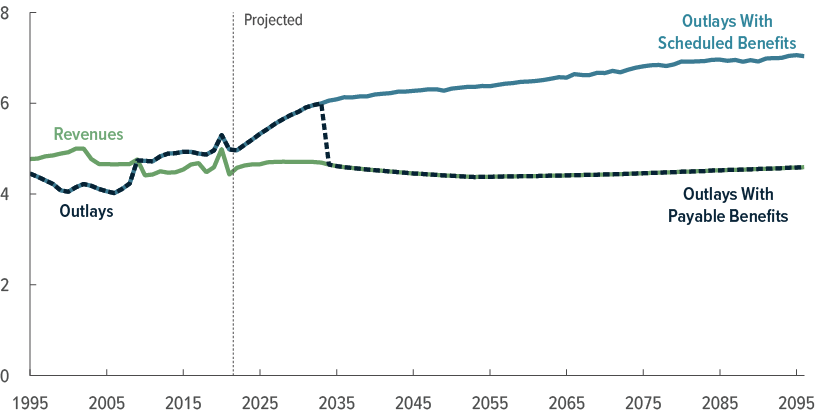
The ups and downs of the trust fund just reflect a change in how we finance spending. While payroll taxes > social security spending, which was the case until 2007, then payroll taxes are financing other spending. When payroll taxes < social security spending, then income taxes or increases in debt are financing social security spending, which (graph below) was the case after 2008.* The trust fund just adds up this change over time. But exhausting the trust fund is, in this view, really irrelevant. 

source: CBO

That doesn't mean we can all go to sleep, for two reasons. First, when payroll taxes < Social Security outlays, and the trust fund is winding down, then income taxes or additional public debt must finance the shortfall. The government has to spend less on other things, raise income tax receipts, or borrow which means raising future taxes. And, per the graph, the numbers are not small. 1% of GDP is $230 billion. The extra strain on income taxes, other spending, or debt, happens right now, when the trust fund is positive but decreasing. 

Zero matters only because by law,  when the trust fund goes to zero, Social Security payments must be automatically cut to match Social Security taxes. That's the sudden drop in the graph. The program was set up as if  the trust fund were buying stocks and bonds, real assets, and would not lay claim on income tax revenues. But it was not; social security taxes were used to cover other spending, and now income taxes must start to pay social security benefits. 

What happens when the trust fund runs out, then?  Congress has a choice: automatically cut benefits, as shown, or change the law so that the government can pay Social Security benefits from income taxes, or, more realistically, by issuing ever more debt, until the bond vigilantes come. (Or raise payroll taxes, or reform the whole mess.) I bet on change the law. 

So what's the right measure of debt? It's conventional to look only at debt in public hands. But there is a case to look at the total debt, i.e. including the trust funds. Those are the total claims against the income  tax. Looking at it this way, however, one could also go on and count unfunded future social security benefits as a debt -- the present value of the difference between the two lines above, which leads to immense numbers, per Larry Kotlikoff. 

I have usually not considered the present value of unfunded promises as "debt," because Congress can change the payments at any time. Changing debt repayment to the public is a default, with financial and legal consequences; changing social security benefits is legislation. You can't sell your future social security benefits as you can sell your treasury debt. The trust fund is half way on this scale. What would be the consequence of a haircut or rescheduling of trust fund debt? Would that trigger something like cross-default clauses in corporate debt? I don't know. The event is unlikely anyway. The left pocket defaulting on the right pocket doesn't help pay the bills. The trust fund is certainly unlikely to run, and its debt is not used as collateral in financial transactions. As a somewhat meaningless accounting identity, it's a lot less "debt" than the debt in public hands. 

I think this all goes to remind us that paying off the existing debt is not the US central fiscal problem. The central problem is vast unfunded future promises. Defaulting or inflating away current debt does nothing to fund those promises. 

I look forward to comments on this one, especialy if there are standard views on these apparently simple questions that I'm not aware of. 

*In the end,  

payroll taxes + income & other taxes + increase in public debt = Social Security spending + other spending. 

The trust fund nets out. 


Sunday, February 12, 2023

Fair/consumption tax adjustment

The main (vocal) comment on my consumption/fair tax post and oped  has been to complain about retirees who have earned income, paid taxes, saved, and now must pay consumption taxes on what they buy with the proceeds. 

When writing an oped, one tries to anticipate a few objections, but not to overdo it. I left this one out because it surely seemed an easy exercise for the reader. This is a problem easily solved with money. If the consumption tax is 30%, then the government can top up retirement savings by 30%. Done. 

It obviously need not be that generous. First, old savers will benefit by not having to pay capital gains tax and estate tax on their savings. That almost adds up to the consumption tax right there! So at best they need a subsidy only equal to the difference between the new consumption taxes and what they will save from the absence of all other taxes. Second, the market is likely to boom. So, subsidy only to the value of investments on the day before the tax is announced. Third, this only applies to old savers. Fans of wealth taxation should be lining up for the consumption tax as it hits high wealth accumulators most! (There is an interesting question whether the CPI will include the consumption tax or not. If so, social security is immediately indexed and rises to pay the tax, thereby greatly benefiting seniors who no longer pay income taxes on social security.) 

But more importantly, in the big government intergenerational transfer scheme, current old people who have saved money came out pretty well. They get a lot more out of social security and medicare than they put in, and a lot more than young people will ever see. Whatever the benefits of 100% debt to GDP are, they got them and their grandchildren will pay them. If one is arguing on distributive justice, leaving the poker game just after you scored a big hand, and then crying about taxes is a bit unseemly.

And I'm sure that's only the beginning. Every reform has winners and losers. Tax lawyers and accountants are going to do terribly!  I assume some muddy mess will emerge to compensate old savers and other politically organized losers.  Government and politics are about transfers. Economics is about incentives. If every change must be completely Pareto optimal, we might as well go back to subsistence farming. 

Friday, February 3, 2023

Fair tax oped

An Oped in the Wall Street Journal on the "fair tax" proposal. As usual, I have to wait 30 days to post the full version 

The bill eliminates the personal and corporate income tax, estate and gift tax, payroll (Social Security and Medicare) tax and the Internal Revenue Service. It replaces them with a single national sales tax. Business investment is exempt, so it is effectively a consumption tax.

I've been writing about consumption taxes for a while. Some previous posts on these points,  VAT (WSJ), A progressive VAT, Consumption tax, Tax reform, Taxes, Alternative Minimum Tax, also  Wealth and Taxes Convexification and complication Tax graph Economists and Taxes Corporate tax burden Tax Reform Tax reform again (WSJ) Corporate tax reading list Corporate tax (zero) Trump taxes 2 Those address a lot of the what ifs and whatabouts. 

But it's not progressive! (Meaning, better off people pay the same rate, not the same amount, not "politically progressive"). 

Already the "fair tax" proposal adds 

Each household would get a check each month, so that purchases up to the poverty line are effectively not taxed.

Yes, effectively universal basic income from Republicans! One could do more. And as in the above forest of links there are plenty of ways to make a consumption tax as progressive as you'd like. 

But the most important point, with added emphasis: 

the progressivity of a whole tax and transfer system matters, not of a particular tax in isolation. If a flat consumption tax finances greater benefits to people of lesser means, the overall system could be more progressive than what we have now. A consumption tax would still finance food stamps, housing, Medicaid, and so forth. And it would be particularly efficient at raising revenue, meaning there would potentially be more to distribute—a point that has led some conservatives to object to a consumption tax.

Wednesday, January 18, 2023

Two points on the debt limit, 1 serious 1 fun

Everyone keeps repeating that hitting the debt limit would necessitate a default on principal and interest. The Treasury itself says 

Failing to increase the debt limit would have catastrophic economic consequences. It would cause the government to default on its legal obligations – an unprecedented event in American history. That would precipitate another financial crisis and threaten the jobs and savings of everyday Americans – putting the United States right back in a deep economic hole, just as the country is recovering from the recent recession.   

The first statement is correct. The second is not. The government is still hauling in tax revenues. The Treasury could easily say "given the catastrophe that a default would produce, we will always pay interest and principal on treasury debt before any other payment." Congress could pass a law stating that fact. There is no economic reason  that a debt limit should force a default. 

There is a legal argument, and a claim that the Treasury cannot prioritize debt payments over other legally mandated payments. In the research I've been able to do however, this is a very uncertain claim. And it makes no sense. The Treasury is legally obligated to make debt payments, as it is obligated to pay Social Security checks, and also legally obligated not to borrow. Law prescribes the impossible. It has to prioritize. Indeed, unpaid bills are a form of debt, so if you want  to be a stickler, the government will violate the debt limit no matter what it does. 

The second statement is false. The US has defaulted on  gold clauses in the 1930s. It has defaulted on other "legal obligations."

The third is correct, and appropriate. If we are to tussle over paying Wall Street fat cats vs. grandma's social security, keep in mind just what a catastrophe default would be. Grandma will be way worse off if that happens. Treasury debt is now the golden collateral, supporting most of the financial system. (We should have a financial system much less dependent on short term collateralized borrowing, but that's another story.) If in default it would not be. Worse, and most important here, if financial markets suspect a default will really happen, they will start refusing to accept treasury collateral in the first place. This is basically what happened in 2008 with mortgage backed securities. They didn't fall to pieces,  they just weren't acceptable as collateral any more. 

A flight from treasury collateral under a debt limit would be far worse. And the government's magic tonic, borrow a ton and bail everyone out, would be unavailable. 

Perhaps Treasury thinks that by threatening default, they can get Congress to wake up and raise the debt limit promptly. But this risks Wall Street also believing the threat and causing the panic you're trying to prevent. 

Treasury secretary Janet Yellen should say out loud, right now "we pay principal and interest on treasury debt first, before anything else." President Biden should back her up. Drastic delays in social security, medicine, government shutdown and more are plenty enough threat to get Congress to move, without risking a run. 

States with balanced budget rules are interesting legal precedent. The State of Illinois, while I was watching, simply delayed payments, often by years. It paid its bonds on time. That isn't a good outcome of course, but it represents the State's choice of how to handle the legal requirement to pay vendors and to pay interest and principal on bonds. Other states have defaulted as have cities and counties. And countries. 

*****

Now for fun. Just print money, some say. Fortunately, our legal system is full of mechanisms to prevent the government from printing money instead of borrowing it. The treasury has to issue debt; the Fed has to buy it,  and thereby give the Treasury new money to spend.  That violates the debt limit. But Treasury can create coins. So, last time, the fun suggestion of $1 trillion dollar coins came up. 

Here is a novel proposal in the same sprit. The debt limit is calculated based on face value, not market value of debt. A bond promising $100 in 10 years and $3 coupons from now to then counts as $100 of debt. So issue perpetuities. Or, more realistically, issue coupon only debt.  The government could issue a bond that pays a $3 coupon for 30 years and no principal payment. As things are now calculated, that bond adds zero to the debt! 

Like the trillion dollar coin, this proposal so clearly violates the spirit of the debt limit that I doubt serious people would do it. It does point to a serious shortcoming in how the Treasury calculates debt however. Most of the time Treasury issues debt at par, borrowing $100 and promising to repay $100 in 10 years. Then the distinction does not matter. But the formulas should be fixed. 

Disclaimer: I'm not an expert on the law of the debt limit. If these points are in error, let me know and I'll issue a "never mind." 

****

To clarify, this is just a fun way to get around the debt limit if one wants a fun way to do it. It's not obvious that getting around the debt limit is a good idea. What is the justification for running primary deficits right now? No, I'm not a balanced budget nut. In times of crisis, war, pandemic, and recession, the government should borrow, for standard tax-smoothing reasons. But then the government should repay the debt. When the economy is humming and there is no crisis on, we should be running small steady primary surpluses. That is now. One has to argue that yes, we should get there, and stop borrowing in good times,  but it's too hard to do all of a sudden. But just what are those adjustment costs? A crisis is a terrible thing to waste. Today is as good a day as any to clean up the US long term fiscal mess. It's not clear to me that Washington does anything better if it takes a long time to do it. 


Friday, January 6, 2023

Strassel insight, and cheers for a long speaker tussle

I'm a policy wonk, but I care very little about politics, who is up and who is down. The house speaker voting coverage has been largely the latter, with no more than the usual tropes about "normal Republicans" vs. "Radicals" suffused with Trump-loving election-denying fervor.  

The WSJ's Kim Strassel, whose fact-filled columns are always a delight, explains that there actually are important issues at stake here: 

Committees barely function. Members have no ability to debate or amend. Leaders disappear into back rooms to cook up mammoth bills that are dropped on the floor for last-minute take-it-or-leave it votes. Add Mrs. Pelosi’s Covid “proxy” voting rules, and most of the House didn’t even bother to clock in.

Under the proposed new rules package, committees are back in charge of legislation, with rules designed to ensure that bills address single subjects—rather than catch-all legislation. It similarly gives members new power to challenge amendments that aren’t related to the topic at hand. And it revives “Calendar Wednesday,” whereby any committee chairman can bring a bill straight to the floor.

It includes new provisions for accountability and transparency. Proxy voting is history, as are virtual committee meetings. It requires a 72-hour rule to give members time to read legislation. It ends Democrats’ wild experiment with staffer unionization, which threatened to tie the chamber up with crazy demands. 

Wednesday, December 28, 2022

Calomiris on Gramm Ekelund and Early on Income Distribution.

Charles Calomiris has a splendid WSJ review of a great book, "The Myth of American Inequality" by by Phil Gramm, Robert Ekelund and John Early.

It is a "'a truth universally acknowledged,' according to the Economist magazine in 2020" that 

little progress has been made in raising average American living standards since the 1960s; that poverty has not been substantially reduced over the period; that the median household’s standard of living has not increased in recent years and inequality is currently high and rising 

Most of all the last one. 

All of this is false. Most of all the last one. 

1) Income. The central jaw-dropping, astonishing fact: The statistics you read about income and income inequality ignore taxes and transfers. By doing so, of course, they create a problem that is immune to its purported solution! 

Tuesday, October 25, 2022

Truss Tragedy

(at Project Syndicate)

The Liz Truss Tragedy

The former British prime minister’s downfall holds important lessons for growth-minded policymakers in the United States, Europe, and elsewhere. While her diagnosis of the country’s economic problem was spot on, she fatally mismanaged both the politics and the messaging of her policy response.

STANFORD – Liz Truss’s stint as British prime minister is over, but she was right that the United Kingdom needs growth. Her downfall is tragic, because growth is the only path out of the country’s economic dilemma. 

The UK is surprisingly poor. Its GDP per capita is just $43,000, compared to $60,000 in the United States. The average British home is one-third the size of the average US home. Worse, the country’s economy is not growing. Its GDP per capita is lower than it was in 2007. Productivity – the underlying source of economic growth – has been flat for over a decade. 

The UK desperately needs supply-side reforms. Surging inflation tells us that demand-side stimulus is a spent force. 

Wednesday, September 21, 2022

Gramm, Early and the Unfixable Problem

Phil Gramm and John Early have a new WSJ oped, based on their smashing new book. Both are based on an astounding fact: The numbers used by the Census Bureau, and countless following researchers, to define income inequality and poverty do not include taxes, which reduce income of the rich, and transfers, which increase income of the poor. The latter, obviously, matters to just how many Americans fall in the Census Bureau's definition of poverty.

Specifically, in the oped, the new refundable tax credit cannot, by arithmetic, do anything to alleviate measured child poverty because 

"the income numbers used to calculate the official poverty rates don’t count refundable tax credits as income to the recipients. "

This is wonderful for advocates of ever larger transfer programs, as it creates a problem that can never be measured to be fixed! 

The more general issue 

The Census Bureau fails to count two-thirds of all government transfer payments to households in the income numbers it uses to calculate not only poverty levels but also income inequality and income growth. In addition to not counting refundable tax credits, which are paid by checks from the U.S. Treasury, the official Census Bureau measure doesn’t count food stamps, Medicaid, the Children’s Health Insurance Program, rent subsidies, energy subsidies and health-insurance subsidies under the Affordable Care Act. In total, benefits provided in more than 100 other federal, state and local transfer payments aren’t counted by the Census Bureau as income to the recipients

The book goes on to show how this startling omission overturns just about everything you've heard from the hyperventilating classes about income inequality. Granted, spending zillions on rotten health insurance that people value much less than a dollar per dollar is not quite the same as cash, but there are lots of cash or cash equivalent transfers in there. 

A question I do not know the answer to: Do means-tested programs count as "income" the transfers from other means-tested programs? If a program is only available to, say, those with less than $50,000 per year income, does that figure include any other means-tested programs?  Even the ones that send cash, rather than in-kind transfers such as rent, energy, and health insurance subsidies? I suspect largely no. If not, the incentives for means-tested programs are far worse than even they appear. Facts welcome.

One might easily respond that ok, but evil capitalism created wider pre-tax pre-transfer inequality, and only by the grace of larger and larger transfers has some measure of stability been restored. Well, which is the cause and which is the effect -- wider pre-tax pre-transfer inequality, or the large expansion of means-tested programs, all of which add to the stupendous marginal tax rates facing Americans with less opportunity? The book goes on to argue convincingly the latter. I'll cover that later. Noting here, they anticipate the argument. 

Thursday, July 28, 2022

The Fed Needs Fiscal Help

The Fed Cannot Cure Inflation by Itself, Wall Street Journal June 28 2022

This is the original version, before WSJ edits. They made it shorter, but I think this version is better. 

The Fed cannot cure this inflation alone. Relying on it to do so will only lead to cycles of stagflation. 

Our inflation stems from fiscal policy.  We are seeing the effects of about $5 trillion of printed or borrowed money, most sent out as checks.  But that alone need not cause inflation. The new money is reserves, which pay interest, and so are equivalent to Treasury debt. The US can borrow and spend without inflation, if people have faith that debt will be repaid, and that Treasury debt is a good investment. Then those who wish to spend will sell it to those who wish to save. With this faith, the US has had many deficits without inflation. The fact that this stimulus led to inflation implies a broader loss of faith that the US will repay debt. 

The Fed’s tools to offset this inflation are blunt.  By raising interest rates, the Fed pushes the economy toward recession. It hopes to push just enough to offset the fiscal boost. 

Thursday, June 9, 2022

Climate finance emperor update

I wrote a review of Stuart Kirk's climate finance speech, which among other things criticized the Dutch Central Bank for putting fingers on the scale in order to make "climate financial risk" look bigger than it is. 

Remember where we are. Here we are not talking about the fantasy that in the next 5 years or so, on the scale of actual bank investments and regulatory horizon, some physical "climate" event will destroy the financial system. We are talking about "transition risk," the chance that our legislators take such extreme action that their carbon policies cause a financial meltdown of systemic proportions. And here, whether a carbon tax could do that.  

Robert Vermeulen of the Dutch Central Bank wrote (in personal capacity, and with extraordinary politeness given the circumstances) to defend their calculations:  

In the Dutch Central Bank scenario Kirk refers to we model the impact of a US$ 100 increase in the carbon price. On whether this is low, high or outrageous we can debate, but if fully passed on to consumers it would make a round trip Amsterdam – New York US$ 200 more expensive.

 The GDP numbers in the table need to be interpreted as relative to the baseline. So, let us assume a baseline GDP growth of 2% per year. Suppose the economy has size 100 in year 0, then the size of the economy is 110 in year 5. So, this baseline economy has a GDP level of 102 in year 1, 104 in year 2, etcetera. Since the scenario needs to be read as relative to the baseline, the GDP level in the scenario is 100.7 in year 1, 100.8 in year 2, 103.2 in year 3, 106.7 in year 4 and 109.5 in year 5. So, the carbon price we model by no means destroys the economy.
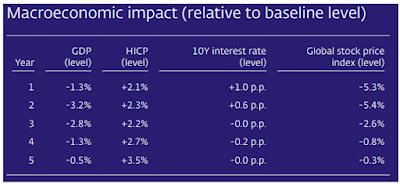

With respect to the interest rate shock, this variable is not assumed but follows endogenously from the model. Note that the long-term interest rate increases by 1 percentage point. As the economy grows slower compared to the baseline, the interest rate converges again to the baseline interest rate and is about equal to it in year 5. To put things into perspective, the US 10-year gov’t bond yield increased from 1.72% on March 1st to 3.12% on May 6th this year. Since a carbon price has a very similar effect on fossil fuel energy prices, the increase in long-term interest rates is not something strange and fully in line with what we observed this year.

The main point "the interest rate shock...is not assumed but follows endogenously from the model" Kirk is not correct  in alleging that the high interest rates are a separate assumption plugged in to the model to make GDP fall. 

I have not read the appendix, nor studied the model. However, this being a blog, that won't stop me from a few speculations. 

I am still a little bit puzzled. That a 2% of GDP tax increase should lower GDP makes a lot of sense, as it adds distortions (not counting externalities) to the economy. But real interest rates usually fall in recessions. Perhaps this is a nominal interest rate rise? 

It is also puzzling that a carbon tax is so damaging. In response I needled Robert a bit: Why don't you simulate a decline in Europe's already prodigious fuel taxes? If a rise in the carbon tax lowers GDP this much, a decline in fuel taxes should raise GDP and lower interest rates by similar amounts! 

In response to a few queries from me, Robert adds: 

Please note that we investigate tail risk scenarios and how banks would be affected in case of a sharp increase in carbon prices. In case the policymaker wants to meet the Paris Agreement carbon emission targets we would argue that you ideally present companies with a predictable policy path until 2050. This allows gradual adjustment in the economy, but it requires action soon. However, when governments wait too long and still want to meet the emission targets the economy will receive a bigger shock. 

This is interesting. I presume this means the economic model has very large "adjustment costs." Usually taxes have a "level effect" so the speed of implementation doesn't matter that much. Kirk might have a thing to say about a model in which putting in the carbon tax suddenly has much larger effect than spreading it over a few years.  

Perhaps interesting, in the study we also analyze the effects of technological shocks which make solar power much cheaper and easier to store. Basically this is a deflationary price shock and due to the adjustments in the economy it still leads to some temporary lower GDP growth relative to the baseline growth. In this case you indeed see interest rate decreases because the shock of the source is deflationary, i.e. energy becomes cheaper.

No matter what you do GDP goes down? Usually cost-reducing supply shocks are good for GDP. It seems that this model has a very strong Phillips curve, so that lower inflation (which we now all might think of as a good thing) lowers GDP? Good thing our ancestors who built power plants, highways, and dikes, didn't think that supply improvements lower GDP! The last comment leads to my question whether we're looking at real vs. nominal interest rates.   

Saving the best for last: 

 Please note that carbon price increases, at least of the magnitude we modeled, should not lead to financial crises. For the Dutch economy a US$100 carbon price increase amount to a little less than 2% of Dutch GDP at face value. We modeled it as a quota (e.g. similar to OPEC production limits), so the benefits of the higher prices fall on to the fossil fuel producers. In case you would model it as a tax levied by the governments and would assume that the tax is redistributed e.g. as a decrease in the VAT, you would find (much) smaller GDP impacts. Therefore, with appropriate policies you can ideally achieve simultaneously lower carbon emissions and minimize negative short-term impacts on the economy. 

"Carbon price increases, at least of the [big] magnitude we modeled, should not lead to financial crises." Well, the game is up right there. As for the topic of Kirk's whole speech, is there a financial system risk from climate, or is this all a smokescreen to get central banks to de-fund fossil fuels where legislators will not go, the game is up. (And, I would add, it is even more contradictory for regulators to say they have to step in to de fund fossil fuels before legislators impose the big carbon tax because legislators will never impose the big carbon tax.) 

The last part is important as we think about the actual issue: What you do with  carbon tax revenue matters a lot to its impact on its economic effect. If the carbon tax revenue is used to offset other distorting taxes,  I can easily imagine that GDP rises, a win-win. There are other taxes with far higher marginal rates and far worse distortions. 

We are of course witnessing an experimental version of the calculation, courtesy of Vladimir Putin. Others such as Ben Moll are making more microeconomic calculations that the effect of this large and sudden price hike and quantity reduction will be much smaller. We shall see. We shall also see if there is any stress at all on the banking system as a result of higher oil prices. For now, higher prices are causing dramatic increases in profits of legacy oil, not the collapse that climate financial risk advocates predicted. Econ 101 works.  But it is worth pointing out that the carbon tax and "Putin's price hike" are economically identical, so experience of one can inform the other, and complaining about one is a bit silly if one enthusiastically endorses the other. 


Thursday, March 3, 2022

Time for Supply

At Project Syndicate essay, with Jon Hartley. It's not the first, and it won't be the last on the issue! 

Now that surging inflation has refocused everyone's attention on the long-ignored supply side of the economy, the question is how best to support broad-based growth, efficiency, and innovation. The answer is not necessarily deregulation, but the need for smarter regulation is increasingly apparent – even to progressives.

STANFORD – The return of inflation is an economic cold shower. Governments can no longer hope to solve problems by throwing money at them. Economic policy must now turn its attention to supply and its cousin, economic efficiency. 

The issue is deeper than delayed goods deliveries and a year’s worth of sharp price increases. From the end of World War II to 2000, US real (inflation-adjusted) GDP per capita grew 2.3% per year, from $14,171 to $44,177 (in 2012 dollars). Americans became healthier, lived longer, reduced poverty, and paid for a much cleaner environment and a vast array of social programs. But since 2000, that post-war growth rate has fallen almost by half, to 1.4% per year. And it’s worse in Canada and Europe, where many countries have not grown at all since 2010 on a per capita basis. 

Nothing matters more for human flourishing than long-term economic growth. So, no economic trend is more worrisome than growth falling by half, especially for the well-being of the less fortunate. 

The eruption of inflation settles a long debate. Sclerotic growth is not the result of demand-side “secular stagnation,” fixable only with massive fiscal and monetary stimulus. Sclerotic growth is a supply problem. We need policies to increase the economy’s productive capacity – either directly or by reducing costs. 

How? The simplest and most important thing governments can do is to get out of the way. Byzantine regulations and capricious regulatory authorities stymie business. We do not need thoughtless deregulation, but rather smarter regulation that is simple, effective, avoids disincentives and unintended consequences, and is not distorted to protect current business and prop up regulatory empires. That means adding sunset clauses to regulations, regularly re-evaluating existing measures, and instituting a right to external appeal. 

Friday, February 4, 2022

Covid tests parable

The saga (WSJ) [link now works] of "free" Covid testing is a great parable for many things wrong with the American health payments system. 

... On a recent Sunday my family got tested at a pop-up tent outside a gasoline station. The sign on the tent advertised “free Covid testing.”

...The cost is billed to my health insurance. A few days ago, I received a routine letter from my insurance company summarizing what it paid: $1,140 a month for my daughter’s weekly PCR test. That comes to about $285 per test, 20 times the cost of an at-home rapid test.

Policy makers at both the state and federal levels have opted to finance Covid testing through private health insurance. ...Insurers must reimburse testing providers, even out-of-network ones, and the state places no restriction on the amount reimbursed.

"We'll make the insurance companies pay for it," rings the standard-issue progressive policy-maker. Except, as should be obvious to anyone who has ever heard the word "budget constraint," 

...Insurance companies will inevitably pass the costs on to policyholders through either higher premiums or reduced benefits.

Friday, January 21, 2022

Institute for progress

We need to be reminded occasionally that nothing matters but long-run growth, and long-run growth all comes from productivity, better knowledge of how to better serve human needs and desires.  Yet economic policy is almost all not about growth, but rather about redistribution, and in particular propping up old ways of doing things and the rents associated with them. 

Courtesy Marginal Revolution, the Institute for Progress is a noteworthy new effort to produce growth-oriented policy. Institutions are important, to spread the word and create a constituency for tending the golden goose. 

..productivity growth has been in long-term decline since the 1970s. This is supposed to be the age of ambitious infrastructure investments in the battle to fight climate change, but we can’t even build new solar plants without being vetoed by conservation groups. Hyperloops and supersonic airplanes promise to revolutionize transportation, but building a simple subway extension in NYC costs up to 15 times more per kilometer than it does in other cities around the world. ...The pace of scientific progress has been slowing.... 

(Here and elsewhere see the original for links.) Why? 

Over the last 50 years, we’ve increased the number of veto points at nearly every governmental level, failed to invest in state capacity, and raised the stakes of the debate through polarization. So it perhaps shouldn’t be a surprise that the federal government that went to the moon in 1969 botched production of simple diagnostic tests during a once-in-a-century pandemic.

But the potential is there. Maybe we are not running out of ideas after all, but merely on the edge of technical revolutions, like changing from rail to airplanes:    

...there are genuinely exciting — potentially game-changing — discoveries on the horizon. 

Thursday, December 23, 2021

The Ghost of Christmas Inflation

This is part of an ongoing series of essays on inflation.  This one is at Project Syndicate. The next post is somewhat longer and more academic with the same themes. 

The Ghost of Christmas Inflation

Inflation continues to surge. From its inflection point in February 2021 to last month, the US consumer price index has grown 6% – an 8% annualized rate. 

The underlying cause is no mystery. Starting in March 2020, the US government created about $3 trillion of new bank reserves (an equivalent to cash) and sent checks to people and businesses. The Treasury then borrowed another $2 trillion or so and sent even more checks. The total stimulus comes to about 25% of GDP, and to around 30% of the original federal debt. While much of the money went to help people and businesses severely hurt by the pandemic, much of it was also sent regardless of need, intended as stimulus (or “accommodation”) to stoke demand. The goal was to induce people to spend, and that is what they are now doing. 

Milton Friedman once said that if you want inflation, you can just drop money from helicopters. That is basically what the US government has done. But this US inflation is ultimately fiscal, not monetary. People do not have an excess of money relative to bonds; rather, people have extra savings and extra apparent wealth to spend. Had the government borrowed the entire $5 trillion to write the same checks, we likely would have the same inflation. 

Friday, December 10, 2021

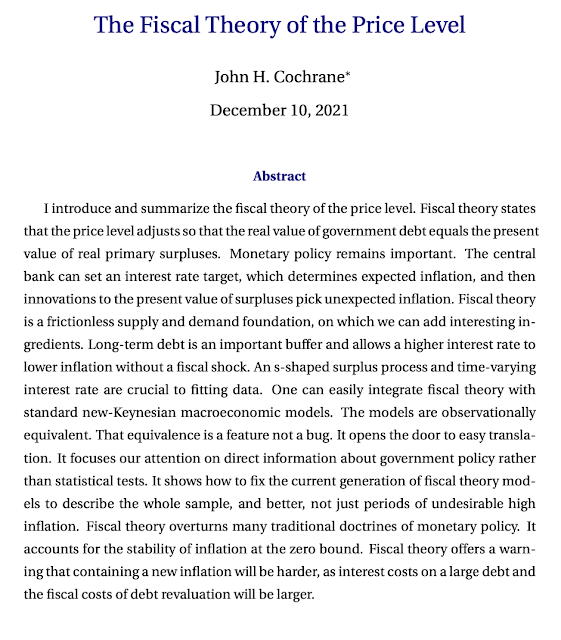
FTPL article

I wrote a short-ish article for the Journal of Economic Perspectives on Fiscal Theory of the Price Level. It tries to summarize the 700 page book in a readable article with no equations. Let me know how I'm doing -- comments most welcome.