Showing posts with label Stimulus. Show all posts

Friday, October 13, 2023

Heterogeneous Agent Fiscal Theory

Today, I'll add an entry to my occasional reviews of interesting academic papers. The paper: "Price Level and Inflation Dynamics in Heterogeneous Agent Economies," by Greg Kaplan, Georgios Nikolakoudis and Gianluca Violante. 

One of the many reasons I am excited about this paper is that it unites fiscal theory of the price level with heterogeneous agent economics. And it shows how heterogeneity matters. There has been a lot of work on "heterogeneous agent new-Keynesian" models (HANK). This paper inaugurates heterogeneous agent fiscal theory models. Let's call them HAFT. 

Tuesday, May 16, 2023

Hoover Monetary Policy Conference

Friday May 12 we had the annual Hoover monetary policy conference. Hoover twitter stream here.  Conference webpage and schedule here (update 5/24 now contains videos.) As before, the talks, panels, and comments will eventually be written and published. 

The Fed has experienced two dramatic institutional failures: Inflation peaking at 8%, and a rash of bank failures. There were panels focused on each, and much surrounding discussion.  

Tuesday, June 14, 2022

ECB word salad hubris

The  Speech by the ECB's Isabel Schnabel, advertised on the official ECB twitter stream 


caused a characteristically grumpy outburst from me. Savor the ECB's tweet in all of its glory: 

We will not tolerate changes in financing conditions that go beyond fundamental factors and that threaten monetary policy transmission.

Also, 

In December of last year, we made clear that we would not tolerate price adjustments that would undermine the transmission of our monetary policy

So now central bankers know what "fundamentals" are in all asset prices, and "will not tolerate" bond prices (aka "changes in financing conditions") that deviate from their idea of "fundamentals." And I thought they had an inflation mandate, and a short-term interest rate "tool." 

The contrast between the vision of detailed machinery that central bankers think they know how to control and any actual scientific knowledge of the monetary and financial system is gaping. The one thing I actually know as an "expert" is how little anyone else actually knows. Nobody really knows what the "monetary transmission mechanism" is to start with, let alone how "financing" conditions affect it. And if Ms. Schnabel knows reliably how to distinguish prices from "fundamentals" I know a lot of hedge funds that would pay her a whole lot more than the ECB does! 

As one way to see that gap, I compiled the following list of central-bankerese from her speech. At a minimum, if you want to be a central banker, learn to talk like this. As a human, ask yourself if anybody actually knows what any of this word salad actually means, let alone if the ECB has the technical knowledge to control it. (Some, of course, is just complex euphemism.) If I knew more computers it would be great fun to program up an AI that can replicate a central banker. It shouldn't be that hard, because nobody knows what any of this means! 

Your central banker word-salad vocabulary list: 
  

vulnerability to fragmentation risks 

disruptive and self-fulfilling price spirals 

financing conditions 

wedge 

national borrowing conditions

fragmentation 

Friday, April 15, 2022

Video week

It's been a busy week for video. I started Monday with a good roundtable with Benn Steil at the Council on Foreign Relations "Understanding Inflation and its Causes

Tuesday we did a great Goodfellows conversation with Larry Summers. (Audio podcast at that link, plus video if the embed doesn't work.) Larry answers "what would you do at the Fed" much better than I did when Benn asked, among other great topics. 

This week also Casey Weade posted a podcast and video interview we did on Fiscal Theory of the Price Level, for a general audience, at his "Retire with Purpose" podcast. Casey did a great job asking good questions and steering the conversation. Link, including audio podcast

More got recorded, not up yet... a busy week.  


Inflation and the end of illusions.

An oped at Project Syndicate

Inflation’s return marks a tipping point. Demand has hit the brick wall of supply. Our economies are now producing all that they can. Moreover, this inflation is clearly rooted in excessively expansive fiscal policies. While supply shocks can raise the price of one thing relative to others, they do not raise all prices and wages together. 

A lot of wishful thinking will have to be abandoned, starting with the idea that governments can borrow or print as much money as they need to spray at every problem. Government spending must now come from current tax revenues or from credible future tax revenues, to support non-inflationary borrowing. 

Stimulus spending for its own sake is over. Governments must start spending wisely. Spending to “create jobs” is nonsense when there is a widespread labor shortage. 

Unfortunately, many governments are responding to inflation by borrowing or printing even more money to subsidize energy, housing, childcare, and other costs, or to hand out more money to cushion the blow from inflation – for example, by forgiving student loans. These policies will lead to even more inflation. 

Monday, April 4, 2022

Is the Fed Fisherian?

The current situation, and puzzling inertia


Inflation has been with us for a year; it is 7.9% and trending up. March 15, the Fed finally budged the Federal Funds rate from 0 to 0.33%, (look hard) with slow rate rises to come.  

A third of a percent is a lot less than eight percent. The usual wisdom says that to reduce inflation, the Fed must raise the nominal interest rate by  more than the inflation rate. In that way the real interest rate rises, cooling the economy. 

At a minimum, then, usual wisdom says that the interest rate should be above 8%. Now. The Taylor rule says the interest rate should be 2% (inflation target), plus 1.5 times how much inflation exceeds 2%, plus the long run real rate. That means an interest rate of at least 2+1.5x(8-2) = 11%. Yet the Fed sits, and contemplates at most a percent or two over the summer. 

This reaction is unusually slow by historical precedent, not just by standard theory and received wisdom. The graph above shows the last episode for comparison. In early 2017, unemployment got below 5%, inflation got up to and just barely breached the Fed's 2% target, and the Fed promptly started raising interest rates. Inflation batted around the Fed's 2% target. March 2022 unemployment is 3.6%, lower than it has been since December 1969. No excuse there.  

Thursday, March 31, 2022

Will inflation persist?

(Note: this post uses Mathjax equations. If you see garbage, come back to the original.)

Introduction

Will inflation persist? One line of thought says no: This inflation came from a one-time fiscal blowout. That "stimulus'' being over, inflation should stop. In fiscal language, we had a one-time big deficit, that people do not expect to be repaid by future surpluses. That gives rise to a one-time price-level increase, paying for the deficit by inflating away some debt, but then it's over.

There are many objections to this argument: We still have persistent deficits, and the entitlement deluge is coming. Or, maybe our inflation comes from something else.

Here, I analyze one simple point. Suppose we do, in fact, have a one-time large deficit. How much do sticky prices and policy responses draw a one-time deficit shock out to a long-lasting inflation? The answer is, quite a bit. (This post is an extension of "Fiscal Inflation," which documents the size and nature of the fiscal shock to inflation, and talks through the frictionless model.)

Thursday, December 23, 2021

The Ghost of Christmas Inflation

This is part of an ongoing series of essays on inflation.  This one is at Project Syndicate. The next post is somewhat longer and more academic with the same themes. 

The Ghost of Christmas Inflation

Inflation continues to surge. From its inflection point in February 2021 to last month, the US consumer price index has grown 6% – an 8% annualized rate. 

The underlying cause is no mystery. Starting in March 2020, the US government created about $3 trillion of new bank reserves (an equivalent to cash) and sent checks to people and businesses. The Treasury then borrowed another $2 trillion or so and sent even more checks. The total stimulus comes to about 25% of GDP, and to around 30% of the original federal debt. While much of the money went to help people and businesses severely hurt by the pandemic, much of it was also sent regardless of need, intended as stimulus (or “accommodation”) to stoke demand. The goal was to induce people to spend, and that is what they are now doing. 

Milton Friedman once said that if you want inflation, you can just drop money from helicopters. That is basically what the US government has done. But this US inflation is ultimately fiscal, not monetary. People do not have an excess of money relative to bonds; rather, people have extra savings and extra apparent wealth to spend. Had the government borrowed the entire $5 trillion to write the same checks, we likely would have the same inflation. 

Thursday, December 16, 2021

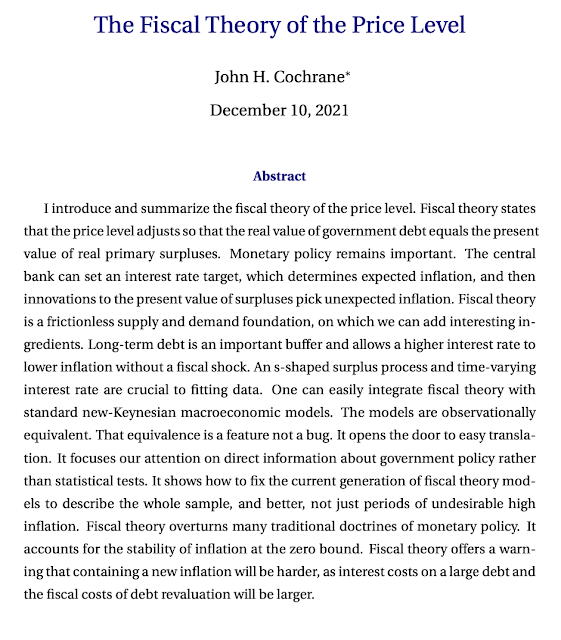
Fiscal theory update

Whew. The penultimate draft of The Fiscal Theory of the Price Level is now done, and in the hands of the copy-editors at Princeton. There is still time to send me typos, thinkos, wrong equations, excessive repetition and more! 


Friday, December 10, 2021

FTPL article

I wrote a short-ish article for the Journal of Economic Perspectives on Fiscal Theory of the Price Level. It tries to summarize the 700 page book in a readable article with no equations. Let me know how I'm doing -- comments most welcome. 


Wednesday, December 1, 2021

Inflation speculation

I'm working madly to finish The Fiscal Theory of the Price Level. This is a draft of Chapter 21, on how to think about today's emerging inflation and what lies ahead, through the lens of fiscal theory. (Also available as pdf). I post it here as it may be interesting, but also to solicit input on a very speculative chapter. Help me not to say silly things, in a book that hopefully will last longer than a blog post! Feel free to send comments by email too. 

Chapter 21. The Covid inflation 

As I finish this book's manuscript in Fall 2021, inflation has suddenly revived. You will know more about this event by the time you read this book, in particular whether inflation turned out to be ``transitory,'' as the Fed and Administration currently insist, or longer lasting. This section must be speculative, and I hope rigorous analysis will follow once the facts are known. Still, fiscal theory is supposed to be a framework for thinking about monetary policy, so I would be remiss not to try. 

Figure 1. CPI through the Covid-19 recession.

Figure 1 presents the CPI through the covid recession. Everything looks normal until February 2021. From that point to October 2021 the CPI rose  5.15% (263.161 to 276.724), a 7.8% annual rate.

What happened, at least through the lens of the simple fiscal theory models in this book? Well, from March 2020 through early 2021, the U.S. government -- Treasury and Fed acting together -- created about $3 trillion new money and sent people checks. The Treasury borrowed an additional $2 trillion, and sent people more checks. M2, including checking and savings accounts, went up $5.5 trillion dollars. $5 trillion is a nearly 30% increase in the $17 trillion of debt outstanding at the beginning of the Covid recession. Table 21.1 and Figure 2 summarize. ($3 trillion is the amount of Treasury debt purchased by the Fed, and also the sum of larger reserves and currency.  Federal debt held by the public includes debt held by the Federal Reserve.)

M2, debt, and monetary base (currency + reserves) through the Covid-19 recession.

Some examples: In March 2020, December 2020, and again in March 2021, in response to the deep recession induced by the Covid-19 pandemic, the government sent ``stimulus'' checks, totaling $3,200 to each adult and $2,500 per child. The government added a refundable child tax credit, now up to $3,600per child, and started sending checks immediately. Unemployment compensation, rental assistance, food stamps and so forth sent checks to people. The ``paycheck protection program'' authorized $659 billion to small businesses. And more. The payments were partly designed as economic insurance, transfers from people doing well during covid to those who had lost jobs or businesses, and efforts to keep businesses from failing. But they were also in large part, intentionally, designed as fiscal-monetary stimulus to boost aggregate demand and keep the economy going. The  massive ``infrastructure'' and ``reconciliation'' spending plans occupied the Congress through 2021, adding expectations of more deficits to come.  

From a fiscal-theory perspective, the episode looks like a classic fiscal helicopter drop. There is a large increase in government debt, transferred to people, who do not expect that debt to be repaid. It is a``fiscal shock,'' a decline in surpluses s_t, with no expectation of larger subsequent surpluses. Of course it led to inflation! 

Sunday, June 6, 2021

What about Japan?

What about Japan? It's a question I often hear from advocates of fiscal expansion. Japan has huge debts and no crisis or inflation (so far). Doesn't that prove the US can borrow a ton more money painlessly? 

I offer two new points today: 1) Not every high debt country is so happy. 2) Just what did Japan get for all its fiscal stimulus? Indeed, I will start asking "What about Japan?" Japan seems a tough case for those who advocate that fiscal stimulus will save us from secular stagnation, or that huge spending programs bring prosperity in other dimensions.   

1. Picking and choosing

Here, fresh from the April IMF Fiscal Monitor  is the list of top 30 countries sorted by debt to GDP ratios. I boldfaced larger countries. 


Yes, Japan is up there at 256% of GDP. The champion is Venezuela however. Sudan and Eritrea are not particularly known for economic prosperity. Greece and Italy are not held up as examples to follow either. Serial defaulter Argentina is behind the US already. 

If Japan is sustainable, that doesn't mean all large debts are sustainable. It means there's something different about Japan than the other countries on the list -- or ones now lower down on the list because they already defaulted or had crises. 

2. So what did Japan get for all that debt anyway? 


It was not always thus. Japan started borrowing heavily in the 1990s from a debt/GDP ratio of 63%. (For some reason the IMF does not have US data before 2002.) 


Those debts come from deficits, of 5-10% of GDP every year. Since 2006, the US has been behaving a lot like Japan, or more so. We only have less debt because the US ran surpluses through the 1990s. 

Japan has had perpetually low GDP growth, low inflation and zero interest rates since the 1990s. I view it as low "supply" growth, but it ought to be the poster child for "secular stagnation" fans. 

So I turn the question around: If massive deficits, including lots of "infrastructure"  are going to boost the US economy, why did they not do so for Japan? 

Update

In response to tweets about why is Japan different from the US,  

I did not want to repeat old points. Japan's debt is long-term, held by domestic people, pensions and central bank. US debt is short-term, held by foreign central banks and financial institutions. Our debt is much more prone to run, and a rise in interest rates will feed quickly into the budget. Japan also has accumulated assets from trade surpluses; we have the opposite. Japan's debt is held by old people and subject to estate tax. A lot of Japanese hold bank accounts, as mutual funds and similar investment vehicles familiar in the US are less prevalent. Bank accounts flow in to reserves, backed by Treasury debt. 

More importantly, Japan  does not have looming unfunded Social Security and Medicare, underfunded pensions, contingent liabilities (Fannie and Freddy guarantee most home mortgages, who is going to pay student loans?) bailout guarantees and more.

 Sustainability is about debt vs. ability to repay; about future deficits;  not debt alone.

Japan's slow growth for three decades comes from microeconomics, taxes, regulations, demographics, slow productivity, not money, stimulus, "aggregate demand." 

Wednesday, April 28, 2021

Infrastructure and jobs

William Gropper, Construction of the Dam, 1938

To many on the left, it's always 1933. Building "roads and bridges" will "create jobs," soaking up the mass army of unemployed desperate for work that they seem to see. 

Driving around though, I notice that we build roads with big machines, not lots of people. And construction jobs are high-skill jobs, not people with shovels. "Shovel-ready" itself is a misnomer. Nobody uses shovels on a construction site anymore, they use a backhoe. Neither you, reading this, nor I, nor an unemployed Wal-Mart greeter or bartender could do much of anything useful on a road construction site. 

On a lark, I went to the Bureau of Labor Statistics to see just how many people are employed on roads and bridge construction. 


Latest

Feb-Mar change

Total nonfarm

144,120.0

916

Construction of buildings

1,689.3

17.8

Heavy and civil engineering construction

1,062.9

27.3

Water and sewer system construction

183.8


Oil and gas pipeline construction

134.9


Power and communication system construction 

211.3


Highway street and bridge construction 

338.3


Specialty trade contractors

4,714.2

65.0

For perspective, total nonfarm employment is 144 million people, up nearly a million in the last month. That's a lot, usually 200,000 is a good month. Well, we're recovering fast from the pandemic. In case you didn't hear the pounding of nails, building construction employees 1.6 million people, with 4.7 million more in the trades. (We're not so much building new housing as building in new places.) 


Total unemployment is 9.7 million right now, down from 23 million at its peak. 

Roads and bridges employ 338,000 people. The total is a half of this month's gain alone.  We could use some water construction here in California, though it's not going to happen, and with only 184,000 people employed there looks to be room to expand. 135,000 are building oil and gas pipelines. Uh-oh.

Thursday, April 8, 2021

Ip on Bidenomics

Greg Ip has a great column in the WSJ on Bidenomics.  It's not long, it's so well written that it's hard to condense the good parts, and you should really read it all. 

There is an intellectual framework to Bidenomics, and with that a scarily more durable move on economic policy. 

There used to be 

"certain rules about how the world worked: governments should avoid deficits, liberalize trade and trust in markets. Taxes and social programs shouldn’t discourage work."

By contrast President Biden's (really his team's) "embrace of bigger government" is founded on different economic ideas. To wit, abridged: 

Growth

Old view: Scarcity is the default condition of economies: the demand for goods, services, labor and capital is limitless, their supply is limited. ...faster growth requires raising potential by increasing incentives to work and invest. Macroeconomic tools—monetary and fiscal policy—are only occasionally needed to deal with recessions and inflation.

New view: Slack is the default condition of economies. Growth is held back not by supply but chronic lack of demand, calling for continuously stimulative fiscal and monetary policy. J.W. Mason.. said, that “‘depression economics’ applies basically all of the time.”

I guess I'm an old fogie. 

Sunday, February 28, 2021

r < g

r<g is an essay on the question whether r<g means the government can borrow and not worry about repaying debts. No. 

Abstract:

A situation that the rate of return on government bonds r is less than the economy's growth rate g seems to promise that borrowing has no fiscal cost. r<g is irrelevant for the current US fiscal problems. r<g cannot begin to finance current and projected deficits. r<g does not resolve exponentially growing debt. r<g can finance small deficits, but large deficits still need to be repaid by subsequent surpluses. The appearance of explosive present values comes by using perfect-certainty discount formulas with returns drawn from an uncertain world. Present values can be well behaved despite r<g. The r<g opportunity is like the classic strategy of writing put options, which fails in the most painful state of the world.

The essay is based on comments I gave at the spring NBER EFG meeting on Ricardo Reis' "The constraint on public debt when r<g but g<m." My discussion starts here at 4:48,  Ricardo presents the paper (very good, worth listening to, many points I didn't get to) at 4:30 

pdf for now, as translating equations to blogger is taxing. 


Tuesday, February 16, 2021

The wages of stimulus


Discussing stimulus, a colleague passed along a factoid -- wages and salaries, he said,  are running $20 billion a month or $240 billion a year below where they should be. If the "stimulus" were to aim entirely to replace all lost wages due to the pandemic, that would stop at $240 billion, not $1.9 trillion. (My colleague is usually a pro-stimulus type.) I forgot to get the source, so I tried to recreate it. Here are some documented numbers, total compensation of employees, wage and salaries. 

Feb 2019 $9,228

Feb 2020 $9,659

Dec 2020 $9,675

These are billions at an annual rate. Actually, by these numbers Dec 2020 is already above Feb 2020! That doesn't account for inflation, or missing growth. If we want to entitle ourselves to the trend, wages should have gone up $430 billion. Ok, still less than $1.9 trillion. (My snarky comment: trends are earned slowly, not laws of nature. Trends in wages come from higher productivity, expanding businesses, greater labor force participation, lower unemployment.) 

One can argue for federal payments as insurance. Some people are definitely hurting, and some others are doing better. But the case for an overall "aggregate demand" shortfall seems weak. It is not always 1933. 


Wednesday, March 18, 2020

WSJ oped on virus policy

Why is the market going nuts? What should policy do? I put some of my recent thoughts in a Wall Street Journal Op-ed, here. As usual I can't post the whole thing for 30 days, but if you're clever you can find it.

This is not a "demand" recession needing "stimulus." The economic policy challenge is to allow the economy to shut down, but make sure it doesn't die in the process. The problem is -- once again -- debt.
Had everyone kept a few months of cash around, things would be fine. But many did not. Now we are seeing the beginnings of a scramble for cash, as people and businesses try to sell assets or borrow. But who is buying? And who is lending? Banks can’t make new loans to companies and people with no income.
If there is a wave of firing and bankruptcy,
A pandemic can turn quickly to a financial crash and a long recession, not a V-shaped pause. That’s the scenario spooking markets, and it should spook all of us.
What to do? Clearly the central goal of policy should be to keep businesses alive so they are ready to turn back on again.  
The main focus of economic policy should be
Lending is better than transfers. Since loans must be paid back, larger amounts can go where needed. ...
Forbearance is important. Banks and creditors should not immediately shut down a nonpayer. But they have to be allowed to forbear by their regulators, their own creditors, and their own fiduciary responsibility, and to borrow or pass forbearance up the line....
Rather than give each of us $1,000, allow us to borrow a fraction of last year’s income from the Internal Revenue Service and repay when we file our taxes. That provides more money to those who need it, and helps those even with large debts not to default. Allow penalty-free withdrawals from retirement accounts. Social-program rules must be stretched. If people have to lose a job to get help, we tempt the employer to needlessly fire them, and they and the employer are not ready to start up again fast.
This is all really hard. Economists blogging from home are full of good and creative ideas. But changing rules for who banks can lend to, to create pandemic exemptions, is much much harder than writing checks. It would be awfully nice if anyone in government had put the slightest thought into this ahead of time.

We are headed to the second huge creditor bailout. When it's over, we need to start taking seriously that if you're too big to fail, you're too big to borrow. Airlines, this means you.

The Oped summarizes many ideas in condensed form. To see more, use the "pandemic" label below, or this link

Tuesday, March 17, 2020

Monetary policy and coronavirus -- French edition

Vox-Fi put up an edited version of my monetary policy and coronavirus post, in French, La politique monétaire en réponse au coronavirus

Un collègue et moi avons discuté de la question suivante : la Fed (Federal Reserve, la banque centrale des Etats-Unis) devrait-elle baisser ses taux d’intérêt en réponse au coronavirus?
Plus généralement, supposons qu’une pandémie devienne grave et que, par choix ou par décret, une grande partie de l’économie s’arrête pendant quelques semaines ou mois. Qu’est-ce que la Fed, ou toute autre politique économique devrait faire à ce sujet?
...

Practice your French. Read the whole thing here

Thursday, March 12, 2020

Area 45 pandemic podcast


For you podcast fans, here is a longer podcast with Hoover's Bill Whalen on economics and the pandemic. It clarifies some of my evolving thoughts -- more lending, less bailout.

The pandemic is quickly threatening to turn in to a financial crisis. I'm brooding on that for upcoming posts.

If you're not worried yet, read here

https://medium.com/@tomaspueyo/coronavirus-act-today-or-people-will-die-f4d3d9cd99ca