Showing posts with label Teaching. Show all posts

Sunday, December 17, 2023

Bond risk premiums -- certainty found and lost again

This is a second post from a set of comments I gave at the NBER Asset Pricing conference in early November at Stanford.  Conference agenda hereMy full slides here. First post here, on new-Keynesian models

I  commented on "Downward Nominal Rigidities and Bond Premia" by François Gourio  and Phuong Ngo. The paper was about bond premiums. Commenting made me realize that I thought I understood the issue, and now I realize I don't at all. Understanding term premiums still seems a fruitful area of research after all these years.  

I thought I understood risk premiums

The term premium question is, do you earn more money on average holding long term bonds or short-term bonds? Related, is the yield curve on average upward or downward sloping? Should an investor hold long or short term bonds? 

Sunday, January 23, 2022

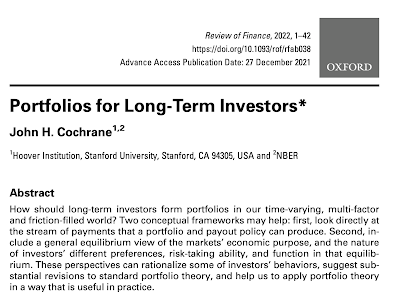
Portfolios for long-term investors

"Portfolios for long-term investors" is published, Review of Finance 26(1), 1-42. (2022). This standard link works if you have institutional or individual access. I am not allowed to post a free access link here, but I am allowed to post one on my webpage where you will find it. 


The theme: How do we account for the vast gulf between portfolio practice and portfolio theory? How do we make portfolio theory useful given that the world has time-varying expected returns and time-varying returns and correlations? I argue for a view more focuses on prices and payouts, as a long-term bond investor should buy an indexed perpetuity and ignore one-period returns. I advise one to think about the market and equilibrium. The average investor must hold the market portfolio. Anything else is a zero sum game. So figure out why you are different than average. (If you think you're smarter than average, note that they think they're smarter than you.) The result encapsulates some ancient advice: Buy stocks for the dividends, broadly interpreted. Take risk you are well-positioned to take. If stocks have great value to other investors for reasons either technical (liquidity, short-sales constraints, etc.) or behavioral, avoid them. 

The paper grows out of the summary I used to give for MBA and PhD students. There aren't any equations, but there are lots of suggestions about how academic portfolio theory might be done better, and connect better to its intended audience. Thanks especially to Monika Piazzesi and Luis Viceira, who invited me to give the talk on which it is based, and Alex Edmans who shepherded it to publication. 

******

Update: I just found that the NBER has posted the original lecture video


Tuesday, February 4, 2020

Wokeademia spreads

In my first and second posts on "diversity statements," I discovered how these political loyalty oaths are now required by the University of California and the National Institutes of Health. 

In a quick look at academicjobsonline I discovered that this cancer has metastasized even further. "Diversity statements," professions of loyalty to the "diversity" cause, and testimonials about one's past commitment to "diversity" efforts pervade academic jobs postings. This is not just a requirement imposed by a nebulous bureaucracy, as I had assumed. It is deeply embedded in each department's recruiting, with therefore the active participation of faculty. 

At the cost of repetition, let me be clear about this sensitive issue. 

Universities started with a desire to hire African Americans, women, and other groups, to address the sadly small numbers of these on their faculties. Racial and gender discrimination being illegal, this was soon labeled a "diversity" effort. But for a long time "diversity" meant only who you hire, not their politics. 

The "diversity statement" is a new effort, in which every potential faculty member must pledge their personal loyalty to the diversity movement, and pledge future activity.  They also must describe their personal experiences advancing "diversity." And they must not mention ideological or other diversity. 

In part, as documented in my first post and references, this has simply been a way to more effectively impose illegal racial and gender quotas. 
 
The part I object to in these posts is the "diversity statement," and the activity it commands. This statement is a clearly political oath, and squashes ideological diversity. Republicans are a lot rarer on college faculty than any racial or sexual group! 

This post is not about the desirability of seeing more under-represented groups in academia. It is not about the previous "diversity" regime which mostly amounted to spending a lot more time making sure one had examined all potential candidates from under represented groups, and documented such to upper administration. We can discuss those another day. The point here is only about the diversity statement, and the requirement to bend ones research, political support and activity to its cause.

Here is a brief sampling of current job postings (it's a little late in the season, so the pickings are slim. I'll look again in the fall. All emphasis in italics are mine. Major news below, Cornell seems to have the same institution-wide diversity pledge requirement as the UC system. 

*******

CALIFORNIA STATE UNIVERSITY, LONG BEACH 
Position: Assistant Professor of History  

Required Qualifications:
Ph.D. in History with specialization in Modern World history, with an emphasis in either the African Diaspora, the Islamicate, or South Asia 
....
Demonstrated commitment to working successfully with a diverse student population 

Preferred Qualifications:
...Evidence of support for and/or experience related to the University’s strong commitment to the academic success of its diverse student body ...

Duties: 
...enthusiastically support the University’s strong commitment to the academic success of all of our students, including students of color, students with disabilities, students who are first generation to college, veterans, students with diverse socio-economic backgrounds, and students of diverse sexual orientations and gender expressions. 

How to Apply - Required Documentation:
An Equity and Diversity Statement about your teaching or other experiences, successes, and challenges in working with a diverse student population (maximum two pages, single-spaced)....

(Cal state Long Beach has lots of job postings at the moment, all with this language, so it does come from upper administration, but with the consent of the departmental faculty.) 

***********

Purdue University, History Department
Position Title: Assistant Professor of History
Position Description: Tenure Track Assistant Professor in Military History / History of the American Civil War Era 

Monday, February 3, 2020

Online Asset Pricing back again!

My online Asset Pricing course is back again, after one more software/administrative change once again threatened its demise.  It's still on Canvas, but you have to ask to sign on.

The course is here, University of Chicago Canvas course 23303. To log in and use it, you need to email  instructional.design@chicagobooth.edu.  The course is open to anyone, not just University of Chicago students. If that doesn't work, email me john dot cochrane at stanford dot edu, and I'll see what's wrong.

The videos, notes, and other materials are still available ungated on my website, here, under the "Asset Pricing" tab.

If all goes well you see this:


Economic note: It's interesting how software depreciates so rapidly, though its physical being depreciates not at all. Perfectly good software stops working as operating systems and machines get "upgraded," as IT departments seem to latch on to new "solutions" every three years, and so forth. Most of my email from before the mid 2000s is gone due to an "upgrade." My website is in the midst of an "upgrade" crisis, and I can't seem to keep the online class going for more than two or three years. There is an interesting economics paper in this. As son of a historian, I feel for the historians of a few hundred years from now who, looking back on our interesting era, will find a blank void, as all of our records are unreadable.

Tuesday, May 28, 2019

Cost divergence

Source: Marginal Revolution
This lovely picture is from Why are the prices so D*mn High? by Eric Helland and Alex Tabarrok. (It's covered in Marginal Revolution: The Initial post,  Bloat does not explain the rising cost of education, and an upcoming summary on health care.)

Bottom line: objects got cheap, people got expensive. Technology, automation, globalization (thank you China), and quality improvement made goods cheaper. People, especially skilled people, got more expensive. All of which should make you feel good if you're a person and especially a skilled person.

The source of the relative rise in the cost of education and health care is less clear. Looking around at  a typical university,  school system, or hospital suggests massive bloat and inefficiency. Alex suggests  not:
I assumed that regulation, bloat and bureaucracy, monopoly power and the Baumol effect would each explain some of what is going on. After looking at this in depth, however, my conclusion is that it’s almost all Baumol effect. 

Sunday, December 30, 2018

Sumner on teaching economics

Scott Sumner has a terrific post on teaching economics. (HT Marginal Revolution)
The core ideas of economics are extremely counterintuitive and are not accepted by most people....
Non-economists also tend to reject the central ideas of basic economics, and for reasons that are not well justified. [In particular these central ideas do not rest on hyper-rationality.] For the economics profession, our “value added” comes not from spoon feeding behavioral theories that the public is already inclined to accept, rather it is in teaching well-established basic principles of which the public is highly skeptical.  Thus we should try to discourage people from believing in the following popular myths: 
1.    People don’t respond very strongly to economic incentives.  (I.e., the demand for life-saving drugs is very inelastic.) 
2.    Imported goods, immigrant labor, and automation all tend to increase the unemployment rate. 
3.    Most companies have a lot of control over prices.  (I.e. oil companies set prices, not “the market”.) 
4.    Policy disputes over taxes and regulations are best thought of in terms of who gains and who loses. 
5.    Experts are smarter than the crowd. 
6.    Speculators make market prices more unstable. 
7.    Price gouging hurts consumers. 
8.   Rent controls help tenants. 
These myths are all widely believed by the general public.
Our primary goal should not be to add new information, it should be to have people unlearn false ideas about the world.
My emphasis.

One is tempted to add to the list. (An invitation to comments.)  Many of them stem from a basic principle -- "find the supply response" or ("demand response") that the fallacy ignores. "State the budget constraint" is another good habit.  Look for competition, entry, and choice among alternatives -- a market is not just bilateral negotiation. I might add reverse causality and selection bias -- empirical economics has stories to tell as well.

Scott frames the essay as a reaction to an Atlantic story advocating more teaching of behavioral economics. Scott is very clear: he is not opposed to behavioral economics. (He will likely be misquoted on this. Some behaviorists are very touchy. I know this from painful experience.) He is merely opining that our profession has more value added in teaching regular economics first. Regular economics is harder, less intuitive, less known, and therefore more valuable. To really understand behavioral economics, you have to understand what it is behaviorists object to -- and the vast amount of regular economics that good behaviorists agree with. Art schools might do better teaching people to draw, music schools to teach classical before atonal, physics programs newtonian before quantum mechanics, and so forth.
Most people find the key ideas of behavioral economics to be more accessible than classical economic theory. If you tell students that some people have addictive personalities and buy things that are bad for them, they’ll nod their heads.  And it’s certainly not difficult to explain procrastination to college students. [Dave Henderson's nomination for best sentence in the essay!] Ditto for the claim that investors might be driven by emotion, and that asset prices might soar on waves of “irrational exuberance.”  ... One should spend more time on subjects that need more time, not things that people already believe. 
I.e. let us not indulge in our own quest for teaching ratings via confirmation bias.

Yes, people do nutty things. But if you approach rent control, and all you have in the back of your head is behavioral stories, you will miss the clear prediction, borne out time and time again, that within a decade there will be a massive shortage of rental housing.

Scott does not neglect how awful most economics courses are
That doesn’t mean that I agree with the way that economics majors are currently being taught.  Our intermediate level courses are far too theoretical; they waste students’ time on lots of minor theories that would only be useful for people planning to do graduate work in economics.  (Most students do not.)  Too many homework problems with Cobb-Douglas utility, Hicksian demand, marginal rates of substitution, Giffen goods, gross substitutes, indifference curves, etc.  Some of that is appropriate, but all economics courses should focus heavily on applied economics. 
Most students come out of such courses still unable to coherently judge Scott's nice list of fallacies. Most of our courses are histories of thought, "greatest hits" of past theoretical contributions, passed on rather mindlessly. We teach many harmful parables. For example, natural monopoly due to increasing returns to scale, and the need for resulting regulation is a staple, passed down from about 1910. It has little to do with modern industrial organization in a global economy.

In part, it's easy to get through an hour by moving the curves around. Teaching real applied cases is much harder.

Macroeconomics teaching is in worse shape. Keynesian macro, like behavioral economics, enshrines most people's intuitive fallacies. Consuming more will increase output - forgetting the budget constraint. Breaking windows is good as it gives employment to window repair people. Good Keynesian macro justifies these apparent fallacies with carefully described "frictions," by which classical economic results fail. But you have to understand those classical results first to arrive at a correct economics that recognizes frictions (like behavioral biases) but doesn't violate budget constraints and accounting identities. Most macro teaching consists of young professors pushing IS-LM curves around, though such curves appear nowhere in their own research, nor anyone else's since the time they were born. Well, it passes the time easily.

An important point is implicit. Economics is not hard because of math. The math in even graduate level economics is no greater than in sophomore physics. Classical economics is hard because it can attack social problems in a value-free, cause-and-effect way, and upends the little morality stories that most people use to think about those problems -- rents are high because landlords are greedy. "Learning to think like an economist" is indeed best learned by application. And "learning to think like a behavioral economist" requires learning to think like an economist first.

Thursday, May 4, 2017

Wonderful Loaf


A charming animated free-market poem by Russ Roberts, on the invisible hand, at http://wonderfulloaf.org

The "read the poem" link includes much interesting annotation.

Mild critique: I would rather the "planner" be a well-meaning economist faced with impossible information problems than a darkly sinister white guy in a suit. It looks like all we need is better  planners. And the bakers seem really happy about all that competition and free entry, whereas real bakers quickly band together to demand regulation, occupational licensing, and other restrictions. But I'm just whining, it's a good romp through the invisible hand in a mythic war-free and Disney-clean 1940s Europe.

Tuesday, August 30, 2016

Asset Pricing Mooc, Resurrected

The online class "Asset Pricing" is resurrected, at least half-way.

The videos, readings, slides/whiteboards and notes are all now here on my webpage.  If you just want the lecture videos, they are all on Youtube, Part 1 here and Part 2 here.

These materials are also hosted in a somewhat prettier manner on the University of Chicago's Canvas platform. You may or may not have  access to that. It may become open to the public at some point.

I'm working on the quizzes, problems, and exams, and also on finding a new host so you can have problems graded and get a certificate. For now, however, I hope these materials are useful as self-study, and as assignments for in-person classes. I found that sending students to watch the videos and then having a more discussion oriented class worked well.

What happened? Coursera moved to a new platform. The new platform is not backward-compatible, did not support several features I used from the old platform, and some of the new platform features don't work as advertised either. Neither the excellent team at U of C, nor Coursera's staff, could move the class to the new platform. And Coursera would not keep the old platform open. So, months of work are consigned to the dustbin of software "upgrades," at least for now.

Obviously, if you are thinking of doing an online course, I do not recommend that you work with Coursera. And make sure to write strong language about keeping your course working in the contract.

Update: The latest version of the class is here

Monday, March 21, 2016

The Habit Habit

The Habit Habit. This is an essay expanding slightly on a talk I gave at the University of Melbourne's excellent "Finance Down Under" conference. The slides

(Note: This post uses mathjax for equations and has embedded graphs. Some places that pick up the post don't show these elements. If you can't see them or links come back to the original. Two shift-refreshes seem to cure Safari showing "math processing error".)

Habit past: I start with a quick review of the habit model. I highlight some successes as well as areas where the model needs improvement, that I think would be productive to address.

Habit present: I survey of many current parallel approaches including long run risks, idiosyncratic risks, heterogenous preferences, rare disasters, probability mistakes -- both behavioral and from ambiguity aversion -- and debt or institutional finance. I stress how all these approaches produce quite similar results and mechanisms. They all introduce a business-cycle state variable into the discount factor, so they all give rise to more risk aversion in bad times. The habit model, though less popular than some alternatives, is at least still a contender, and more parsimonious in many ways,

Habits future: I speculate with some simple models that time-varying risk premiums as captured by the habit model can produce a theory of risk-averse recessions, produced by varying risk aversion and precautionary saving, as an alternative to  Keynesian flow constraints or new Keynesian intertemporal substitution. People stopped consuming and investing in 2008 because they were scared to death, not because they wanted less consumption today in return for more consumption tomorrow.

Throughout, the essay focuses on challenges for future research, in many cases that seem like low hanging fruit. PhD students seeking advice on thesis topics: I'll tell you to read this. It also may be useful to colleagues as a teaching note on macro-asset pricing models. (Note, the parallel sections of my coursera class "Asset Pricing" cover some of the same material.)

I'll tempt you with one little exercise taken from late in the essay.

Saturday, June 20, 2015

Econ 1


John Taylor is offering his Economics 1, the introductory economics course for Stanford undergraduates, as a free online class. Class starts Monday, June 22.

John's blog post here, and registration page here.

Yes, Martha, apparently there is a free lunch.

Monday, March 31, 2014

EconTalk MOOC Podcast

Russ Roberts
podcast interview with Russ Roberts on EconTalk about my experience teaching a MOOC and thoughts on the economics of MOOCs. (The interview was based a bit on my last post here.)

Russ is a very good interviewer, and the EconTalk series quite interesting.

Thursday, March 20, 2014

University Debt

Bloomberg has a story on the University of Chicago's big debt expansion. Obviously, it's a topic around faculty lounges too.

A few thoughts. Why does a university simultaneously borrow $3.6  billion but have $6.7 billion Invested? If borrowing is such a big deal, why not just spend the endowment on new buildings?

Answer: universities can borrow at municipal rates, free of federal tax to the lender, if they are building something. Borrowing at tax-free rates makes financial sense, even you just stuff the marginal dollar into endowment. Of course the endowment is not invested in Treasuries -- universities don't do simple tax arbitrage. So the model is more that of a leveraged hedge fund -- borrow at low tax-free rates, up to the limit imposed by tax law, and invest in high risk, (hopefully) high-return projects like hedge funds, private equity, real estate etc. The fact that investment returns are also not taxed makes this a doubly advantageous strategy. Donors: if you give now, your gift grows tax-free, while if you earn the rate of return and then give the money to the university, you pay taxes on the intervening returns.

Sunday, February 9, 2014

Mooconomics

An Economist article and Alex Tabarrok in a Marginal Revolution blog post weigh in on the future and economic structure of moocs (massively open online classes).

A few thoughts on this question, based on my experience teaching a Coursera mooc last fall. (This was supposed to be a short post, and grew out of control. Oh well.)

Yes, moocs potentially upend the fundamental economic structure of teaching. Teaching had been a high marginal cost business. Moocs are a nearly zero marginal cost business.

But.. For now, Moocs are a quite high fixed-cost business. Putting a class up in a mooc is not quite as much work as writing a textbook, but it's nowhere near as easy as teaching a new class. If you're tempted, beware!  Preparing, taping, editing and uploading a lecture is not the same as walking in, telling a few jokes, and getting through the week. Fixing anything that went wrong or updating is costly too.