
Just in time for the holidays, the perfect stocking stuffer -- if you have really big stockings. 30% discount on Fiscal Theory of the Price Level until June 30 2024.
And Fiscal Theory makes the Economist's list of best books for 2023.


Just in time for the holidays, the perfect stocking stuffer -- if you have really big stockings. 30% discount on Fiscal Theory of the Price Level until June 30 2024.
And Fiscal Theory makes the Economist's list of best books for 2023.
(This post continues part 1 which just looked at the data. Part 3 on theory is here)
When the Fed raises interest rates, how does inflation respond? Are there "long and variable lags" to inflation and output?
There is a standard story: The Fed raises interest rates; inflation is sticky so real interest rates (interest rate - inflation) rise; higher real interest rates lower output and employment; the softer economy pushes inflation down. Each of these is a lagged effect. But despite 40 years of effort, theory struggles to substantiate that story (next post), it's had to see in the data (last post), and the empirical work is ephemeral -- this post.
The vector autoregression and related local projection are today the standard empirical tools to address how monetary policy affects the economy, and have been since Chris Sims' great work in the 1970s. (See Larry Christiano's review.)
I am losing faith in the method and results. We need to find new ways to learn about the effects of monetary policy. This post expands on some thoughts on this topic in "Expectations and the Neutrality of Interest Rates," several of my papers from the 1990s* and excellent recent reviews from Valerie Ramey and Emi Nakamura and Jón Steinsson, who eloquently summarize the hard identification and computation troubles of contemporary empirical work.
Maybe popular wisdom is right, and economics just has to catch up. Perhaps we will. But a popular belief that does not have solid scientific theory and empirical backing, despite a 40 year effort for models and data that will provide the desired answer, must be a bit less trustworthy than one that does have such foundations. Practical people should consider that the Fed may be less powerful than traditionally thought, and that its interest rate policy has different effects than commonly thought. Whether and under what conditions high interest rates lower inflation, whether they do so with long and variable but nonetheless predictable and exploitable lags, is much less certain than you think.
By the standards of mainstream media coverage of technical economics, Peter Coy's coverage of HANK (Heterogeneous Agent New Keynesian) models in the New York Times was actually pretty good.
1) Representative agents and distributions.
Yes, it starts with the usual misunderstanding about "representative agents," that models assume we are all the same. Some of this is the standard journalist's response to all economic models: we have simplified the assumptions, we need more general assumptions. They don't understand that the genius of economic theory lies precisely in finding simplified but tractable assumptions that tell the main story. Progress never comes from putting more ingredients and stirring the pot to see what comes out. (I mean you, third year graduate students looking for a thesis topic.)
But in this case many economists are also confused on this issue. I've been to quite a few HANK seminars in which prominent academics waste 10 minutes or so dumping on the "assumption that everyone is identical."
There is a beautiful old theorem, called the "social welfare function." (I learned this in graduate school in fall 1979, from Hal Varian's excellent textbook.) People can have almost arbitrarily different preferences (utility functions), incomes and shocks, companies can have almost arbitrarily different characteristics (production functions), yet the aggregate economy behaves as if there is a single representative consumer and representative firm. The equilibrium path of aggregate consumption, output, investment, employment, and the prices and interest rates of that equilibrium are the same as those of an economy where everyone and every firm is the same, with a "representative agent" consumption function and "representative firm" production function. Moreover, the representative agent utility function and representative firm production function need not look anything like those of any particular individual person and firm. If I have power utility and you have quadratic utility, the economy behaves as if there is a single consumer with something in between.
Defining the job of macroeconomics to understand the movement over time of aggregates -- how do GDP, consumption, investment, employment, price level, interest rates, stock prices etc. move over time, and how do policies affect those movements -- macroeconomics can ignore microeconomics. (We'll get back to that definition in a moment.)
I've been reading a lot of macro lately. In part, I'm just catching up from a few years of book writing. In part, I want to understand inflation dynamics, the quest set forth in "expectations and the neutrality of interest rates," and an obvious next step in the fiscal theory program. Perhaps blog readers might find interesting some summaries of recent papers, when there is a great idea that can be summarized without a huge amount of math. So, I start a series on cool papers I'm reading.
Today: "Tail risk in production networks" by Ian Dew-Becker, a beautiful paper. A "production network" approach recognizes that each firm buys from others, and models this interconnection. It's a hot topic for lots of reasons, below. I'm interested because prices cascading through production networks might induce a better model of inflation dynamics.
(This post uses Mathjax equations. If you're seeing garbage like [\alpha = \beta] then come back to the source here.)
To Ian's paper: Each firm uses other firms' outputs as inputs. Now, hit the economy with a vector of productivity shocks. Some firms get more productive, some get less productive. The more productive ones will expand and lower prices, but that changes everyone's input prices too. Where does it all settle down? This is the fun question of network economics.
Ian's central idea: The problem simplifies a lot for large shocks. Usually when problems are complicated we look at first or second order approximations, i.e. for small shocks, obtaining linear or quadratic ("simple") approximations.

My first post described a few anecdotes about what a warm person Bob Lucas was, and such a great colleague. Here I describe a little bit of his intellectual influence, in a form that is I hope accessible to average people.
The “rational expectations” revolution that brought down Keynesianism in the 1970s was really much larger than that. It was really the “general equilibrium” revolution.
Macroeconomics until 1970 was sharply different from regular microeconomics. Economics is all about “models,” complete toy economies that we construct via equations and in computer programs. You can’t keep track of everything in even the most beautiful prose. Microeconomic models, and “general equilibrium” as that term was used at the time, wrote down how people behave — how they decide what to buy, how hard to work, whether to save, etc.. Then it similarly described how companies behave and how government behaves. Set this in motion and see where it all settles down; what prices and quantities result.
Three small thoughts.
1) There is much commentary that bank troubles will interfere with the Fed's plan to lower inflation by raising rates. Actually, this is a feature not a bug. The main mechanism by which, in the Fed's view, raising interest rates slows the economy and lowers inflation is by "constricting credit," "tightening financial conditions," lowering borrowing that finances investment and consumer durables purchases. The Fed didn't want runs, no, but it wants the result. If you don't like that, well, we need to think of other ways to contain inflation, like taking the fiscal gasoline off the fire.
2) On uninsured deposits. A correspondent suggests that the Fed simply mandate that all large depositors participate in the sorts of services, there for the asking, that split large accounts into multiple $249k accounts spread over multiple banks, or sweeps into money market funds.
I don't think that mandating this system is a good idea. If you're going to do that, of course, you might as well just insure all deposits and keep it simple.
But the suggestion prompts doubt over the oft repeated notion that we want large sophisticated depositors to monitor banks. Anyone who was large and sophisticated enough to monitor banks had already gamed the system to make sure their accounts were insured, at some nontrivial cost in fees and trouble. The only people left with millions in checking accounts were, sort of by definition, financially unsophisticated or too busy running actual companies to bother with this sort of thing. Sort of like taxes.
We might as well give in, that all deposits are here forth insured. If so, of course, then banks are totally gambling with the house's money. But we also have to give in that if they can't spot this elephant in the room, asset risk regulation is hopeless. The only workable answer (of course) is narrow deposit taking -- all runnable deposits invested in reserves and short term treasuries; fund portfolios of long term debt with long-term borrowing (CDs for example) and lots of equity.
3) Liquidity and fixed value are no longer necessarily tied together. I still don't quite get why better payment services are not attached to floating value funds. Then we wouldn't need run-prone bank accounts at all.
Everyone keeps repeating that hitting the debt limit would necessitate a default on principal and interest. The Treasury itself says
Failing to increase the debt limit would have catastrophic economic consequences. It would cause the government to default on its legal obligations – an unprecedented event in American history. That would precipitate another financial crisis and threaten the jobs and savings of everyday Americans – putting the United States right back in a deep economic hole, just as the country is recovering from the recent recession.
The first statement is correct. The second is not. The government is still hauling in tax revenues. The Treasury could easily say "given the catastrophe that a default would produce, we will always pay interest and principal on treasury debt before any other payment." Congress could pass a law stating that fact. There is no economic reason that a debt limit should force a default.
There is a legal argument, and a claim that the Treasury cannot prioritize debt payments over other legally mandated payments. In the research I've been able to do however, this is a very uncertain claim. And it makes no sense. The Treasury is legally obligated to make debt payments, as it is obligated to pay Social Security checks, and also legally obligated not to borrow. Law prescribes the impossible. It has to prioritize. Indeed, unpaid bills are a form of debt, so if you want to be a stickler, the government will violate the debt limit no matter what it does.
The second statement is false. The US has defaulted on gold clauses in the 1930s. It has defaulted on other "legal obligations."
The third is correct, and appropriate. If we are to tussle over paying Wall Street fat cats vs. grandma's social security, keep in mind just what a catastrophe default would be. Grandma will be way worse off if that happens. Treasury debt is now the golden collateral, supporting most of the financial system. (We should have a financial system much less dependent on short term collateralized borrowing, but that's another story.) If in default it would not be. Worse, and most important here, if financial markets suspect a default will really happen, they will start refusing to accept treasury collateral in the first place. This is basically what happened in 2008 with mortgage backed securities. They didn't fall to pieces, they just weren't acceptable as collateral any more.
A flight from treasury collateral under a debt limit would be far worse. And the government's magic tonic, borrow a ton and bail everyone out, would be unavailable.
Perhaps Treasury thinks that by threatening default, they can get Congress to wake up and raise the debt limit promptly. But this risks Wall Street also believing the threat and causing the panic you're trying to prevent.
Treasury secretary Janet Yellen should say out loud, right now "we pay principal and interest on treasury debt first, before anything else." President Biden should back her up. Drastic delays in social security, medicine, government shutdown and more are plenty enough threat to get Congress to move, without risking a run.
States with balanced budget rules are interesting legal precedent. The State of Illinois, while I was watching, simply delayed payments, often by years. It paid its bonds on time. That isn't a good outcome of course, but it represents the State's choice of how to handle the legal requirement to pay vendors and to pay interest and principal on bonds. Other states have defaulted as have cities and counties. And countries.
*****
Now for fun. Just print money, some say. Fortunately, our legal system is full of mechanisms to prevent the government from printing money instead of borrowing it. The treasury has to issue debt; the Fed has to buy it, and thereby give the Treasury new money to spend. That violates the debt limit. But Treasury can create coins. So, last time, the fun suggestion of $1 trillion dollar coins came up.
Here is a novel proposal in the same sprit. The debt limit is calculated based on face value, not market value of debt. A bond promising $100 in 10 years and $3 coupons from now to then counts as $100 of debt. So issue perpetuities. Or, more realistically, issue coupon only debt. The government could issue a bond that pays a $3 coupon for 30 years and no principal payment. As things are now calculated, that bond adds zero to the debt!
Like the trillion dollar coin, this proposal so clearly violates the spirit of the debt limit that I doubt serious people would do it. It does point to a serious shortcoming in how the Treasury calculates debt however. Most of the time Treasury issues debt at par, borrowing $100 and promising to repay $100 in 10 years. Then the distinction does not matter. But the formulas should be fixed.
Disclaimer: I'm not an expert on the law of the debt limit. If these points are in error, let me know and I'll issue a "never mind."
****
To clarify, this is just a fun way to get around the debt limit if one wants a fun way to do it. It's not obvious that getting around the debt limit is a good idea. What is the justification for running primary deficits right now? No, I'm not a balanced budget nut. In times of crisis, war, pandemic, and recession, the government should borrow, for standard tax-smoothing reasons. But then the government should repay the debt. When the economy is humming and there is no crisis on, we should be running small steady primary surpluses. That is now. One has to argue that yes, we should get there, and stop borrowing in good times, but it's too hard to do all of a sudden. But just what are those adjustment costs? A crisis is a terrible thing to waste. Today is as good a day as any to clean up the US long term fiscal mess. It's not clear to me that Washington does anything better if it takes a long time to do it.
(at Project Syndicate)
The Liz Truss Tragedy
The former British prime minister’s downfall holds important lessons for growth-minded policymakers in the United States, Europe, and elsewhere. While her diagnosis of the country’s economic problem was spot on, she fatally mismanaged both the politics and the messaging of her policy response.
STANFORD – Liz Truss’s stint as British prime minister is over, but she was right that the United Kingdom needs growth. Her downfall is tragic, because growth is the only path out of the country’s economic dilemma.
The UK is surprisingly poor. Its GDP per capita is just $43,000, compared to $60,000 in the United States. The average British home is one-third the size of the average US home. Worse, the country’s economy is not growing. Its GDP per capita is lower than it was in 2007. Productivity – the underlying source of economic growth – has been flat for over a decade.
The UK desperately needs supply-side reforms. Surging inflation tells us that demand-side stimulus is a spent force.
Expectations and the Neutrality of Interest Rates is a new paper. It's an essay, really, expanding on a lunch talk I was privileged to give at the Minneapolis Fed "Foundations of Monetary Policy" conference in honor of the 50th anniversary of Bob Lucas' 1972 "Expectations and the Neutrality of Money."
Abstract:
Lucas (1972) is the pathbreaking analysis of the neutrality and temporary non-neutrality of money. But our central banks set interest rate targets, and do not even pretend to control money supplies. How is inflation determined under an interest rate target?
We finally have a complete theory of inflation under interest rate targets, that mirrors the long-run neutrality and frictionless limit of monetary theory: Inflation can be stable and determinate under interest rate targets, including a k percent rule, i. e. a peg. The zero bound era is confirmatory evidence. Uncomfortably, long-run neutrality means that higher interest rates eventually produce higher inflation, other things (and fiscal policy in particular) constant.
With a Phillips curve, we have some non-neutrality as well: Higher nominal interest rates raise real rates and lower output. A good model in which higher interest rates temporarily lower inflation is a harder task. I exhibit one such model. It has the Lucas property that only unexpected interest rate rises can lower inflation. A better model, and empirical understanding, is as crucial to today's agenda as Lucas (1972) was in its day.
Much of this is contentious. The issues are crucial for policy: Can the Fed contain inflation without dramatically raising interest rates? Given the state of knowledge, a bit of humility is in order.
The link also has slides, if you like those. In one slide, I managed to put together the 54 year project to (finally) produce a full theory of inflation under interest rate targets:


Behold the Phillips curve, one more statistical correlation treated as an eternal verity that our inflationary era has just undermined.
From 2007 to 2019, the standard observation was "The Phillips curve has become flat." Large changes in unemployment correspond to very little change in inflation, or small changes in inflation correspond to huge changes in unemployment, depending on which causal (mis) reading of the correlation you choose. To the optimist, allowing a tiny bit of inflation could dramatically reduce unemployment. To the pessimist, it would take immense unemployment to do anything about inflation, should we have to.
Then came the pandemic. Unemployment shot up with no change in inflation, right on the curve.
Then came the inflation. The Phillips curve woke up. It's almost vertical! (The scales of the two axes are different).
Much Fed and commentator thinking relies on the Phillips curve. It's the central way interest rates affect inflation, in conventional thinking. High interest rates raise real interest rates lower aggregate demand cause unemployment which causes via the Phillips curve, lower inflation.
Clearly, something is very wrong here. Maybe expectations shift. Maybe supply shocks do matter after all. Surely one should start with a serious dynamic Phillips curve, as most macro literature does. Maybe the Phillips curve is flexible up but sticky down, and the natural rate shifts around. Maybe prices are sticky until they aren't. As Bob Lucas showed long ago, the slope of the Phillips curve depends on the volatility of inflation. Countries with volatile inflation get no output boost from additional inflation. Thousands of epicycles can be added, and this post is a bit of an invitation to do so. Or maybe the Phillips curve was just a correlation after all, hiding a deeper reality. (My view, but for another blog post).
In the meantime, it's another good warning not to take statistical correlations too seriously, and certainly not as causally as we tend to do. Such as inflation will always be 2%. Such as real interest rates are on a permanent downward trend?
This time of inflation will lead us to rewrite an awful lot of macroeconomics.
It's been a busy week for video. I started Monday with a good roundtable with Benn Steil at the Council on Foreign Relations "Understanding Inflation and its Causes"
Tuesday we did a great Goodfellows conversation with Larry Summers. (Audio podcast at that link, plus video if the embed doesn't work.) Larry answers "what would you do at the Fed" much better than I did when Benn asked, among other great topics.
This week also Casey Weade posted a podcast and video interview we did on Fiscal Theory of the Price Level, for a general audience, at his "Retire with Purpose" podcast. Casey did a great job asking good questions and steering the conversation. Link, including audio podcast
More got recorded, not up yet... a busy week.
An oped at Project Syndicate
Inflation’s return marks a tipping point. Demand has hit the brick wall of supply. Our economies are now producing all that they can. Moreover, this inflation is clearly rooted in excessively expansive fiscal policies. While supply shocks can raise the price of one thing relative to others, they do not raise all prices and wages together.
A lot of wishful thinking will have to be abandoned, starting with the idea that governments can borrow or print as much money as they need to spray at every problem. Government spending must now come from current tax revenues or from credible future tax revenues, to support non-inflationary borrowing.
Stimulus spending for its own sake is over. Governments must start spending wisely. Spending to “create jobs” is nonsense when there is a widespread labor shortage.
Unfortunately, many governments are responding to inflation by borrowing or printing even more money to subsidize energy, housing, childcare, and other costs, or to hand out more money to cushion the blow from inflation – for example, by forgiving student loans. These policies will lead to even more inflation.
Doug Irwin of Dartmouth gave a really informative talk at the Hoover Economic Policy Working Group, based on his paper The Trade Reform Wave 1985-1995, AER May 2022. Embed (hopefully) below, or go to the link here.
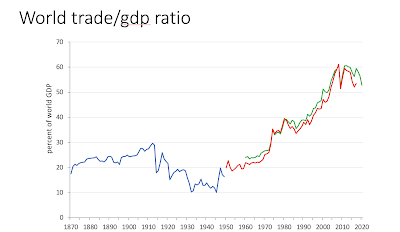
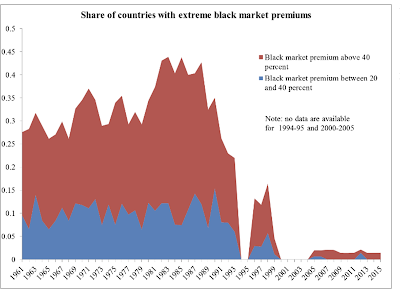

Why no reform in 1970s? “foreign exchange reserves kill the will to reform”
Why reform in 1980s?
Era of scarce foreign exchange – all three BOP shocks.
Goal: increase foreign exchange earnings by increasing exports.
Learning from experience – cost of import controls, benefit of exports
Shift from import repression to export promotion to overcome foreign exchange shortage
Michael Bruno (World Bank): “We did more for Kenya by cutting off aid for one year than by giving them aid for the previous three decades”
Aid lets a country put off reform.
I asked one question, about the importance of an open capital account. That also used to be gospel, now under debate. Doug's answer was interesting: In these cases, a free currency market was crucial, but free capital markets less so.
I'm working madly to finish The Fiscal Theory of the Price Level. This is a draft of Chapter 21, on how to think about today's emerging inflation and what lies ahead, through the lens of fiscal theory. (Also available as pdf). I post it here as it may be interesting, but also to solicit input on a very speculative chapter. Help me not to say silly things, in a book that hopefully will last longer than a blog post! Feel free to send comments by email too.
Chapter 21. The Covid inflation
As I finish this book's manuscript in Fall 2021, inflation has suddenly revived. You will know more about this event by the time you read this book, in particular whether inflation turned out to be ``transitory,'' as the Fed and Administration currently insist, or longer lasting. This section must be speculative, and I hope rigorous analysis will follow once the facts are known. Still, fiscal theory is supposed to be a framework for thinking about monetary policy, so I would be remiss not to try.
 |
| Figure 1. CPI through the Covid-19 recession. |
Figure 1 presents the CPI through the covid recession. Everything looks normal until February 2021. From that point to October 2021 the CPI rose 5.15% (263.161 to 276.724), a 7.8% annual rate.
What happened, at least through the lens of the simple fiscal theory models in this book? Well, from March 2020 through early 2021, the U.S. government -- Treasury and Fed acting together -- created about $3 trillion new money and sent people checks. The Treasury borrowed an additional $2 trillion, and sent people more checks. M2, including checking and savings accounts, went up $5.5 trillion dollars. $5 trillion is a nearly 30% increase in the $17 trillion of debt outstanding at the beginning of the Covid recession. Table 21.1 and Figure 2 summarize. ($3 trillion is the amount of Treasury debt purchased by the Fed, and also the sum of larger reserves and currency. Federal debt held by the public includes debt held by the Federal Reserve.)
 |
| M2, debt, and monetary base (currency + reserves) through the Covid-19 recession. |
 |
Some examples: In March 2020, December 2020, and again in March 2021, in response to the deep recession induced by the Covid-19 pandemic, the government sent ``stimulus'' checks, totaling $3,200 to each adult and $2,500 per child. The government added a refundable child tax credit, now up to $3,600per child, and started sending checks immediately. Unemployment compensation, rental assistance, food stamps and so forth sent checks to people. The ``paycheck protection program'' authorized $659 billion to small businesses. And more. The payments were partly designed as economic insurance, transfers from people doing well during covid to those who had lost jobs or businesses, and efforts to keep businesses from failing. But they were also in large part, intentionally, designed as fiscal-monetary stimulus to boost aggregate demand and keep the economy going. The massive ``infrastructure'' and ``reconciliation'' spending plans occupied the Congress through 2021, adding expectations of more deficits to come.
From a fiscal-theory perspective, the episode looks like a classic fiscal helicopter drop. There is a large increase in government debt, transferred to people, who do not expect that debt to be repaid. It is a``fiscal shock,'' a decline in surpluses s_t, with no expectation of larger subsequent surpluses. Of course it led to inflation!
Should the Fed raise interest rates fast? Or should it leave them alone, figuring inflation will be "transitory?"
Lots of models, including ones I play with, predict that a constant unchanging interest-rate peg leads to stable inflation. If there is a fiscal shock, it leads to a one-period price-level jump, but no further inflation, so long as the interest rate stays where it is. The models in the first few chapters of The Fiscal Theory of the Price Level have this feature, also "Michelson Morley, Fisher and Occam.'' Martin Uribe has also written about this issue, here for example.
The simplest example is \[i_t = E_t \pi_{t+1}\] \[(E_{t+1}-E_t) \pi_{t+1} = -(E_{t+1}-E_t) \sum_{j=0}^{\infty} \rho^j \tilde{s}_{t+j} \] where \(\tilde{s}\) denotes real primary surpluses scaled by the value of debt. If the interest rate \(i_t\) does not move, expected inflation does not move. A fiscal shock (negative \(\tilde{s}\) ) gives a one-period unexpected inflation, devaluing outstanding debt; essentially a Lucas-Stokey state-contingent default. Sticky prices smooth all this out over a year or two.
You can replace the latter with standard new-Keynesian equilibrium-selection rules if you want. This isn't really about fiscal theory; the key is rational forward-looking expectations in the first equation, which also hold in the standard sticky-price extensions. This "Fisherian" property is a common though widely ignored prediction of most new-Keynesian models.
It certainly seems plausible that we are seeing an inflationary fiscal shock, from trillions of money printed up and sent to consumers, while interest rates stay fixed. These models predict that such inflation will indeed be transitory if the Fed does not raise interest rates, and will rise if it does!
However, like all lower-rates-to-lower-inflation arguments, there are lots of warnings here. In particular, the "transitory" inflation could last a long time once we put in sticky prices. The trick only works if the Fed is completely committed to not raising rates, to waiting as long as it takes for inflation to settle back down on its own. If people suspect the Fed will raise rates, inflation rises. There are lots of temporary forces that go in the other direction. And there may be more fiscal shocks -- I sort of see one brewing in Congress -- so we may not be done with the unexpected inflation term.
FTPL section 5.3 has a long discussion of all the preconditions for lower interest rates to bring down inflation, which still obtain. But we haven't been talking about this issue much since the low-inflation zero-bound era ended, and the discussion that maybe determined, permanent, pre-announced interest rate rises could eventually bring up inflation. The opposite sign works as well.
In these models, with a few more ingredients than I show above, the Fed can also lower inflation by raising rates. Raising rates gives a temporary inflation decline before going the other way. So, the Fed has to raise rates, push inflation down, then quickly get on the other side. That's the historical pattern, and what it will likely do. But it's only honest, and fun, to remember the prediction of the opposite possibility and to think about how it might work out.
******
Update. A second try, with more English. The government, Fed and Treasury, basically printed up about $5 trillion of new cash and treasury debt -- these are largely perfect substitutes so the composition doesn't really matter -- with no change at all in plans to repay debt. By simple FTPL, a 25% increase in debt with no increase in expected future surpluses generates a 25% rise in the price level, 25% cumulative inflation. It basically defaults on outstanding debt and transfers that value to the recipients of stimulus.
But then it ends. If there is no more issue of nominal debt, without additional surpluses, then there is no more inflation.
Additional issues of nominal debt can come from more unbacked fiscal expansion, or it can come from monetary policy. Monetary policy also puts extra government debt (same thing as interest-paying reserves) out there, with (of course) no change in fiscal policy.
So there is the FTPL case for "transitory."In the long run, no change in interest rate puts no extra government debt in the system, and higher nominal interest rates must mean eventually higher inflation and hence more unbacked government debt in the system.
Torsten Slok passed on a lovely graph, created from the Philadelphia Fed survey of professional forecasters:

It's not just the Fed, whose own forecasts and dot plots have the same characteristics.
Some potential lessons
1) Just you wait. There is the story of the hypochondriac, who when he died at 92 had inscribed on his tombstone "See, I told you I was sick." More serious stories have been told of the 1980s high interest rates, worried for a decade about inflation that could have come but never did. Or the famous "Peso problem," persistently low forward rates that eventually proved to be right.
2) A lot of fun is made in survey research about the "irrational" expectations revealed by surveys. Whether "professionals" are involved is often a used to select between "rational" and "noise" investors in asset pricing studies. Hello, the professionals are just as behavioral as the rest of us. As are the Fed economists whose forecasts look the same. The argument from irrational-looking surveys to let the "experts" run and nudge things never did hold water.
3) Just what do survey forecasts mean? How many of these Wall Street economists, or their trading desks are heavily short 10 year bonds? How many of them lost money on that trade for 20 years running? It's a good bet the same economists work for firms that, to the contrary, have been riding this... well, call it a trend, call it a bubble, call it a golden two decades for long-term bonds. What is the risk premium story for believing long term bonds are about to take a bath, but buying a lot of them anyway?
4) Just what do survey forecasts mean? We ask people "what do you expect," and scratch our heads that they do not reply with numbers that make sense as true-measure conditional means. The event of a sharp raise in rates might come with substantially higher marginal utility, i.e. a very bad event. Reporting risk-neutral measure, probability times marginal utility might make sense for many reasons. Reporting a 40% quantile, shaded to bad news, makes a lot of sense for many reasons. Clients who make money don't complain. Clients who lose money do.
5) Just what do survey forecasts mean? For most surveys, the interesting thing is not the average but the astounding variation around that average. In theory, asset trading should lead to common expectations. In fact it does not. I would love to see the variation around this mean forecast.
Confessions. I've been ... well, not forecasting, but doom and glooming about a sharp interest rate rise for just as long. And, I have to report, the graph has not yet changed my mind. To some extent, one faces the problem of the value investor, who every time the stock goes down has to say, "now it's an even better deal!" I guess I have company. See, I told you I was sick?
Greg Ip has a great column in the WSJ on Bidenomics. It's not long, it's so well written that it's hard to condense the good parts, and you should really read it all.
There is an intellectual framework to Bidenomics, and with that a scarily more durable move on economic policy.
There used to be
"certain rules about how the world worked: governments should avoid deficits, liberalize trade and trust in markets. Taxes and social programs shouldn’t discourage work."
By contrast President Biden's (really his team's) "embrace of bigger government" is founded on different economic ideas. To wit, abridged:
Growth
Old view: Scarcity is the default condition of economies: the demand for goods, services, labor and capital is limitless, their supply is limited. ...faster growth requires raising potential by increasing incentives to work and invest. Macroeconomic tools—monetary and fiscal policy—are only occasionally needed to deal with recessions and inflation.
New view: Slack is the default condition of economies. Growth is held back not by supply but chronic lack of demand, calling for continuously stimulative fiscal and monetary policy. J.W. Mason.. said, that “‘depression economics’ applies basically all of the time.”
I guess I'm an old fogie.
Essay on monetary policy in National Review Online.
Short version: The Fed's monetary policy has returned to the intellectual framework of the late 1960s. At best "expectations" now float around as an independent force, manipulable by speeches, but not tied to patterns of action by the Fed as analysis since the 1980s would require.
If you follow the conventional reading of how monetary policy works, that observation leads to a natural prediction: we're on the verge of reliving 1970s inflation. (Fiscal policy, entitlements, regulation and cities seem to be headed also to 1970s policy on steroids.)
True, the Fed says "we have the tools" to stop inflation should it break out. But that tool is to rerun 1980. Does the Fed have the will? Will the Fed really induce a 2 year agonizing recession to bring down inflation, followed by 15 years of historically unprecedented high interest rates? Or will the Fed do what it did three times before that -- half-hearted interest rate rises that brought milder recessions, and a quick backtrack? Having even a nuclear weapon is useless if people stop believing you will use it.
I don't follow that conventional reading, so I'm not confidently predicting inflation. I worry more about fiscal affairs directly than about the Fed, which leads to a fear of a larger but less predictable inflation, that the Fed will have little power to stop. But mine is definitely a minority view.
Does the Fed’s Monetary Policy Threaten Inflation? (Contains Spoilers)
The central bank is headed back to the Seventies — a rerun that no one should want.
Does the Fed’s monetary policy threaten inflation? By conventional measures, yes. But those conventional measures have failed in the past. I believe that the short-run danger is less than it appears, but the long-run danger is larger.
If one reads Fed statements through conventional glasses, monetary policy seems to have been reset to the 1960s, and we know how that worked out.
Can central banking as we know it be the primary tool of macroeconomic stabilization in the industrial world over the next decade?...There is little room for interest rate cuts..QE and forward guidance have been tried on a substantial scale....It is hard to believe that changing adverbs here and there or altering the timing of press conferences or the mode of presenting projections is consequential...interest rates stuck at zero with no real prospect of escape - is now the confident market expectation in Europe & Japan, with essentially zero or negative yields over a generation....The one thing that was taught as axiomatic to economics students around the world was that monetary authorities could over the long term create as much inflation as they wanted through monetary policy. This proposition is now very much in doubt.Agreed so far, and well put. "Monetary policy" here means buying government bonds and issuing reserves in return, or lowering short-term interest rates. I am still intrigued by the possibility that a commitment to permanently higher rates might raise inflation, but that's quite speculative.
Limited nominal GDP growth in the face of very low interest rates has been interpreted as evidence simply that the neutral rate has fallen substantially....We believe it is at least equally plausible that the impact of interest rates on aggregate demand has declined sharply, and that the marginal impact falls off as rates fall. It is even plausible that in some cases interest rate cuts may reduce aggregate demand: because of target saving behavior, reversal rate effects on fin. intermediaries, option effects on irreversible investment, and the arithmetic effect of lower rates on gov’t deficitsCentral banks are a lot less powerful than everyone seems to think, and potentially for deep reasons. File this as speculative but very interesting. Larry has many thoughts on why lowering interest rates may be ineffective or unwise.
Call it the black hole problem, secular stagnation, or Japanification, this set of issues should be what central banks are worrying about...We have come to agree w/ the point long stressed by Post Keynesian economists & recently emphasized by Palley that the role of specific frictions in economic fluctuations should be de-emphasized relative to a more fundamental lack of aggregate demand.
The right issue for macroeconomists to be focused on is assuring adequate aggregate demand.My jaw drops.


