Monday, March 24, 2014

Stein on Financial Stability in Monetary Policy

Fed governor and Harvard Professor Jeremy Stein gave an important speech on March 21, Incorporating Financial Stability Considerations into a Monetary Policy Framework. I have a few minor criticims, specifically on standard errors, causal mechanism, and Lucas critique. But it's great for Jeremy to think out loud this way, and give me occasion to do the same. You should read the whole thing.

Stein's bottom line:
...all else being equal, monetary policy should be less accommodative--by which I mean that it should be willing to tolerate a larger forecast shortfall of the path of the unemployment rate from its full-employment level--when estimates of risk premiums in the bond market are abnormally low.
This view has put Stein a bit in the camps of the hawks, meaning simply those who for one reason or another think the time to raise rates is sooner rather than later.

Friday, March 21, 2014

A World Without Banks?


A graphic short story in this month's "capital ideas."  Click on the link or the image to read the whole thing (4 panels). If you can find the print magazine, the visual quality is much better. I think it does a great job of making economic ideas visual without too many talking heads and big balloons full of text. More of these to come in future "Capital Ideas." More work from this unusually talented graphic novelist here. (My side of this "debate" is a bit captured here.)

Thursday, March 20, 2014

Hello Discretion

Today, the much-anticipated first Fed policy statement of the Yellen era came out. FOMC statement, here.

Some interesting tidbits:
The Committee will closely monitor incoming information on economic and financial developments in coming months and will continue its purchases of Treasury and agency mortgage-backed securities, and employ its other policy tools as appropriate, until the outlook for the labor market has improved substantially in a context of price stability. ... asset purchases are not on a preset course, and the Committee's decisions about their pace will remain contingent on the Committee's outlook for the labor market and inflation as well as its assessment of the likely efficacy and costs of such purchases. 
In determining how long to maintain the current 0 to 1/4 percent target range for the federal funds rate, the Committee will assess progress--both realized and expected--toward its objectives of maximum employment and 2 percent inflation. This assessment will take into account a wide range of information, including measures of labor market conditions, indicators of inflation pressures and inflation expectations, and readings on financial developments. 
With the unemployment rate nearing 6-1/2 percent, the Committee has updated its forward guidance. 
In other words, the committee will do whatever it feels like doing, whenever it feels like doing it, based on whatever information it decides is relevant. The Committee updated its forward guidance by throwing it under a bus, or at least by clarifying that it is of the form "here is what we think now we will want to do in the future, but we can change our minds at any time."

The larger context is the debate between commitment or rules and discretion. Discretion wins.

You might expect me to be fulminating. I'm not. (Though I'm waiting for a rules vs. discretion blast from John Taylor! (Update: here it is.)  I regard this as simply stating reality.

University Debt

Bloomberg has a story on the University of Chicago's big debt expansion. Obviously, it's a topic around faculty lounges too.

A few thoughts. Why does a university simultaneously borrow $3.6  billion but have $6.7 billion Invested? If borrowing is such a big deal, why not just spend the endowment on new buildings?

Answer: universities can borrow at municipal rates, free of federal tax to the lender, if they are building something. Borrowing at tax-free rates makes financial sense, even you just stuff the marginal dollar into endowment. Of course the endowment is not invested in Treasuries -- universities don't do simple tax arbitrage. So the model is more that of a leveraged hedge fund -- borrow at low tax-free rates, up to the limit imposed by tax law, and invest in high risk, (hopefully) high-return projects like hedge funds, private equity, real estate etc. The fact that investment returns are also not taxed makes this a doubly advantageous strategy. Donors: if you give now, your gift grows tax-free, while if you earn the rate of return and then give the money to the university, you pay taxes on the intervening returns.

Monday, March 17, 2014

House of Debt

Atif Mian and Amir Sufi have started a blog related to their new book, "House of Debt." Amir and Atif are admirably data-oriented, which ought to make for good reading.

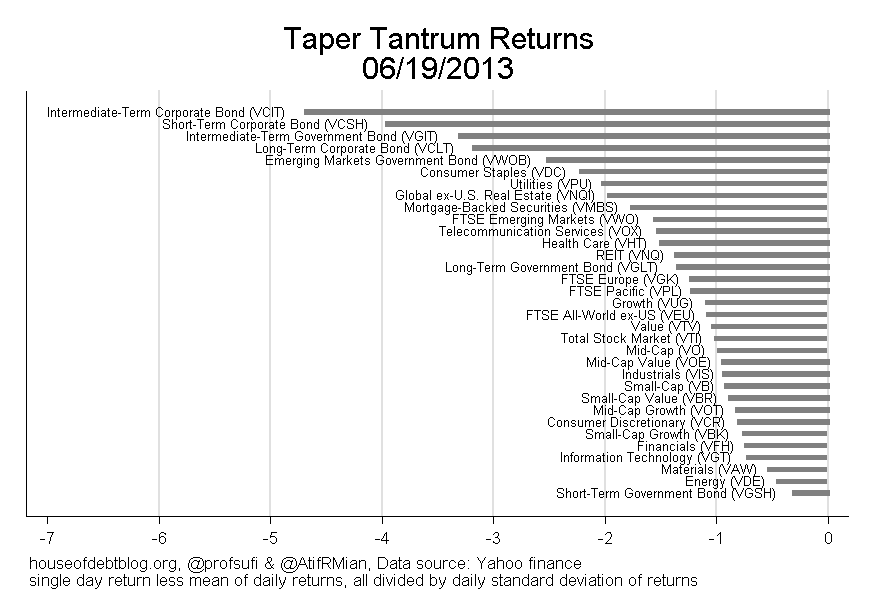
Today's post "Fed Meetings and Asset Prices" is a good example. They put together one-day returns on the June 19 "taper tantrum" when the Fed announced it might (heavens) start tapering bond purchases. There is, of course, a large literature studying announcement effects. Atif and Amir  put together an unusually wide spectrum of asset classes.


Monday, March 10, 2014

Goodman Plan

John Goodman has an excellent health-care piece at National Review Online. You don't have to subscribe to every element of his "plan" to appreciate many of his trenchant observations of coming Obamacare disasters. (Any "plan" that advertises it is crafted to meet perceived political constraints is bound to be less than perfect as a matter of economics.)

The slight weak point: he keeps community rating and guaranteed issue, but talks about how people need to sign up immediately or lose that benefit as they do in Medicare. I'm not sure just how he wants to do that or if that's realistic. But the big picture is right on: deregulated, individual, portable insurance.

Transferability between plans is a nice point:  "if an expensive-to-treat patient moves from Plan A to Plan B, the former has to compensate the latter for any above-average expected costs — just the way Medicare compensates private plans."

But read it for the mess we're in now. Lots of looming problems have not made headlines. Yet.

Asness and Liew on Efficiency

Source: Institutional Investor
Cliff Asness and John Liew -- Chicago PhD's and now founding principals of AQR -- have a nice piece in Institutional Investor on Fama, Shiller, Nobel Prizes and efficiency.

They do a good job on the joint hypothesis theorem -- maybe a more important part of Fama's 1970 paper than efficiency itself -- and value and momentum strategies.

They point out one big difficulty for the inefficiency view (p.5). If value stocks are just overlooked and growth stocks irrationally overpriced, why do value stocks all subsequently rise or fall together, and growth stocks go the other way? "Cheap stocks would get cheaper across the board at the same time. It didn't matter if the stock was an automaker or an insurance company. When value was losing it was losing everywhere."

A second very important theorem: the average investor must hold the market portfolio, so alpha is a zero sum game. If you're going to profit, it helps a lot to identify just who the morons are whose money you are taking and why they're willing to give it to you. Everyone thinks the other guy is "behavioral." Are you sure it's not you?

Saturday, March 8, 2014

Employment-Population Ratio: war of the graphs

The comments on my last post were particularly good, and pointed to some alternative graphs. And, I think, to the important conclusion, that there is no substitute really for sitting down and doing some economics.

Thursday, March 6, 2014

Friday, February 28, 2014

Budish, Cramton and Shim on High Frequency Trading

Today I taught a really nice paper to my MBA class, "The High-Frequency Trading Arms Race" by Eric Budish, Peter Cramton and John Shim. I've been fascinated by high frequency trading for a while (Some previous posts in the new "trading" label on the right.)

Eric, Peter and John look at the arbitrage between the Chicago S&P500 e-mini future and the New York S&P500 SPDR.  This is a nice case, because there are no fancy statistical strategies involved: high speed traders simply trade on short-run deviations between these two essentially identical securities. Some cool graphs capture the basic message.

First, we get to look at the quantum-mechanical limits of asset pricing. At a one hour frequency, the two securities are perfectly correlated.

But as we look at finer and finer time intervals, price changes become less and less correlated.  If the ES rises in Chicago, somebody has to send a buy message to New York. We write down Brownian motions for convenience, but when you actually look at very high frequency they break down.

It's not obvious this activity "adds liquidity." If you leave a SPY limit order standing, then the fast traders will pick you off when they see the ES rise before you do. The authors  call this "sniping."

Wednesday, February 26, 2014

Cost-Benefit Analysis for Financial Regulation

Is cost-benefit analysis a good idea for financial regulation? Ostensibly an essay addressing that question, this piece expanded to a rather critical survey of financial regulation, as I thought about what the costs and benefits of financial regulation are. It's based on a presentation I gave at the Sloan Conference on Benefit-Cost Analysis at the University of Chicago Law School last fall, with many interesting papers, most of them more optimistic.

HTML here, to make it easy to read. Pdf and permanent link here which is where updates and a final (I hope) published version will reside.

Introduction

Regulations should only be enacted if their benefits exceed their costs. Who can object to that?

That’s not the question. The question is whether legal requirements for cost-benefit analysis, a new legal and regulatory process erected around such calculations, a “judicially enforced quantification” (Coates 2014) on top of the current regulatory procedure, would produce better policies. Would laws forcing regulatory agencies to produce cost/benefit analysis, of certain specified types, with specified codified methods, and allowing proponents and opponents of regulation – who often have strong private reasons to favor one outcome or other – to challenge regulations on the basis of cost/benefit analysis – and especially, to challenge the cost-benefit process – overall produce better policy results?

Monday, February 17, 2014

In Box

It is a delight of being an economist how many fascinating papers come through the in box. It is a deep frustration that I don't have the time to read them all.  Here are a few on my in-box today, courtesy of NBER, SSRN, and AEA email lists. Disclaimer: I've only read the abstracts so far. (If you can't get NBER working papers, Google usually finds ungated versions on authors' webpage or ssrn.)

1. The Demise of U.S. Economic Growth: Restatement, Rebuttal, and Reflections by Robert J. Gordon. http://papers.nber.org/papers/W19895

Thursday, February 13, 2014

A Brief History of the Efficient Markets Hypothesis


Back in 2008, Gene Fama made a nice video for the American Finance Association on the history of the efficient markets hypothesis. The video is finally out on the new AFA youtube channel here. You may have to drag the cursor back to see the introduction, on which I did a pretty good job if I do say so myself.

Calomiris and Meltzer on Financial Reform

Charles Calomiris and Alan Meltzer have a very nice Op-Ed on financial reform in the Feb 13 Wall Street Journal
At a Senate hearing in January, Elizabeth Warren asked a bipartisan panel of four economists (including Allan Meltzer ) whether the Dodd-Frank Act would end the problem of too-big-to-fail banks. Every one answered no.
See, economists can agree on something!

Sunday, February 9, 2014

Mulligan interview

Source: Wall Street Journal
The Saturday Wall Street Journal has a nice interview / overview of Casey Mulligan, including this cool cartoon.

Casey has done pioneering work looking really hard at how the ACA and other social programs work, figuring out exactly what their disincentives are, and calculating how much those disincentives are likely to affect people's decisions to work, go to school, and so forth.

This is hard work. Most of the punditocracy (I'm guilty too) sort of waves our hands at disincentives as a big source of economic malaise. Casey puts together the numbers. It's so much easier to just wave your hands about "demand," invent a multiplier, and conclude all our troubles would be over if the government would only spend so many trillions.  Disagree with him if you like, but only by doing the same thing and coming up with different numbers.

Mooconomics

An Economist article and Alex Tabarrok in a Marginal Revolution blog post weigh in on the future and economic structure of moocs (massively open online classes).

A few thoughts on this question, based on my experience teaching a Coursera mooc last fall. (This was supposed to be a short post, and grew out of control. Oh well.)

Yes, moocs potentially upend the fundamental economic structure of teaching. Teaching had been a high marginal cost business. Moocs are a nearly zero marginal cost business.

But.. For now, Moocs are a quite high fixed-cost business. Putting a class up in a mooc is not quite as much work as writing a textbook, but it's nowhere near as easy as teaching a new class. If you're tempted, beware!  Preparing, taping, editing and uploading a lecture is not the same as walking in, telling a few jokes, and getting through the week. Fixing anything that went wrong or updating is costly too.

Thursday, February 6, 2014

Phillips curve, RIP


From February 6 Wall Street Journal. So much macro discussion presumes that inflation is always and everywhere driven by booming economies, it's worth remembering rather striking contrary evidence.

I'm looking for a good graphic, but this last week's failure of emerging market central banks to put a dent in their currencies by raising interest rates is also an important reminder of the limits of monetary policy. As surely Argentina's and Venezuela's troubles are beyond anything a central bank can fix by any finite interest rate.

A mean-variance benchmark

"A mean-variance benchmark for intertemporal portfolio theory." Journal of Finance 69:1-49 (Feburary 2014) DOI: 10.1111/jofi.12099 (ungated version here.)

After all these years, it is still a thrill when an article gets published, and this being a bit of a personal day on the blog (see last post), I can't resist sharing it.

Two stories.

This paper started when John Campbell presented "Who should buy long-term bonds?" (with Luis Viceira, American Economic Review) in the late 1990s at the Booth (then, GSB) finance workshop.  John pointed out that long term bonds are the riskless asset for long-term investors, so we should build portfolio theory around indexed perpetuities, not one-month T bills.

I thought, "that's so obvious!" and, simultaneously, kicking myself, "why didn't I think of that?," a sign of a great paper. (I was also inspired by Jessica Wachter's "Risk Aversion and the Allocation to Long Term Bonds" which came out in the Journal of Economic Theory 2003.)

Favorite Book

My favorite book is back, via the University of Chicago press, in both electronic and print form. A consequence of digital technology, books that once were permanently out of print now can be found again. E-books and short-batch print are great innovations. (Most if it is also on Google Books, a great place to sample.)

I won't pretend objectivity -- or that this has much of anything to do with economics or finance.

What's so great about the book? The writing for one. Sit back and enjoy. Read between the lines too for the breathtaking primary-source scholarship.

This is a book about dead white men and their ideas in an unfashionable time -- the Medici as grand dukes, not the republic and early renaissance. Start right in on p.6-9 with the realities of why the republic did not work, in the circumstance of 16th century Florence. But if you didn't like unfashionable ideas, you wouldn't be here.

It's greatest lesson, to me at least, is empathy. It forces you to work hard to understand how people saw things, and not to fall prey to that common habit of reading our own values and judgments on historical characters. Decisions that make little sense from modern sensibilities become inevitable if you really understand the circumstances, knowledge and mindset of people at the time.

Monday, February 3, 2014