Tuesday, December 2, 2014

McCloskey on Piketty and Friends

Deirdre McCloskey has written an  excellent essay reviewing Thomas Piketty’s Capital in the Twenty-First Century.

As an economic historian and historian of economic ideas, McCloskey can place the arguments into the framework of centuries-old ideas (and fallacies) as few others can. She has read philosophy and "social ethics." She can even knowledgeably review the literary references.

Her central point: "trade-based betterment," (she wisely avoids "capitalism" to emphasize that  the focus on "capital" is about a hundred years out of date) has raised living standards by factors of 30 or more -- much more if you think about health, freedom, lifespan, tavel, etc. unavailable at any price in 1800;  it has led to much greater equality in many things that count, such as consumption, health and so on; and stands to do so again if we do not kill the goose that laid these golden eggs.  From late in the review,
Redistribution, although assuaging bourgeois guilt, has not been the chief sustenance of the poor....If all profits in the American economy were forthwith handed over to the workers, the workers ... would be 20 percent or so better off, right now....
But such
one-time redistributions are two orders of magnitude smaller in helping the poor than the 2,900 percent Enrichment from greater productivity since 1800. Historically speaking 25 percent is to be compared with a rise in real wages 1800 to the present by a factor of 10 or 30, which is to say 900 or 2,900 percent. 
As a too-long post on a far-too-long review of a enormously-too-long book, I'll pass on some particularly good bits with comment.

On the long history of fashionable worrying:

Monday, December 1, 2014

Sequester and vortex redux.

I posted this last week, but I was unaware at the time of the Paul Krugman's "Keynes is slowly winning" post; Tyler Cowen's 15-point response, documenting not only Keynesian failures but more importantly how the policy world is in fact moving decidedly away from Keynesian ideas, right or wrong (that was Krugman's point); and Krugman's retort, predictably snarky and disconnected from anything Cowen said, changing the subject from Keynesian ideas are winning to the standard what a bunch of morons they're not Keynesians though I keep telling them to be. (I like Krugman's chart though. I see a glass half full -- look at all those nominal wage cuts, even in Spain! And look how many people got raises.)

In that context, I added two "Facts in front of our noses." Keynsesians, and Krugman especially, said the sequester would cause a new recession and even air traffic control snafus. Instead, the sequester, though sharply reducing government spending, along with the end of 99 week unemployment insurance, coincided with increased growth and a big surprise decline in unemployment. And ATC is no more or less chaotic than ever. Keynesians, and Krugman especially, kept warning of a "deflation vortex." We and Europe still don't have any deflation, and even Japan never had a "vortex."  These are not personal prognostications, but widely shared and robust predictions of a Keynesian worldview. Two strikes. Batter up. 

The original: (This is a re-post if you saw it the first time around, but easier to copy and paste than link.) 
 
Multiplier? What multiplier? 

Saturday, November 29, 2014

Frameworks for Central Banking in the Next Century

The special issue of the JEDC containing papers from the conference "Frameworks for Central Banking in the Next Century" is available until Jan 18 online for free. My "monetary policy with interest on reserves" is here.  Alas, Elsevier doesn't allow me to post a pdf and only allows free access until Jan 18, so if you want pdfs grab them now. 

The lineup is pretty impressive. Of those I have read, I highly recommend Sargent, Prescott, Ohanian, Ferguson and Plosser to blog readers. In particular, if you thought Friedman was always and everywhere MV=PY and 4%, read Sargent.

The lineup:

Wednesday, November 26, 2014

Target the spread?


To send you off with some more Thanksgiving good cheer, here is another out of the box Neo-Fisherian idea.

Perhaps the Fed (or the Treasury) should target the spread between real and nominal interest rates.

Above, I plotted the real (TIPS) and nominal 5 year rates. By the usual relationship \[ i_t = r_t + E_t \left[ \pi_{t+1} \right] \] we typically interpret the difference between real (r) and nominal (i) rate as the expected inflation rate.

Now, the usual Neo-Fisherian idea says, peg the nominal rate (i), eventually the real rate (r) will settle down, and inflation will follow the nominal rate. It's contentious, among other reasons, because we're not quite sure how long it takes the real rate to settle down, and there is some fear that real rate movements induce a temporarily opposite move in inflation.

So why not target the spread? The Fed or Treasury could easily say that the yield difference between TIPS and Treasuries shall be 2%. (I prefer 0, but the level of the target is not the point.)  Bring us your Treasuries, say, and we will give you back 1.02 equivalent TIPS. Give us your TIPS, and we will give you back 0.98 Treasuries. (I'm simplifying, but you get the idea.) They could equivalently simply intervene in each market until market prices go where they want. Or offer nominal-for-indexed swaps at a fixed rate.

Now, I think, the Neo-Fisherian logic is even tighter. If the government targets the difference \( i_t - r_t  \), in a firmly committed way, \( E_t \left[ \pi_{t+1} \right] \) is going to have to adjust.  I plotted 5 years, because I'm attracted to the idea of nailing down 5 year inflation expectations, but the general idea works across the maturity spectrum.

Sequester, growth, and the deflation that did not bark.

Multiplier? What multiplier? 
Wall Street Journal, November 26 2014:
The economy expanded at its fastest pace in more than a decade during the spring and summer,... Gross domestic product...grew at a seasonally adjusted annual rate of 3.9% in the third quarter... combined growth rate in the second and third quarters at 4.25%, affirming the best six-month pace since the second half of 2003." 
The upward revision to overall growth, driven by [sic] stronger consumer and business spending and a smaller drag from inventory investment, surprised economists... 
Paul Krugman, February 22 2013, "Sequester of Fools"
The sequester, by contrast, will probably cost “only” around 700,000 jobs.
New York Times, Februrary 21 2013, "Why Taxes Have to Go Up"
Democrats and Republicans remain at odds on how to avoid a round of budget cuts so deep and arbitrary that to allow them now could push the economy back into recession. The cuts, known as a sequester, will kick in March 1 [my emphasis]

Sunday, November 23, 2014

Behavioral Political Economy

I was interested to read "Behavioral Political Economy: A Survey" by Jan Schnellenbach and Christian Schubert. (HT marginal revolution's irresistible links.)

Context: I have long been puzzled at the high correlation between behavioral economics and interventionism.

People do dumb things, in somewhat predictable ways. It follows that super-rational aliens or divine guidance could make better choices for people than they often make for themselves. But how does it follow that the bureaucracy of the United States Federal Government can coerce better choices for people than they can make for themselves?

For if psychology teaches us anything, it is that people in groups do even dumber things than people do as individuals -- groupthink, social pressure, politics, and so on -- and that people do even dumber things when they are insulated from competition than when their decisions are subject to ruthless competition.

So on logical grounds, I would have thought that behavioral economists would be libertarians. Where are the behavioral Stigler, Buchanan, Tullock, etc.?  The case for free markets never was that markets are perfect. It has always been that  government meddling is  worse. And behavioral economics -- the application of psychology to economics -- seems like a great tool for understanding why governments do so badly. It might also inform us how they might work better; why some branches of government and some governments work better than others.

This nice paper got my attention, since the paper says that's starting to happen.
...Assuming cognitive biases to be present in the market, but not in politics, behavioral economists often call for government to intervene in a “benevolent” way. Recently, however, political economists have started to apply behavioral economics insights to the study of political processes, thereby re-establishing a unified methodology. This paper surveys the current state of the emerging field of “Behavioral Political Economy”
I came away horribly disappointed. Not with the paper, but with the state of the literature that the authors ably summarize.

Saturday, November 22, 2014

Writing compactly

A correspondent sends a suggested edit of a part of my writing tips for PhD students

With markup

Keep it short

Keep the paper as short as possible. Be concise. Every word must count. As you edit the paper ask yourself constantly, “can I make the same my point in less space?” and “Do Must I really have to say this?” Final papers should be no more than  under 40 pages, drafts should be shorter. (Do as I say, not as I do!) Shorter is better.
 
Clean: 

Keep it short

Be concise. Every word must count. As you edit, ask yourself, “can I make my point in less space?” and “must say this?” Final papers should be under 40 pages, drafts shorter.  Shorter is better.

Well, I did say "do as I say, don't do as I do!" 

Friday, November 21, 2014

Segregated Cash Accounts

An important little item from the just released minutes of the October Federal Open Market Committee meeting will be interesting to people who follow monetary policy and financial reform issues.
Finally, the manager reported on potential arrangements that would allow depository institutions to pledge funds held in a segregated account at the Federal Reserve as collateral in borrowing transactions with private creditors and would provide an additional supplementary tool during policy normalization; the manager noted possible next steps that the staff could potentially undertake to investigate the issues related to such arrangements.
A slide presentation by the New York Fed's Jamie McAndrews explains it.

The simple version, as I understand it, seems like great news. Basically, a company can deposit money at a bank, and the bank turns around and invests that money in interest-paying reserves at the Fed. Unlike regular deposits, which you lose if the bank goes under, (these deposits are much bigger than the insured limit) the depositor has a collateral claim to the reserves at the Fed.

This is then exactly 100% reserve, bankruptcy-remote, "narrow banking" deposits.  I argued for these in "toward a run-free financial system" as a substitute for all the run-prone shadow-banking that fell apart in the financial crisis. (No, this isn't going to siphon money away from bank lending, as the Fed buys Treasuries to issue reserves. The volume of bank lending stays the same.)

Dusty corners of the market

Thursday and Friday I attended the NBER Asset Pricing conference. As usual it was full of interesting papers and sharp discussion. Program here.

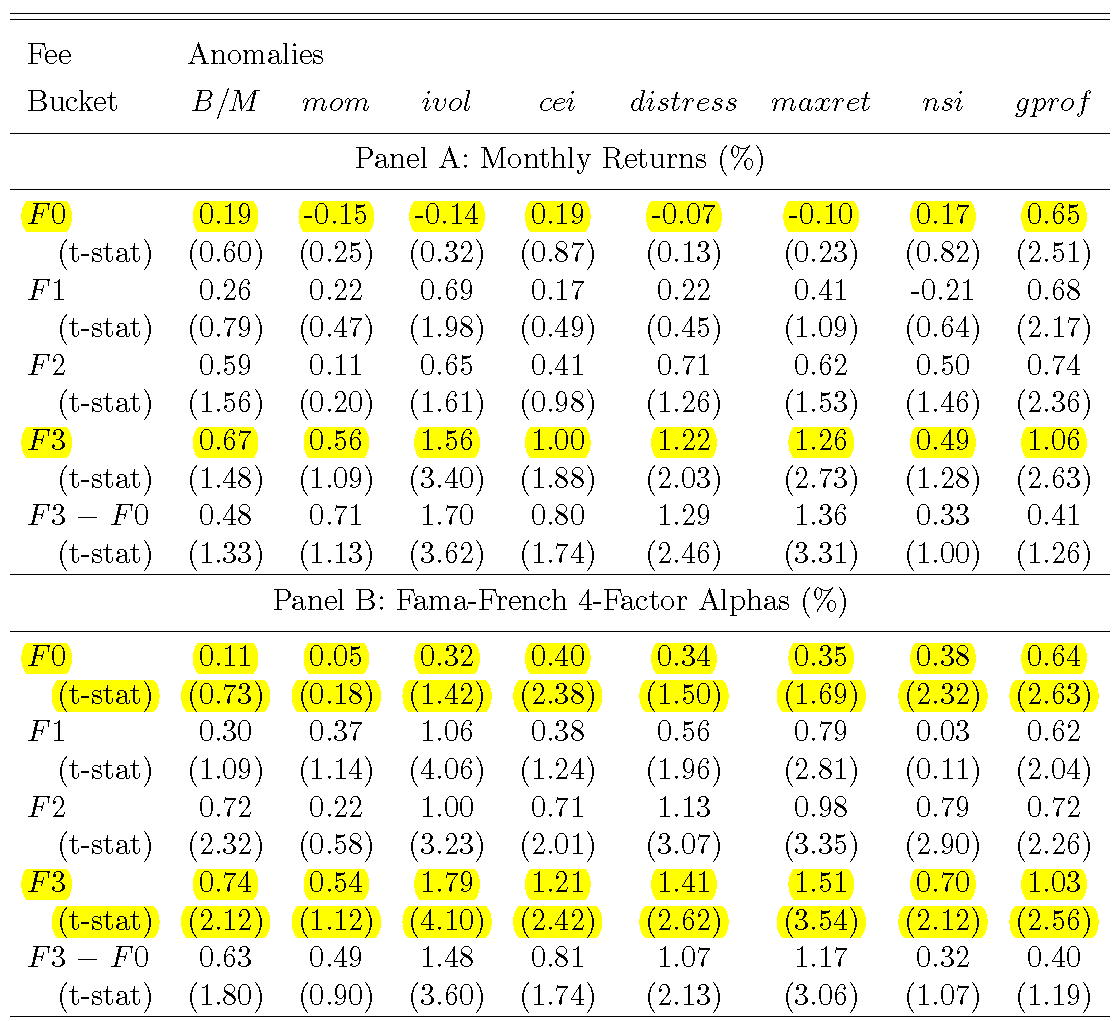
A bloggable insight: Itamar Drechsler, and Qingyi F. Drechsler "The Shorting Premium and Asset Pricing Anomalies." They carefully found the cost to short-sell stocks.

Here's their Table 5. F0 are all the easy to short stocks. F3 are the hardest to short stocks. They construct long-short anomaly portfolios in each group. "F 0 Mom" for example is the average monthly return of past winners minus that of past losers, among the easy to short stocks. Now compare the F0 row to the F3 row. The anomaly returns only work in the hard-to-short portfolios.

The second panel shows  Fama-French alphas, which are better measured. The sample is alas small. But the result is cool.

The implication is that a lot of anomalies exist only in hard to trade stocks. There is a lot more in the paper, of course.


Table 5: Anomaly Returns Conditional on Shorting Fees

We divide the short-fee deciles from Table 2 into four buckets. Deciles 1-8, the low-fee stocks, are placed into the F0 bucket. Deciles 9 and 10, the intermediate- and high-fee stocks, are divided into three equal-sized buckets, F1 to F3, based on shorting fee, with F3 containing the highest fee stocks. We then sort the stocks within each bucket into portfolios based on the anomaly characteristic and let the bucket's long-short anomaly return be given by the di erence between the returns of the extreme portfolios. Due to the larger number of stocks in the F0 bucket, we sort it into deciles based on the anomaly characteristic, while F1 to F3 are sorted into terciles. Panel A reports the monthly anomaly long-short returns for each anomaly and bucket. Panel B reports the corresponding FF4 alphas. Panel C reports the FF4 + CME alphas. The sample period is January 2004 to December 2013.

(From Table 4 caption) The anomalies are: value-growth (B=M), momentum (mom), idiosyncratic volatility (ivol), composite equity issuance (cei), nancial distress (distress), max return (maxret), net share issuance (nsi), and gross pro tability (gprof). The sample is January 2004 to December 2013.

Thursday, November 20, 2014

Inequality at WSJ

"What the Inequality Warriors Really Want" a Wall Street Journal oped on inequality. It's a much edited version of my evolving "Why and How we Care About Inequality" essay. Any writers will appreciate the pain that cutting so much caused.

As usual I can't post the whole thing for 30 days, but you might find the WSJ short version interesting, especially if you couldn't slog through the whole thing. Their comments might be fun too.

Monday, November 17, 2014

Guilds

The Syndics of the Drapers' Guild by Rembrandt, 1662.

I enjoyed Sheilagh Ogilvie's The Economics of Guilds in the latest Journal of Economic Perspectives. Bottom line:
..the behavior of guilds can best be understood as being aimed at securing rents for guild members; guilds then transferred a share of these rents to political elites in return for granting and enforcing the legal privileges that enabled guilds to engage in rent extraction. 
The paper nicely works through all the standard pro-guild and pro-regulation arguments. If you just replace "Guild" with "regulatory agency" it sounds pretty fresh.

Did guilds provide contract enforcement, security in weak states, property right protections not otherwise available? No.

Thursday, November 13, 2014

Who is afraid of a little deflation?

Who is afraid of a little deflation? Wall Street Journal Op-Ed.

Fears of "tipping" into deflation are overblown. I poke a little fun at sticky wages, Fed headroom, deflation-induced defaults and the long-predicted Keynesian deflationary spiral that never seems to happen, and the doom and gloom language from the ECB, IMF and other worriers who just happen to (of course) want to spend trillions to fix this latest "biggest economic problem."

One point that went by a little too quickly in the interest of space: Deflation can be a symptom of bad things. The issue is whether deflation is by itself a bad thing, and causes further damage.

Also, I should have been clearer on a big bottom line: we don't need huge "infrastructure" projects just to save us from deflation.  

They ask me not to post the whole thing for 30 days, so those of you without WSJ access will just have to google or wait breathlessly.

Update: Ed Leamer wrote a great similar piece for Economists' Voice a while back "Deflation Dread Disorder; 'The CPI is Falling!'"  In addition to a better title, he's got a cool Godzilla reference and picture.

Reason for big Government: The Firm

I enjoyed John Goodman's essay at Forbes.com, "Reason for big Government: The Firm"
California has a new law that requires all eggs sold in the state to come from chickens that are housed in roomier cages. Specifically, the hens “must be able to lie down, stand up and fully spread their wings.” 
So how many Californians have been arrested for eating the wrong kind of egg? Zero. Not even one? Not one. Actually, the law doesn’t take effect until January, but even then egg eaters will have nothing to fear. The reason: the law doesn’t apply to people who eat eggs. It only applies to people who sell eggs.

Thursday, November 6, 2014

The Neo-Fisherian Question

On the "Neo-Fisherian" idea that maybe raising interest rates raises inflation, Nick Rowe asks an important question. What about the impression, most recently in a host of countries that seemed to raise rates "too early" and then backed off, that raising interest rates lowers inflation? (And thanks to commenter Edward for the pointer.)

Partly in answer, and partly just in mulling it over, I think I can boil down the issue to this question:

If the central bank pegs the nominal rate at a fixed value, is the economy eventually stable, converging to the interest rate peg minus the real rate? Or is it unstable, careening off to hyperinflation or deflationary spiral?

Here are some possibilities to consider. At left is what we might call the pure neo-Fisherian view. Raise interest rates, and inflation will come.

I guess there is a super-pure view which would say that expected inflation rises right away. But that's not necessary. The plot in Monetary Policy with Interest on Reserves worked out a simple sticky price model. In that model, dynamics were pretty much as I have graphed to the left: real rates rise for the period of price stickiness, then inflation sets in.

Now,  here is a possibility that I think might satisfy  Neo-Fisherism, Nick, and a lot of people's intuition:

In response to the interest rate rise, indeed in the short run inflation declines. But if the central bank were to persist, and just leave the target alone, the economy really is stable, and eventually inflation would give up and return to the Fisher relation fold. (I was trying to get the model of "Interest on Reserves" to produce this result, but couldn't do it. Maybe fancier price stickiness, habits, adjustment costs...?)

This view would account for the Swedish and other experience.

We don't see the Fisher prediction because central banks never leave interest rates resolutely pegged. Instead, they pursue short-run pushing inflation around.

Tuesday, November 4, 2014

Across the Great Divide

Across the Great Divide: New Perspectives on the Financial Crisis is published. This is the book form of the joint Brookings-Hoover conference on the financial crisis, organized by Martin Baily and John Taylor.  The link allows you to download the whole thing as pdf for free, or buy the book.

There will be a webcast book event on Wed Nov 5, from the Hoover Institution's Washington D. C. offices, also available after the fact at that link.

My "Toward a Run-Free Financial System" is in it, in published form, also available on my webpage.

Larry Summers' Low Equilibrium Real Rates,  Financial Crisis, and Secular Stagnation is an interesting read in his evolving case for "secular stagnation," which I'm sure will get a lot of attention.

But lots of the other papers are really interesting as well.
Previous posts on this interesting conference here and on the Summers speech here.

The rest of the table of contents:

Introduction
By Martin Neil Baily and John B. Taylor

Thursday, October 16, 2014

Monetary Policy with Interest On Reserves

Or, Heretics Part II

I just finished a big update of a working paper, "Monetary Policy with Interest on Reserves." It also sheds light on the question, what is the sign of monetary policy? (Previous posts here, here and here).

Again, the big issue is whether the "Fisherian" (Shall we call it "Neo-Fisherian?") possibility works. The Fisher equation says nominal interest rate = real interest rate plus expected inflation. So by raising nominal interest rates, maybe expected inflation rises?

The usual answer is "no, because prices are sticky." So, I worked out a very simple new-Keynesian sticky price model in which prices are set 4 periods in advance.

The top left panel of the graph shows the heretical result. I suppose the Fed raises interest rates by 1 percentage point for two periods, then brings interest rates back down (blue line). Prices are stuck for 4 periods (red line) so don't move. After 4 periods prices fully absorb the repressed inflation -- the Fisher equation works great, only waiting for prices to be able to move.

In the meantime the higher real interest rates (green) induce a little boom in consumption. So, raising rates not only raises inflation, it gives you a little output boost along the way! Raising rates forever does the same thing, but sets off a permanent inflation once price stickiness ends.  

Why do conventional models give a different result?

Heretics

Low inflation is back in the news.  The Wall Street Journal covers the latest decline in European inflation. Peter Schiff has a nice article explaining that inflation is not such a great thing, unless of course you're a government that wants to pay back debt with cheap money. I dipped into this heresy in an earlier post, explaining that maybe zero rates and slight deflation just represent the arrival of Milton Friedman's optimal quantity of money.

But this news also brings to mind some thoughts on the second heresy -- maybe we have the sign wrong, and we're getting low inflation or deflation because interest rates are pegged at zero, and maybe the way to raise inflation (if you want to) is for the Fed to raise interest rates, and leave them there. (Earlier posts on this question  here and here)

Back in 2010, Narayana Kocherlakota explained the basic idea
Long-run monetary neutrality is an uncontroversial, simple, but nonetheless profound proposition. In particular, it implies that if the FOMC maintains the fed funds rate at its current level of 0-25 basis points for too long, both anticipated and actual inflation have to become negative. Why? It’s simple arithmetic. Let’s say that the real rate of return on safe investments is 1 percent and we need to add an amount of anticipated inflation that will result in a fed funds rate of 0.25 percent. The only way to get that is to add a negative number—in this case, –0.75 percent.
To sum up, over the long run, a low fed funds rate must lead to consistent, but low, levels of deflation.”
It's really simple. One of the most fundamental relations in economics is the Fisher equation, nominal interest rate = real interest rate plus expected inflation. Real interest rates can be affected by monetary policy in the short run. But not forever. So if the Fed raises the nominal interest rate and leaves it there, expected inflation should eventually rise to meed that nominal rate.

Monday, October 6, 2014

Chicken and Egg Inequality

The FT's Martin Wolf weighs in on "Why inequality is such a drag on economies"

This is the question that was bugging me last week. Why is inequality a problem in and of itself, rather representing a symptom of problems that should be fixed for their own sake?

Since last week's review of these ideas was rather scathing, I hoped Wolf would offer some new, and better tested ideas.

Alas, and interestingly, no.

Wednesday, October 1, 2014

Envy and excess

In the inequality post, I puzzled over the following conundrum:
Why does it matter at all to a vegetable picker in Fresno, or an unemployed teenager on the south side of Chicago, whether 10 or 100 hedge fund managers in Greenwich have private jets? How do they even know how many hedge fund managers fly private? They have hard lives, and a lot of problems. But just what problem does top 1% inequality really represent to them? 
I emphasized the quantity issue here. His grandfather in the 1930s watched movies and saw glamorous lifestyles way beyond what he could achieve. Increasing inequality is about larger numbers who live a lavish lifestyle. And the claim is that increasing inequality is changing behavior.

There is a view motivating the left that inequality is just unjust so we - the federal government is always "we" -- have to stop it. If they'd say that, fine, we could have  productive discussion.

But they say, and I was going after in the post, all sorts of other things. That inequality will cause poor people to spend too much, that it will cause them to rise in political rebellion, for example. For that to happen, for the presence of the rich to affect their behavior in any way, they have to know about how the exploding 1/10 of 1% live, and how many of them there are. Which just doesn't make any sense.

Paul Krugman had a few revealing columns over the weekend. (No, not the endlessly repeated Say's Law calumny. I trust you all understand how empty that is.)

Returns to unwanted education

In my inequality post, I wrote, somewhat speculatively,
The returns to education chosen and worked hard for are not necessarily replicated in education subsidized or forced.
Marginal Revolution points to a nice new paper by Pierre Mouganie making this point. From the abstract:
In 1997, the French government put into effect a law that permanently exempted young French male citizens born after Jan 1, 1979 from mandatory military service while still requiring those born before that cutoff date to serve. ... conscription eligibility induces a significant increase in years of education, which is consistent with conscription avoidance behavior. However, this increased education does not result in either an increase in graduation rates, or in employment and wages. Additional evidence shows conscription has no direct effect on earnings, suggesting that the returns to education induced by this policy was zero.