Monday, September 14, 2020

Latest Goodfellows

The latest Goodfellows discussion. Embedded, hopefully, here: 

or direct link here. (Try that if the embed fails. Youtube has started censoring Hoover.) 

Podcast:


Wednesday, September 9, 2020

Smoke and Nukes

 I was driving in Northern California on Labor Day, contemplating the 1-2 mile visibility in thick smoke through the Central Valley, and listening to NPR, when an enticing story came along. 

Amna Nawaz:

For a closer look at what's behind that heat wave and what's fueling these fires, I'm joined by Leah Stokes, she's a professor and researcher on climate, energy and political policy at the University of California, Santa Barbara

Great, I thought. We're going to hear some real science and policy. What's the role of forest floor cleaning? Climate warming isn't the issue per se -- it's hot in Arizona but Arizona doesn't burn. It's a complex of moisture, growth human activity. And policy. Great. What do we do about the fact that so much burning land is federal, and the federal government isn't cleaning up its forest floor either. What's the budget history of fire fighters? Just what are the air quality numbers? 

I was, to put it mildly, disappointed. 

Sunday, September 6, 2020

More on debt

Following my last post on debt I've thought a bit more, and received some very useful emails from colleagues. 

A central clarifying thought emerges. 

The main worry I have about US debt is the possibility of a debt crisis. I outlined that in my last post, and (thanks again to correspondents) I'll try to draw out the scenario later. The event combines difficulty in rolling over debt, the lack of fiscal space to borrow massively in the next crisis. The bedrock and firehouse of the financial system evaporates when it's needed most. 

To the issue of a debt crisis, the whole debate about r<g, dynamic inefficiency, sustainability, transversality conditions and so forth is largely irrelevant. 

We agree that there is some upper limit on the debt to GDP ratio, and that a rollover crisis becomes more likely the larger the debt to GDP ratio.  Given that fact, over the next 20-30 years and more, the size of debt to GDP and the likelihood of a debt crisis is going to be far more influenced by fiscal policy than by r-g dynamics. 

In equations with D = debt, Y = GDP, r = rate of return on government debt, s = primary surplus, we have* \[\frac{d}{dt}\frac{D}{Y} = (r-g)\frac{D}{Y} - \frac{s}{Y}.\] In words, growth in the debt to GDP ratio equals the difference between rate of return and GDP growth rate, less the ratio of primary surplus (or deficit) to GDP. 

Now suppose, the standard number, r>g, say r-g = 1% or so. That means to keep long run average 100% debt/GDP ratio, the government must run a long run average primary surplus of 1% of GDP, or $200 billion dollars. The controversial promise r<g, say r-g = -1%, offers a delicious possibility: the government can keep the debt/GPD ratio at 100% forever, while still running a $200 billion a year primary deficit! 

But this is couch change! Here are current deficits from the CBO September 2 budget update
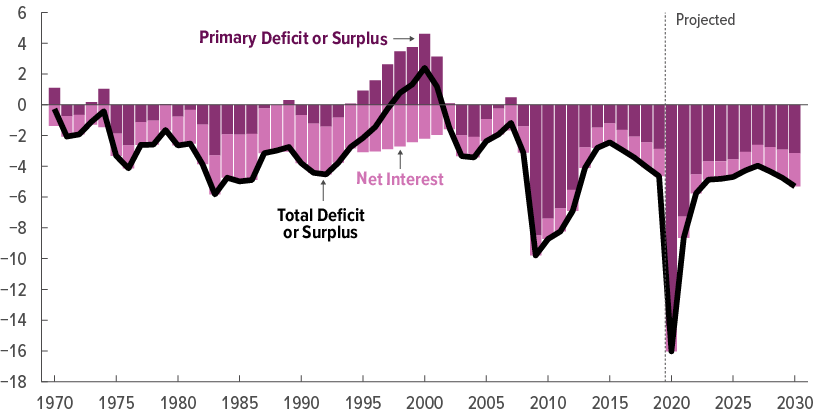

We were running $1 trillion deficits before the pandemic. Each crisis seems to bring greater stimulus.  

I especially like this view because it doesn't make sense that an interest rate 0.1% above the growth rate vs. an interest rate 0.1% below the growth rate should make a dramatic difference to the economy. Once you recognize some limit on the debt/GDP ratio, and desirability of some long-run stable debt/GDP, there is no big difference between these two values. The surplus required to stabilize debt to GDP smoothly runs from negative couch change to positive couch change. 

I find this a liberating proposition. I find the whole sustainability, long run limits, dynamic inefficiency, transversality condition and so forth a big headache. For the question at hand it doesn't matter! (There are other questions for which it does matter, of course.) 

As we look forward,  debt/GDP dynamics for the next 20 years are going to be dominated by the primary surplus/deficit, not plausible variation in r-g. The CBO's 10 years of 6-8% of GDP overwhelm 1-2% of r-g. If each crisis continues to ratchet up 10% of GDP deficits per year, more so. The Green New Deal, and large federal assumption of student debts, state and local debts, pension obligations, and so forth would add far more to debt/GDP than decades of r vs. g.  

**********

Now that this is clear, I realize I did not emphasize enough that Olivier Blanchard's AEA Presidential Address  acknowledges well the possibility of a debt crisis: 

Fourth, I discuss a number of arguments against high public debt, and in particular the existence of multiple equilibria where investors believe debt to be risky and, by requiring a risk premium, increase the fiscal burden and make debt effectively more risky. This is a very relevant argument, but it does not have straightforward implications for the appropriate level of debt.

See more on p. 1226. Blanchard's concise summary

there can be multiple equilibria: a good equilibrium where investors believe that debt is safe and the interest rate is low and a bad equilibrium where investors believe that debt is risky and the spread they require on debt increases interest payments to the point that debt becomes effectively risky, leading the worries of investors to become self-fulfilling.

Let me put this observation in simpler terms. Let's grow the debt / GDP ratio to 200%, $40 trillion relative to today's GDP. If interest rates are 1%, then debt service is $400 billion. But if investors get worried about the US commitment to repaying its debt without inflation, they might charge 5% interest as a risk premium. That's $2 trillion in debt service, 2/3 of all federal revenue. Borrowing even more to pay the interest on the outstanding debt may not work. So, 1% interest is sustainable, but fear of a crisis produces 5% interest that produces the crisis. 

Brian Riedi at the Manhattan Institute has an excellent exposition of debt fears. On this point, 

... there are reasons rates could rise. ...

market psychology is always a factor. A sudden, Greece-like debt spike—resulting from the normal budget baseline growth combined with a deep recession—could cause investors to see U.S. debt as a less stable asset, leading to a sell-off and an interest-rate spike. Additionally, rising interest rates would cause the national debt to further increase (due to higher interest costs), which could, in turn, push rates even higher.

***********

So how far can we go? When does the crisis come?  There is no firm debt/GDP limit. 

Countries can borrow a huge amount when they have a decent plan for paying it back. Countries have had debt crises at quite low debt/GDP ratios when they did not have a decent plan for paying it back. Debt crises come when bond holders want to get out before the other bond holders get out. If they see default, haircuts, default via taxation, or inflation on the horizon, they get out. r<g contributes a bit, but the size of perpetual surplus/deficit is, for the US, the larger issue. Again, r<g of 1% will not help if s/Y is 6%. Sound long-term financial strategy matters. 

From the CBO's 2019 long term budget outlook (latest available) the outlook is not good. And that's before we add the new habit of massive spending. 
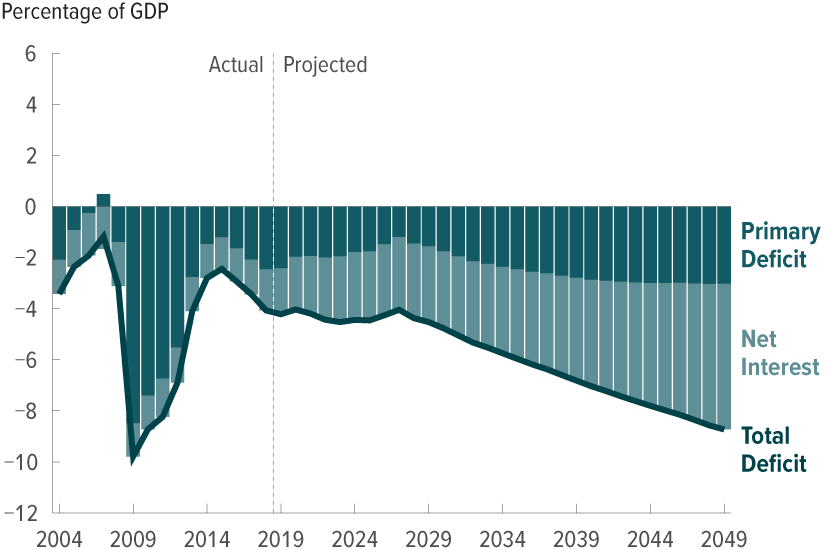

Here though, I admit to a big hole in my understanding, echoed in Blanchard and other's writing on the issue. Just how does a crisis happen? "Multiple equilibria" is not very encouraging. Historical analysis suggests that debt crises are sparked by economic and political crises in the shadow of large debts, not just sunspots.  We all need to understand this better.  

******

Policy. 

As Blanchard points out, small changes do not make much of a difference.  

 a limited decrease in debt—say, from 100 to 90 percent of GDP, a decrease that requires a strong and sustained fiscal consolidation—does not eliminate the bad equilibrium. ...

Now I disagree a bit. Borrowing 10% of GDP wasn't that hard! And the key to this comment is that a temporary consolidation does not help much. Lowering the permanent structural deficit 2% of GDP would make a big difference! But the general point is right. The debt/GDP ratio is only a poor indicator of the fiscal danger. 5% interest rate times 90% debt/GDP ratio is not much less debt service than 5% interest rate times 100% debt/GDP ratio. Confidence in the country's fiscal institutions going forward much more important. 

At this point the discussion usually devolves to "Reform entitlements" "No, you heartless stooge, raise taxes on the rich." I emphasize tax reform, more revenue at lower marginal rates. But let's move on to unusual policy answers. 

Borrow long. Debt crises typically involve trouble rolling over short-term debt. When, in addition to crisis borrowing, the government has to find $10 trillion new dollars just to pay off $10 trillion of maturing debt, the crisis comes to its head faster. 

As blog readers know, I've been pushing the idea for a long time that especially at today's absurdly low rates, the US government should lock in long-term financing. Then if rates go up either for economic reasons or a "risk premium" in a crisis, government finances are much less affected. I'm delighted to see that Blanchard agrees: 

to the extent that the US government can finance itself through inflation-indexed bonds, it can actually lock in a real rate of 1.1 percent over the next 30 years, a rate below even pessimistic forecasts of growth over the same period

It's not a total guarantee. A debt crisis can break out when the country needs to borrow new money, even absent a roll over problem. But avoiding the roll-over aspect would help a lot! Greece got in trouble because it could not roll over debts, not because it could not borrow for one year's spending. 

Contingent plans? Blanchard's concise summary adds another interesting option 
 contingent increases in primary surpluses when interest rates increase. 

I'm not quite sure how that works. Interest rates would increase in a crisis precisely because the government is out of its ability or willingness to tax people to pay off bondholders. Does this mean an explicit contingent spending rule? Social security benefits are cut if interest rates exceed 5%? That's an interesting concept. 

Or it could mean interest rate derivatives. The government can say to Wall Street (and via Wall Street to wealthy investors) "if interest rates exceed 5%, you send us a trillion dollars." That's a whole lot more pleasant than an ex-post wealth tax or default, though it accomplishes the same thing. Alas, Wall Street and wealthy bondholders have lately been bailed out by the Fed at the slightest sign of trouble so it's hard to say if such options would be paid. 

Growth. Really, the best option in my view is to work on the g part of r-g. Policies that raise economic growth over the next decades raise the Y in D/Y, lowering the debt to GDP ratio; they raise tax revenue at the same tax rates; and they lower expenditures. It's a trifecta. In my view, long-term growth comes from the supply side, deregulation, tax reform, etc. Why don't we do it? Because it's painful and upsets entrenched interests. For today's tour of logical possibilities if you think demand side stimulus raises long term growth, or if you think that infrastructure can be constructed without wasting it all on boondoggles, logically, those help to raise g as well. 

********

*Start with \(\frac{dD}{dt} = rD - s.\) Then \( \frac{d}{dt}\frac{D}{Y} =  \frac{1}{Y}\frac{dD}{dt}-\frac{D}{Y^2}\frac{dY}{dt}.\)


*** 

Update: David Andolfatto writes, among other things, 

"Should we be worried about hyperinflation? Evidently not, as John does not mention it"

For these purposes, hyperinflation is equivalent to default. In fact, a large inflation is my main worry, as I think the US will likely choose default via inflation to explicit default. This series of posts is all about inflation. Sorry if that was not clear. 

also 

Is there a danger of "bond vigilantes" sending the yields on USTs skyward? Not if the Fed stands ready to keep yields low.

All the Fed can do is offer overnight interest-paying government debt in exchange for longer-term government debt. If treasury markets don't want to roll over 1 year bonds at less, than, say, 10%, why would they want to hold Fed reserves at less than 10%? If the Fed buys all the treasurys in exchange for reserves that do not pay interest, that is exactly how we get inflation. And mind the size. The US rolls over close to $10 trillion of debt a year. Is the Fed going to buy $10 trillion of debt? Who is going to hold $10 trillion of reserves, who did not want to hold $10 trillion of debt. 

In a crisis, even the Fed loses control of interest rates. 


SALT

Chris Pullman and Richard Reeves at Brookings write opposing a reinstatement of the deduction for state and local taxes on the federal income tax. Jonathan Parker, a great economics tweeter, tweets approvingly, 

I offer a little more guarded approval. Yes, it's praiseworthy when any organization in our politicized times criticizes the favored narrative of the party they are perceived to be associated with. And the SALT deduction should, in my view, not be reinstated. 

But though they are right, but they are not right for the central reasons. And the reasons they give are a lot less non-partisan than Jonathan makes it sound. 

Friday, September 4, 2020

Debt Matters

Debt Matters

(This is a draft of an oped. I got done and saw it's 1500 words, so I'm posting it for your enjoyment rather than go through a painful 600 word diet. Diet later. Maybe. ) 

Last week, the U.S. passed a milestone — US federal debt in private hands exceeded 100% of GDP. But does all this debt matter, or is worrying about debt passé?

This debate has been going on among economists for a while. One does not need to go to the incoherence of "modern monetary theory" to find support for the view that debt has few consequences. Olivier Blanchard, of MIT and the IMF, in his Presidential Address to the American Economic Association, (excellent summary here) declared that “there may be no fiscal costs” of additional debt. The core of his argument is that the interest rate on government debt may be lower than the growth rate of the economy so the US can roll over debt forever. 

Larry Summers, ex treasury secretary, President of Harvard, and adviser to presidents, surely the preeminent policy economist of our generation, has advocated that additional debt-financed spending may have so strong a multiplier as to pay for itself. (Paper here) As a result “expansionary fiscal policies may well reduce long-run debt-financing burdens," a super-Keynesian version of the Laffer curve

(I don’t mean to pick on Blanchard and Summers — they are only superbly distinguished representatives of widely held views.) 

Unlike MMT, these are logically consistent possibilities. But are they right? 

The interest rate on government debt is indeed slightly lower than good guesses of the economy’s growth rate, as sadly low as the latter is, so that if we roll over debt with no additional deficits, the debt to GDP ratio will slowly decline and the US can indeed run this slow-rolling Ponzi scheme. 

But how long will this happy circumstance of ultra-low interest rates continue? More to the point, how scaleable is this opportunity? Bond market investors lend 100% of GDP to the US government at 1% interest. Will they lend 200% of GDP at the same low interest rate, or will they start to require higher interest rates? A government that finances itself only with money and no debt need not pay back the money -- but, obviously, cannot double the opportunity. 

What happens when, rather than grow out of a given debt, the US piles on larger and larger debt to GDP ratios each year? The analysis is about sustainability of a large, but steady debt to GDP ratio. It does not justify a debt to GDP ratio that grows 10 percentage points per year.  At what debt to GDP ratio must the party stop and the growing out of it begin? 

Blanchard recognizes these limits are out there somewhere, and that debt crowds out private investment. But just where the limits are is less clear. That finding the limits will be unpleasant is clear. 

Summers’ view is likewise limited to a period of “secular stagnation” with perennially deficient demand, sticky prices and wages, and the other requirements of extreme Keynesianism.  Are we in such a period, or is covid a supply shock? Was the economy really suffering lack of demand when unemployment hit 50 year lows last February? 

Washington knows no such sophistication, but our politicians have grasped the logical implications of the proposition that debt does not matter with more clarity than have economists. 

The notion that debt matters, that spending must be financed sooner or later by taxes on someone, and that those taxes will be economically destructive, has vanished from Washington discourse on both sides of the aisle. The covid response resembles a sequence of million-dollar bets by non-socially distanced drunks at a secretly reopened bar: I’ll spend a trillion dollars! No, I’ll spend two trillion dollars! That anyone has to pay for this is un-mentioned. Well, perhaps nobody does have to pay. 

And who is to blame them, really? Markets offer 1% long-term interest rates. Blowout spending  financed by the Fed printing money — which is no different from debt — has resulted in no inflation so far. Faced with the deep concerns of current voters, worry that our children and grandchildren might have to pay off debt is not particularly salient. They’re either in the basement playing video games or out protesting for the end of capitalism anyway.  Politicians will take the cheap money as long as markets are happy to provide it. 

The economists, even the modern monetary theorists, envision debt issued to finance worthy investments, or valuable spending, all undertaken with a careful green eyeshade approach. Washington has figured out the logical conclusion of the idea that Federal debt doesn’t matter, in a way these economists have not: If debt and money printing have no fiscal cost, why be careful about how you spend money? Send checks to voters. Why not? It’s costless. No boondoggle project is objectionable. Send billions to prop up dying businesses. Why not? It’s costless. Why bother fixing the post office? Send them another $25 billion. Or $100. 

Deeper: Why should citizens have to pay back debts if the Federal government does not have to do so? Bail out student loans. Bail out bankrupt states and locals and their pensions. Cancel the rent. Cancel the mortgage. Why should anyone have to pay any debt if the Federal government has access to a money machine? Why work? Why should the federal government not just keep printing money and sending it to us? Other countries are not so lucky as we are. Why should emerging markets pay back debt if the US does not have to? Bail them out. 

Why indeed should anyone pay taxes? Here Stephanie Kelton, MMT proponent, has followed the logic. The only reason to charge taxes at all, in her view, is to expropriate the wealthy to rob them of political power. 

These are inescapable logical conclusions of the view that federal debt has no fiscal cost. If you’re uncomfortable with the end of the trip, perhaps you should revisit the assumption from which it inexorably follows. At least, you recognize that the opportunity to borrow with little fiscal cost is limited, so should be preserved. 

Advocates point to WWII. It is true, that the US exited an even greater debt to GDP ratio. It was not painless. Growth higher than interest rates was part of it, but not all. Two bouts of inflation, in the late 1940s and in the 1970s devalued much debt. The US ran steady primary (excluding interest costs) surpluses from the 1940s through the mid 1970s. Spending was low in the pre-entitlement economy, and nobody was totting up hundreds of trillions in unfunded promises. The war, and its spending, was over. Statutory personal taxes and actual corporate taxes were high. Financial repression and closed international capital markets kept interest rates on government bonds low, and deprived Americans of better investment opportunities and our and the world’s economies much needed investment capital. And we had an international debt crisis in the early 1970s, prompting the abandonment of Bretton woods and depreciation of the dollar. 

In short, the US grew out of WWII debt by not borrowing any more, by decades of fiscal probity, and by strong supply-side growth in a deregulated economy. We have none of these reassurances going forward. And this, and the UK exit from Napoleonic War debt in the 1800s by starting the industrial revolution are about the only historical examples of a semi-successful repayment of this much debt. Otherwise, the history of large sovereign debts is one long sorry tale of default, inflation, devaluation, and consequent financial chaos. The UK did not exit WWII debt successfully, leading to crisis after crisis, and everyone else did worse. 

Still, what should we be afraid of? The vision of grandchildren saddled with taxes, or even just unable to borrow more while the economy sits at its limit, of, say, 200% debt to GDP, is indeed not a salient brake to spending. 

That is not the danger. The danger the US faces, the danger we should repeat and keep in mind, is a debt crisis. We print our own money, so the result may be a sharp inflation that wipes away the value of debt rather than an even more disruptive default, but the consequences will be almost as dire. 

Imagine that 5 or even 10 years from now we have another crisis, which we surely will. It might be another, worse, pandemic; a war involving china, Russia or the Middle East. Imagine the US follows its present trends of partisan government dysfunction, so an impeachment is going on, a contested election, and even militias roaming the streets of still boarded up cities. Add a huge economic recession, but unreformed spending promises. 

At this point, the US has, say, 150% debt to GDP.  It needs to borrow another $5 - $10 trillion, or get people to hold that much more newly-printed money, to bail out once again, and pay everyone’s bills for a while. It will need another $10 trillion or so to roll over maturity debt. At some point bond investors see the end coming, as they did for Greece, and refuse. Not only must the US then inflate or default, but the firehouse of debt relief, bailout and stimulus that everyone expects is absent, together with our capacity for military or public health spending to meet the shock that sparks the crisis. 

Yes, I've warned about this before, and no, it hasn't happened yet. Well, if you live in California you live on an earthquake fault. That the big one hasn't happened yet doesn't mean it never will.  

No, interest rates do not signal such problems. (Alan Blinder, covering such matters in the Wall Street Journal, "if the U.S. Treasury starts to supply more bonds than the world's investors demand, the markets will warn us with higher interest rates and a sagging dollar. No such yellow lights are flashing.) They never do. Greek interest rates were low right up until they weren’t. Interest rates did not signal the inflation of the 1970s, or the disinflation of the 1980s. Lehman borrowed at low rates until it didn’t. Nobody expects a debt crisis, or it would have already happened. 

We cannot tell when the conflagration will come. But we can remove the kindling and gasoline lying around. Reform long-term spending promises in line with long run revenues. Reform the tax code to raise money with less damage to the economy. And today, spend only as if someone has to pay it back. Because someone will have to pay it back. 

Blanchard concludes with “public debt.. can be used but it should be used right.” I agree. We are in a crisis, and thoughtful spending with borrowed or printed money is necessary. (How about a test a week for every American?) But keep constantly in mind, it will be paid back, steadily or chaotically. There really is no argument. Most of these points are in Blachard's Presidential Address. 

Whether a steady debt/GDP ratio can life with small steady primary deficits, rather than small steady primary surpluses is not the interesting question. There is a limit, a debt/GDP beyond which markets will not lend. On  this, I think, we all agree. There is a finite fiscal capacity. Even though in theory the r<g argument would allow a 1,000% debt to GDP ratio, or 10,000%, at some point the party stops. The closer we are to that limit, the closer we are to a real crisis when we need that fiscal capacity and it is no longer there. 

***********

And now, dear fellow Americans, enjoy your Labor Day. Please listen to Dr. Fauci and don't run out to party like you did on Memorial Day. Let's be sensible and get this thing over with. 


Update: A new and better post More on Debt follows. 


Thursday, September 3, 2020

On looting

A good read: Graeme Wood's Atlantic essay covering Vicky Osterweil, her popular book In Defense of Looting, and NPR interview. (HT Niall Ferguson) 

NPR summarizes the book as an argument that “looting is a powerful tool to bring about real, lasting change in society.” If the real, lasting change you wish to effect is burning society to cinders and crippling for a generation its ability to serve its poorest citizens, then I suppose I am forced to agree. 

That's as nice a topic sentence as you could ask for.  

Looting is good, she [Osterweil] says, because it exposes a deep truth about the great American confidence game, which is that “without police and without state oppression, we can have things for free.” 

Just who is going to produce those things and work hard to sell them in a looting society? Wood essentially asks that gaping question. 

Osterweil’s argument is simple. The “so-called” United States was founded in “cisheteropatriarchal racial capitalist” violence. That violence produced our current system, particularly its property relations, and looting is a remedy for that sickness. “Looting rejects the legitimacy of ownership rights and property, the moral injunction to work for a living, and the ‘justice’ of law and order,” she writes. Ownership of things—not just people—is “innately, structurally white supremacist.”

This quote, I think, provides a deep understanding of our current far left. 

Wednesday, September 2, 2020

Abbott Labs to the rescue? Free the tests!

Context: Cheap, fast, tests can stop this pandemic quickly, even if they are not very accurate.

Last week, Abbott Labs announced (more info here) that (finally)
the U.S. Food and Drug Administration (FDA) has issued Emergency Use Authorization (EUA) for its BinaxNOW™ COVID-19 Ag Card rapid test for detection of COVID-19 infection. Abbott will sell this test for $5. It is highly portable (about the size of a credit card), affordable and provides results in 15 minutes. BinaxNOW uses proven Abbott lateral flow technology, making it a reliable and familiar format for frequent mass testing through their healthcare provider. With no equipment required, the device will be an important tool to manage risk by quickly identifying infectious people so they don't spread the disease to others.  
Note the last sentence. Abbott gets it -- the point of this test is not to diagnose sick people, it is to keep most sick people from spreading the disease.  If every American got this test once a week for a month ($5 x $350 million = $7 billion = one drop in bucket of the fiscal and economic cost of this pandemic) it would be over in a month.
Abbott will also launch a complementary mobile app for iPhone and Android devices named NAVICA™. This first-of-its-kind app, available at no charge, will allow people who test negative to display a temporary digital health pass that is renewed each time a person is tested through their healthcare provider together with the date of the test result. Organizations will be able to view and verify the information on a mobile device to facilitate entry into facilities along with hand-washing, social distancing, enhanced cleaning and mask-wearing.
"We intentionally designed the BinaxNOW test and NAVICA app so we could offer a comprehensive testing solution to help Americans feel more confident about their health and lives," said Robert B. Ford, president and chief executive officer...
Even better. (It does not say who the app reports data to, which could make it better yet. For example, it could automatically notify your employer.)
"With lab-based tests, you get excellent sensitivity but might have to wait days or longer to get the results. With a rapid antigen test, you get a result right away, getting infectious people off the streets and into quarantine so they don't spread the virus."
Again, Abbott gets it.

But, what's this business about "through their healthcare provider?"
Under FDA EUA, the BinaxNOW COVID-19 Ag Card is for use by healthcare professionals and can be used in point-of-care settings that are qualified to have the test performed and are operating under a CLIA (Clinical Laboratory Improvement Amendments) Certificate of Waiver, Certificate of Compliance, or Certificate of Accreditation. Within these settings, the test can be performed by doctors, nurses, school nurses, medical assistants and technicians, pharmacists, employer occupational health specialists, and more with minimal training and a patient prescription.   
What is wrong with these people? (FDA) If most of us call our health care providers, you get  non-urgent appointment in about 3 weeks, insurance gets billed about $400, we pay $150, to get the necessary referral, and prescription (!) and on for more delays and costs to get the test.

What possible reason is there for all these restrictions? How can anybody be hurt by taking this test, and how will all these layers of bureaucracy help that anyway? Yes, a huge employer like Stanford can probably obtain a CLIA CoW, CoC, etc. and hire a "occupational health specialist" to administer tests, but how is a restaurant going to do it?

There is a pandemic on, folks. Regulators gotta regulate, I guess, to justify their existence. But not now.

Free the tests!

Monday, August 31, 2020

What if the private sector were responsible for California wildfires?


So we enter another week enveloped in smoke, here in California.

My thought for the day: Can you imagine the public and political reaction if this were caused by a private-sector activity?

Imagine for a minute that Jeff Bezos and Mark Zuckerberg had a many thousand acre ranch in Northern California, but for decades they refused to do any proper management and let kindling pile up. Suppose that when massive fires erupted every year, they relied on heroic volunteers and prisoners being paid a few dollars a day to go try to put out the flames. Suppose this happened every year, covering the state in smoke that make the bad old days of 1960s air pollution. Or, worse than Beijing


Suppose when questioned that Bezos and Zuckerberg said, well, there is nothing to be done about it because the climate is getting warmer. Or supposed they offered to build a high speed train and subsidize electric cars to reduce California's 0.1% contribution to carbon, so the climate will only get warmer 2.999 degrees rather than 3.00 degrees in the next century. Which you will pay for.

Imagine if any of this came from the private sector. Suppose one of the few remaining oil refineries were covering the state in smoke for a month at a time every year. Or if it were automobile exhaust.

I think the guillotine set up in front of Bezos' home recently is mild compared to what would happen. The state government would be launching lawsuits, draconian regulations, and long prison terms. Politicians and activists would be issuing daily denunciations of capitalism gone amok.  Bad air  hits poor, sick, and minorities harder, which they'd be screaming about.

This is the state that pioneered clean air after all. We have had our own special smog restrictions on cars for a half a century. Commenters on nextdoor go apoplectic if anyone turns on a gas leaf blower.

Yet the response so far is an amazing silence. If indeed it is climate change, dear fellow citizens, then that is ever more reason to do something about it. Climate change is a slow-moving predictable problem that will get worse. Even if the whole world takes up the whole green new deal, and even if that turns out to work, it only limits how much the climate gets warmer. If it's climate change, the only rational answer is to spend a lot more money to fix the problem, now. There are a lot of unemployed people in this state. They could be cleaning forests 11 months of the year. There is a huge amount of money in the state budget. It could be hiring firefighters, buying airplanes, and stopping this in its tracks.

Underlying it is the moralistic attitude. This is the price we must pay for our carbon sins, so we must pray to the carbon gods with useless virtue signals and endure, as our ancestors prayed to keep plague away. Even though we know the cause and effect here. To do anything about climate-induced problems is dreaded "adaptation," which does not involve the necessary self-flagellation.

But that attitude would change fast if the government were not completely responsible for this avoidable disaster. Hence my thought for the day.

Goodfellows RNC commentary


The latest Goodfellows podcast, with guest Lanhee Chen. We discuss the Republican convention, the implosion of cities,  and related matters.

Direct link here.

The main message of each convention, perhaps: Joe Biden is not Donald Trump. Donald Trump is not a progressive Democrat.

Wednesday, August 19, 2020

More on tests

 Robert Zubrin puts the point well in a National Review essay (thanks to a commenter on my last post). 

There are now a variety of fast coronavirus tests that could be readily administered by businesses and schools and provide results within 20 minutes. These tests require only saliva samples, not deep upper nose swabs, and can be readily administered by practically anyone with very modest training. The FDA just approved “emergency use” of one of them by the NBA. The problem is that they won’t let the rest of us use them. Recently I was offered highly effective and economical rapid tests developed by an extremely well-qualified biotech firm. But FDA rules precluded transporting their tests across state lines. Upon appeal it now appears that the FDA might be willing to authorize such shipments on an “emergency basis,” but only for use in already overbooked clinics certified by yet another bureaucracy.

This won’t do. We need to be able to use the tests ourselves.

No clinics. No prescription. No doctor visit. No faxing forms to insurance companies. 

If we were allowed to use these tests, schools and businesses could test their students and workers at the start of each week and send all virus carriers home by 9 a.m. Monday. We could end the pandemic within four weeks, without needing to shut down any schools or companies. 

Testing every American every two weeks means about 30 million tests a day. 

The authorities can’t possibly administer 30 million tests per day. But we — the people — can do it easily, provided we are allowed to do so. 

We are currently forbidden from doing so. The financial cost is trivial compared to the $5 trillion the government is spending on covid relief.  

Friday, August 14, 2020

Test = vaccine

"Cheap, frequent COVID tests could be ‘akin to vaccine,’ professor says" from the Harvard Gazette HT Miles Kimball 


Yes, I'm repeating myself, but maybe if we just try over and over again we'll get through. We could stop this disease now with tests. Vaccines are just a tool to stop disease transmission. Widespread, cheap frequent tests are just as effective a tool to stop disease transmission. So I'll keep quoting anyone who wants to say this! 

A Harvard epidemiologist and expert in disease testing is calling for a shift in strategy toward a cheap, daily, do-it-yourself test that he says can be as effective as a vaccine at interrupting coronavirus transmission — and is currently the only viable option for a quick return to an approximation of normal life.

“These are our hope,” said Michal Mina, assistant professor of epidemiology at Harvard T.H. Chan School of Public Health and Brigham and Women’s Hospital. “We don’t have anything tomorrow, other than shutting down the economy and keeping schools closed.”

....the paper-strip tests have already been developed and their shotgun approach to testing — cheap and widespread — provides a way back to the workplace, classroom, and other venues.

The tests, which can be produced for less than a dollar, can be performed by consumers each day or every other day. Though not as accurate as current diagnostic tests, they are nonetheless effective at detecting virus when a person is most infectious, Mina said. If everyone who tests positive stays home, he said, the widespread effect would be similar to that of a vaccine, breaking transmission chains across the country.

... What I would like to see happen is to start using testing [as] a true public health tool to break transmission chains in the same way that we know we can use masks to decrease transmission,” Mina said. “I want these tests to tell people they’re transmitting [the virus to others] at the time they’re transmitting, and [when] people can act on it because they’re getting immediate results. And I want them to take it every single day, or every other day.”

Several companies have developed such tests, Mina said.

Why aren't we doing this, voluntarily even? 

The Food and Drug Administration,..  has held up approval because the tests aren’t as accurate as nasal-swab, lab-based tests. While that would matter if they were intended as an individual diagnostic tool, Mina said that from a public health viewpoint, they are accurate enough to provide critical initial screening on a large scale. ....

“Everyone says, ‘Why aren’t you doing this already?’ My answer is, ‘It is illegal to do this right now,’” Mina said. 

In other words, the FDA says:  "Yes, you can use a thermometer to screen people out and send them home. Yes, you can use a questionnaire to screen people out and send them home.  No, you may not use a far more accurate $1 paper test for exactly the same purpose. And if you try, we'll ruin your company and send you to jail." 

Alex Tabarrok puts it nicely: We're testing for contagiousness, not for infection. 

President Trump seems to have discovered President Obama's phone and pen. A suggestion: Tomorrow morning, 9 AM, executive order: The sale and use of these paper tests shall be legal. We could be done with Covid 19 in a month or two. 


Thursday, August 13, 2020

TikTok dust up


This week's Goodfellows conversation was a bit more contentious than usual. The most interesting part, I think, is our little dust-up over TikTok, following Niall's Bloomberg commentary.

As in the rest of this series I am the skeptic of jumping in to Cold War II -- or at least against lashing out against all things China without an overall strategy. So I pushed hard on my colleagues -- Be specific. Just exactly what is the danger you fear about allowing a Chinese social media company to operate in the U.S?

Monday, August 10, 2020

Tests

America has essentially given up on containing the corona virus, and will just let it spread while we await a vaccine. Oh sure, our governors and other public officials flap around about wearing masks and social distancing. But there is no serious public health effort. (If you're in California, I encourage you to listen to NPR's faithful coverage of our Governor Gavin Newsom's noon daily press conference. Never has anyone so artfully said so little in so many words.) 

A vaccine is a technological device that, combined with an effective policy and public-health bureaucracy for its distribution,  allows us to stop the spread of a virus.  But we have such a thing already. Tests are a technological device that, combined with an effective policy and public-health bureaucracy for its distribution, allows us to stop the spread of a virus. 

For that public health purpose, tests do not need to be accurate. They need to be cheap, available, and fast. When the history of this virus is written, I suspect that the immense fubar, snafu, complete incompetence of the FDA, CDC, and health authorities in general at understanding and using available tests to stop the virus will be a central theme. (Well, forecasting historians is a dangerous game. Already "the virus increases inequality and social injustice" seems to be the narrative of the day.) 

Marginal revolution has three insightful posts on the issue. "Bill Gates is angry" starts with a  comment on the fact that currently, once you get a test, it can take days or even weeks to get the results.  

..that’s just stupidity. The majority of all US tests are completely garbage, wasted. 

If the point of the test is to find out who has it, and isolate them, then an answer that comes back after they've gone out to spread the virus to friends, family and co-workers is completely wasted. Gates has an econ-101 insight into why this is happening:

If you don’t care how late the date is and you reimburse at the same level, of course they’re going to take every customer...You have to have the reimbursement system pay a little bit extra for 24 hours, pay the normal fee for 48 hours, and pay nothing [if it isn’t done by then]. And they will fix it overnight.

I know a great such reimbursement system, but I'll hold that in suspense. (You can probably guess what it is.) 

A second great insight: 

Wednesday, August 5, 2020

Sowell review

Coleman Hughes writes a wonderful review of Thomas Sowell's life and work in City Journal. Savor it.

My first Sowell book was Knowledge and Decisions, and I am heartened to see Hughes put that foremost as well. Sowell takes up where Hayek left off, how the price system is the network like our neurons communicating information across a complex economy. This remains a verbal part of the economics tradition, resisting formal modeling so far, and is thereby too often glossed over in graduate training. Read it. 

Sowell of course has written masterpieces on race, a collection of impeccably documented uncomfortable truths to the progressive left. My first, The Economics and Politics of Race is just one of nearly a dozen meticulous books, from Black Education: Myths and Tragedies (1972) to Discrimination and Disparities, second edition (2019). Hughes reviews important points in Conquests and Cultures, Migrations and Cultures, and Race and Culture.

Thursday, July 16, 2020

Goodfellows and Garicano Interview

I did two videos last week that blog readers may enjoy.

I did an interview with Luis Garicano in his "capitalism after coronavirus" series


We covered many topics, but the aftermath of the huge government debt now being racked up is possibly the most interesting, at least to me.

Luis is currently a member of the European Parliament. Among many other things he was a PhD student and then professor of economics at the University of Chicago. He's a also a great interviewer. The interview is also available in Spanish, here.

In the latest Goodfellows, Niall, HR and I interview Victor Davis Hanson, about Trump, cancel culture, and the future of universities.


Podcast


Monday, July 6, 2020

A little financial-econometric history

The issues that have cropped up in applying present value ideas to government finance, in my last post, caused me to write up a little financial-econometric history, which seems worth passing on to blog readers. The lessons of the 1980s and 1990s are fading with time, and we should avoid having to re-learn such hard-won lessons. (Warning: this post uses mathjax to display equations.)

Faced with a present value relation, say \[ p_{t}=E_{t}\sum_{j=1}^{\infty}\beta^{j}d_{t+j}, \] what could be more natural than to model dividends, say as an AR(1), \[ d_{t+1}=\rho_{d}d_{t}+\varepsilon_{t+1}, \] to calculate the model-implied price, \[ E_{t}\sum_{j=1}^{\infty}\beta^{j}d_{t+j}=\frac{\beta\rho_{d}}{1-\beta\rho_{d} }d_{t}, \] and to compare the result to \(p_{t}\)? The result is a disaster -- prices do not move one for one with dividends, and they move all over the place with no discernible movement in expected dividends.

The Surplus Process

How should we model surpluses and deficits? In finishing up a recent article and chapter 5 and 6 of a Fiscal Theory of the Price Level update, a bunch of observations coalesced that are worth passing on in blog post form.

Background: The real value of nominal government debt equals the present value of real primary surpluses, \[ \frac{B_{t-1}}{P_{t}}=b_{t}=E_{t}\sum_{j=0}^{\infty}\beta^{j}s_{t+j}. \] I 'm going to use one-period nominal debt and a constant discount rate for simplicity. In the fiscal theory of the price level, the \(B\) and \(s\) decisions cause inflation \(P\). In other theories, the Fed is in charge of \(P\), and \(s\) adjusts passively. This distinction does not matter for this discussion. This equation and all the issues in this blog post hold in both fiscal and standard theories.

The question is, what is a reasonable time-series process for \(\left\{s_{t}\right\} \) consistent with the debt valuation formula? Here are surpluses


The blue line is the NIPA surplus/GDP ratio. The red line is my preferred measure of primary surplus/GDP, and the green line is the NIPA primary surplus/GDP.

The surplus process is persistent and strongly procyclical, strongly correlated with the unemployment rate.  (The picture is debt to GDP and surplus to GDP ratios, but the same present value identity holds with small modifications so for a blog post I won't add extra notation.)

Something like an AR(1) quickly springs to mind, \[ s_{t+1}=\rho_{s}s_{t}+\varepsilon_{t+1}. \] The main point of this blog post is that this is a terrible, though common, specification.

Write a general MA process, \[ s_{t}=a(L)\varepsilon_{t}. \] The question is, what's a reasonable \(a(L)?\) To that end, look at the innovation version of the present value equation, \[ \frac{B_{t-1}}{P_{t-1}}\Delta E_{t}\left( \frac{P_{t-1}}{P_{t}}\right) =\Delta E_{t}\sum_{j=0}^{\infty}\beta^{j}s_{t+j}=\sum_{j=0}^{\infty}\beta ^{j}a_{j}\varepsilon_{t}=a(\beta)\varepsilon_{t}% \] where \[ \Delta E_{t}=E_{t}-E_{t-1}. \] The weighted some of moving average coefficients \(a(\beta)\) controls the relationship between unexpected inflation and surplus shocks. If \(a(\beta)\) is large, then small surplus shocks correspond to a lot of inflation and vice versa. For the AR(1), \(a(\beta)=1/(1-\rho_{s}\beta)\approx 2.\) Unexpected inflation is twice as volatile as unexpected surplus/deficits.

\(a(\beta)\) captures how much of a deficit is repaid. Consider \(a(\beta)=0\). Since \(a_{0}=1\), this means that the moving average is s-shaped. For any \(a(\beta)\lt 1\), the moving average coefficients must eventually change sign. \(a(\beta)=0\) is the case that all debts are repaid. If \(\varepsilon_{t}=-1\), then eventually surpluses rise to pay off the initial debt, and there is no change to the discounted sum of surpluses. Your debt obeys \(a(\beta)=0\) if you do not default. If you borrow money to buy a house, you have deficits today, but then a string of positive surpluses which pay off the debt with interest.

The MA(1) is a good simple example, \[ s_{t}=\varepsilon_{t}+\theta\varepsilon_{t-1}% \] Here \(a(\beta)=1+\theta\beta\). For \(a(\beta)=0\), you need \(\theta=-\beta ^{-1}=-R\). The debt -\(\varepsilon_{t}\) is repaid with interest \(R\).

Let's look at an estimate. I ran a VAR of surplus and value of debt \(v\), and I also ran an AR(1).


Here are the response functions to a deficit shock:


The blue solid line with \(s=-0.31\) comes from a larger VAR, not shown here. The dashed line comes from the two variable VAR, and the line with triangles comes from the AR(1).

The VAR (dashed line) shows a slight s shape. The moving average coefficients gently turn positive. But when you add it up, those overshootings bring us back to \(a(\beta)=0.26\) despite 5 years of negative responses. (I use \(\beta=1\)). The AR(1) version without debt has \(a(\beta)=2.21\), a factor of 10 larger!

Clearly, whether you include debt in a VAR and find a slightly overshooting moving average, or leave debt out of the VAR and find something like an AR(1) makes a major difference. Which is right? Just as obviously, looking at \(R^2\)   and t-statistics of the one-step ahead regressions is not going to sort this out.

I now get to the point.

Here are 7 related observations that I think collectively push us to the view that \(a(\beta)\) should be a quite small number. The observations use this very simple model with one period debt and a constant discount rate, but the size and magnitude of the puzzles are so strong that even I don't think time-varying discount rates can overturn them. If so, well, all the more power to the time-varying discount rate! Again, these observations hold equally for active or passive fiscal policy. This is not about FTPL, at least directly.

1) The correlation of deficits and inflation. Reminder, \[ \frac{B_{t-1}}{P_{t-1}}\Delta E_{t}\left( \frac{P_{t-1}}{P_{t}}\right) =a(\beta)\varepsilon_{t}. \] If we have an AR(1), \(a(\beta)=1/(1-\rho_{s}\beta)\approx2\), and with \(\sigma(\varepsilon)\approx5\%\) in my little VAR, the AR(1) produces 10% inflation in response to a 1 standard deviation deficit shock. We should see 10% unanticipated inflation in recessions! We see if anything slightly less inflation in recessions, and little correlation of inflation with deficits overall. \(a(\beta)\) near zero solves that puzzle.

2) Inflation volatility. The AR(1) likewise predicts that unexpected inflation has about 10% volatility. Unexpected inflation has about 1% volatility. This observation on its own suggests \(a(\beta)\) no larger than 0.2.

3) Bond return volatility and cyclical correlation. The one-year treasury bill is (so far) completely safe in nominal terms. Thus the volatility and cyclical correlation of unexpected inflation is also the volatility and cyclical correlation of real treasury bill returns. The AR(1) predicts that one-year bonds have a standard deviation of returns around 10%, and they lose in recessions, when the AR(1) predicts a big inflation. In fact one-year treasury bills have no more than 1% standard deviation, and do better in recessions.

4) Mean bond returns. In the AR(1) model, bonds have a stock-like volatility and move procyclically. They should have a stock-like mean return and risk premium. In fact, bonds have low volatility and have if anything a negative cyclical beta so yield if anything less than the risk free rate. A small  (a(\beta)\) generates low bond mean returns as well.

Jiang, Lustig, Van Nieuwerburgh and Xiaolan recently raised this puzzle, using a VAR estimate of the surplus process that generates a high \(a(\beta)\). Looking at the valuation formula \[ \frac{B_{t-1}}{P_{t}}=E_{t}\sum_{j=0}^{\infty}\beta^{j}s_{t+j}, \] since surpluses are procyclical, volatile, and serially correlated like dividends, shouldn't surpluses generate a stock-like mean return? But surpluses are crucially different from dividends because debt is not equity. A low surplus \(s_{t}\) raises  our estimate of subsequent surpluses \(s_{t+j}\). If we separate out
 \[b_{t}=s_{t}+E_{t}\sum_{j=1}^{\infty}\beta^{j}s_{t+j}=s_{t}+\beta E_{t}b_{t+1}  \] a decline in the "cashflow" \(s_{t}\) raises the "price" term \(b_{t+1}\), so the overall return is risk free. Bad cashflow news lowers stock pries, so both cashflow and price terms move in the same direction. In sum a small \(a(\beta)\lt 1\) resolves the Jiang et. al. puzzle. (Disclosure, I wrote them about this months ago, so this view is not a surprise. They disagree.)

5) Surpluses and debt. Looking at that last equation, with a positively correlated surplus process \(a(\beta)>1\), as in the AR(1), a surplus today leads to  larger value of the debt tomorrow. A deficit today leads to lower value of the debt tomorrow. The data scream the opposite pattern. Higher deficits raise the value of debt, higher surpluses pay down that debt. Cumby_Canzoneri_Diba (AER 2001) pointed this out 20 years ago and how it indicates an s-shaped surplus process.  An \(a(\beta)\lt 1\) solves their puzzle as well. (They viewed \(a(\beta)\lt 1\) as inconsistent with fiscal theory which is not the case.)

6) Financing deficits. With \(a(\beta)\geq1\), the government finances all of each deficit by inflating away outstanding debt, and more. With \(a(\beta)=0\), the government finances deficits by selling debt. This statement just adds up what's missing from the last one. If a deficit leads to lower value of the subsequent debt, how did the government finance the deficit? It has to be by inflating away outstanding debt. To see this, look again at inflation, which I write \[ \frac{B_{t-1}}{P_{t-1}}\Delta E_{t}\left( \frac{P_{t-1}}{P_{t}}\right) =\Delta E_{t}s_{t}+\Delta E_{t}\sum_{j=1}^{\infty}\beta^{j}s_{t+j}=\Delta E_{t}s_{t}+\Delta E_{t}\beta b_{t+1}=1+\left[ a(\beta)-1\right] \varepsilon_{t}. \] If \(\Delta E_{t}s_{t}=\varepsilon_{t}\) is negative -- a deficit -- where does that come from? With \(a(\beta)>1\), the second term is also negative. So the deficit, and more, comes from a big inflation on the left hand side, inflating away outstanding debt. If \(a(\beta)=0\), there is no inflation, and the second term on the right side is positive -- the deficit is financed by selling additional debt. The data scream this pattern as well.

7) And, perhaps most of all, when the government sells debt, it raises revenue by so doing. How is that possible? Only if investors think that higher surpluses will eventually pay off that debt. Investors think the surplus process is s-shaped.

All of these phenomena are tied together.  You can't fix one without the others. If you want to fix the mean government bond return by, say, alluding to a liquidity premium for government bonds, you still have a model that predicts tremendously volatile and procyclical bond returns, volatile and countercyclical inflation, deficits financed by inflating away debt, and deficits that lead to lower values of subsequent debt.

So, I think the VAR gives the right sort of estimate. You can quibble with any estimate, but the overall view of the world required for any estimate that produces a large \(a(\beta)\) seems so thoroughly counterfactual it's beyond rescue. The US has persuaded investors, so far, that when it issues debt it will mostly repay that debt and not inflate it all away.

Yes, a moving average that overshoots is a little unusual. But that's what we should expect from debt. Borrow today, pay back tomorrow. Finding the opposite, something like the AR(1), would be truly amazing. And in retrospect, amazing that so many papers (including my own) write this down. Well, clarity only comes in hindsight after a lot of hard work and puzzles.


In more general settings \(a(\beta)\) above zero gives a little bit of inflation from fiscal shocks, but there are also time-varying discount rates and long term debt in the present value formula. I leave all that to the book and papers.

(Jiang et al say they tried it with debt in the VAR and claim it doesn't make much difference.  But their response functions with debt in the VAR, at left,  show even more overshooting than in my example, so I don't see how they avoid all the predictions of a small \(a(\beta)\), including a low bond premium.)

A lot of literature on fiscal theory and fiscal sustainability, including my own past papers, used AR(1) or similar surplus processes that don't allow \(a(\beta)\) near zero. I think a lot of the puzzles that literature encountered comes out of this auxiliary specification. Nothing in fiscal theory prohibits a surplus process with \(a(\beta)=0\) and certainly not \(0 \lt a(\beta)\lt 1\).

Update

Jiang et al. also claim that it is impossible for any government with a unit root in GDP to issue risk free debt. The hidden assumption is easy to root out. Consider the permanent income model, \[ c_t = rk_t + r \beta \sum \beta^j y_{t+j}\] Consumption is cointegrated with income and the value of debt. Similarly, we would normally write the surplus process \[ s_t = \alpha b_t + \gamma y_t. \] responding to both debt and GDP. If surplus is only cointegrated with GDP, one imposes \( \alpha = 0\), which amounts to assuming that governments do not repay debts. The surplus should be cointegrated with GDP and with the value of debt.  Governments with unit roots in GDP can indeed promise to repay their debts.

The filibuster and partisanship

The Wall Street Journal reports that the movement among Senate Democrats to get rid of the filibuster entirely is gaining steam. I think this is a bad idea and will lead to more polarized politics.

Why are our politics so polarized? One answer is that elections are more and more winner take all. The more it is winner take all, the more incentive there is for scorched-earth tactics to win, or to keep from losing.

Imagine a not so distant future in which winning an administration and both houses of Congress by 50.5% means a party can pass any legislation it likes, pack the Supreme Court or better yet impeach the lot and replace them, take control of the Department of Justice and FBI, swiftly jail anyone involved with the previous administration, take control of voting law and regulation, further hand out money to political organizations on its side, and by regulation and high taxes force businesses and wealthy individuals to its side. One person, one vote, one time.

That's extreme, but our political system has headed a lot in this direction already. As the stakes in each election get higher, do not be surprised that the scorched-earth partisanship and polarization of politics gets stronger.

The first function of a democracy is a peaceful transition of power. That requires losers to accept their fate, acknowledge the legitimacy of the outcome, regroup and try again. And they have to be able to do that.  We are not a pure democracy. We are set up as a republic, with elaborate protections for electoral minorities. The point is to keep those electoral minorities from rebelling. Union first, "progress" second.

The filibuster is a small and imperfect part of this protection. It evolved by tradition, not design. It has a sordid racial history, being used for decades by southern democrats to block civil rights legislation. To work, both sides had to accept certain rules of the game. You use it only to block core issues of great importance. You do not use it as willy-nilly obstructionism. It has to be costly to those who use it.  It, and other protections could be improved for sure. But we need somehow the space that a narrow election loss does not mean utter defeat and devastation.

Like the other protections for electoral minorities, it has already been mostly torn down, as the WSJ reports. But if, say, Republicans can shove guns, immigrant deportation, and abortion prohibition down Democratic throats with a tiny majority, or Democrats can shove unions, wealth taxes, and national health insurance down Republican throats with a tiny majority; if, more importantly, either party can take a tiny majority to entrench their hold on power and disenfranchise the other, we have not seen anything yet in the partisanship and polarization department.


Sunday, July 5, 2020

Magical monetary theory full review

I read Stephanie Kelton's book, The Deficit Myth: Modern Monetary Theory and the Birth of the People’s Economy,” and wrote this review for the Wall Street Journal. Now that 30 days have passed I can post the whole thing. 

I approached this task with an open mind. What I had heard of MMT has some overlap with fiscal theory of the price level, on which I work, and I hoped to see some commonality.

I was disappointed.

The review:

Modern monetary theory, known as MMT, erupted suddenly into the public consciousness when it won the attention of high-profile politicians including Bernie Sanders and Alexandria Ocasio-Cortez and their media admirers. Its central proposition states that the U.S. federal government can and should freely print money to finance a massive spending agenda, with no concern about debt and deficits.

What is MMT? Its advocates have told us in essays, blog posts, videos and tweets what MMT says about this and that, but what is its logic and evidence? As a monetary theorist who is also skeptical of conventional wisdom, I looked forward to a definitive exposition from Stephanie Kelton’s “The Deficit Myth: Modern Monetary Theory and the Birth of the People’s Economy.”

Ms. Kelton, a professor of economics at Stony Brook University and senior economic adviser to Bernie Sanders’s presidential campaign, starts with a few correct observations. But when the implications don’t lead to her desired conclusions, her logic, facts and language turn into pretzels.

True, the federal government can spend any amount by simply printing up the needed money (in reality, creating bank reserves). True, our government need never default since it can always print dollars to repay Treasury bonds. But if the government prints up and spends, say, $10 trillion, will that not lead to inflation? Ms. Kelton acknowledges the possibility: “If the government tries to spend too much in an economy that’s already running at full speed, inflation will accelerate.”

So how do we determine if the economy is running at full speed, or full of “slack,” with unemployed people and idle businesses that extra money might put to work without inflation? Ms. Kelton disdains the Federal Reserve’s noninflationary or “natural” unemployment rate measure of slack as a “doctrine that relies on human suffering to fight inflation.” Even the recent 3.5% unemployment is heartlessly too high for her.

“MMT urges us to think of slack more broadly.” OK, but how? She offers only one vaguely concrete suggestion: When evaluating spending bills, “careful analysis of the economy’s . . . slack would guide lawmakers. . . . If the CBO [Congressional Budget Office] and other independent analysts concluded it would risk pushing inflation above some desired inflation rate, then lawmakers could begin to assemble a venue of options to identify the most effective ways to mitigate that risk.” She doesn’t otherwise define slack or even offer a conceptual basis for its measurement. She just supposes that the CBO will somehow figure it out. She doesn't mention that the CBO now calculates a measure, potential GDP, which does not reveal perpetual slack. And she later excoriates the CBO for its deficit hawkishness.

Really her answer is: Don’t worry about it. She simply asserts that “there is always slack in the form of unemployed resources, including labor.”

We’re not talking about a little slack either. Ms. Kelton’s “people’s economy” starts with the full Green New Deal and moves on to a federal job for anyone, free health care, free child care, the immediate cancelation of student debt, free college, “affordable housing for all our people,” national high-speed rail, “expanded Social Security,” “a more robust public retirement system,” “middle-class tax cuts,” and more. How much does this add up to? $20 trillion? $50 trillion? She offers no numbers. How is it vaguely plausible that the U.S. has this much productive capacity lying around going to waste?

In a book about money, the inflation of the 1970s and its defeat are astonishingly absent. History starts with Franklin Roosevelt—a hero for enacting the New Deal but a villain for paying for it with payroll taxes rather than fresh dollars. Ms. Kelton praises John F. Kennedy, too. He “pressured unions and private industry, urging them to keep wage and price increases to a minimum to avoid driving inflation higher. It worked. The economy grew, unemployment fell sharply and inflation remained below 1.5 percent for the first half of the decade.”

The second half of that decade—Lyndon Johnson’s Great Society and Vietnam War spending, inflation’s breakout, Richard Nixon’s [1971] disastrous price controls—is AWOL. Did we not try MMT once and see the inflation? Did not every committee of worthies always see slack in the economy? Did not the 1970s see stagflation, refuting Ms. Kelton’s assertion that inflation comes only when there is no “slack”? Don’t look for answers in “The Deficit Myth.”

Victory over inflation under Ronald Reagan and Margaret Thatcher goes likewise unmentioned. History starts up again when Ms. Kelton excoriates Thatcher for saying that government spending has to be paid for with taxes. She insinuates, outrageously, that Thatcher deliberately lied on this point in order to “discourage the British people from demanding more from their government.”

If spending can be financed by printing money, “why not eliminate taxes altogether?” Ms. Kelton begins consistently. She criticizes Sens. Bernie Sanders and Elizabeth Warren for claiming that they need to raise taxes to pay for spending programs. But then why raise taxes? Taxes exist to decapitate the wealthy, not to fund spending or transfers: “We should tax billionaires to rebalance the distribution of wealth and income and to protect the health of our democracy.”

She offers a second answer, more subtle, and revealingly wrong. She starts well: “Taxes are there to create a demand for government currency.” This is a deep truth, which goes back to Adam Smith. Soaking up extra money with fiscal surpluses [higher taxes or less spending] is, in fact, the ultimate control over inflation. But then arithmetic fails her. To avoid inflation, all the new money must eventually be soaked up in taxes. The new spending, then, is ultimately paid for with those taxes.

What about the debt? Ms. Kelton asserts the government can wipe it out. Again, she starts correctly: The Fed could purchase all of the debt in return for newly created reserves. She continues correctly: The Fed could stop paying interest on reserves. But in conventional thinking, these steps would result in a swift inflation that is equivalent to default. Ms. Kelton asserts instead that these steps “would tend to push prices lower, not higher.” She reasons that not paying interest would reduce bondholders’ income and hence their spending.

 The mistake is easy to spot: People value government debt and reserves as an asset, in a portfolio. If the government stops paying interest, people try to dump the debt in favor of assets that pay a return and to buy goods and services, driving up prices.

What about all the countries that have suffered inflation, devaluation and debt crises even though they print their own currencies? To Ms. Kelton, developing nations suffer a “deficit” of “monetary sovereignty” because they “rely on imports to meet vital social needs,” which requires foreign currency. Why not earn that currency by exporting other goods and services? “Export-led growth . . . rarely succeeds.” China? Japan? Taiwan? South Korea? Her goal posts for “success” must lie far down field.

The problem is that “the rest of the world refuses to accept the currencies of developing countries in payment for crucial imports.” Darn right we do. Her solution: more printed money from Uncle Sam—a “global job guarantee.”

She also advises small and poor countries to cut themselves off from international commerce. They should develop “efficient hydroponic and aquaponics food production” and install “solar and wind farms” rather than import cheap food and oil. They should refuse international investment, with the “classical form of capital controls” under Bretton Woods as an ideal. “We share only one planet,” she writes, yet apparently that planet must have hard national borders.

By weight, however, most of the book is not about monetary theory. It’s rather a recitation of every perceived problem in America: the “good jobs deficit,” the “savings deficit,” the “health-care deficit,” the “infrastructure deficit,” the “democracy deficit” and—of course —the “climate deficit.” None of this is original or relevant. The desire to spend is not evidence of its feasibility.

Much of “The Deficit Myth” is a memoir of Ms. Kelton’s conversion to MMT beliefs and of her time in the hallways of power. She criticizes Democrats, including President Obama and his all-star economic team, for their thick skulls or their timidity to state her truth in public. Republicans, such as former House Speaker Paul Ryan, are just motivated by dark desires to keep the people down and enrich big corporations and wealthy fat cats. President Trump’s tax cuts are a “crime.” How insightful.

In a revealing moment, Ms. Kelton admits that “MMT can be used to defend policies that are traditionally more liberal . . . or more conservative (e.g., military spending or corporate tax cuts).” Well, if so, why fill a book on monetary theory with far-left wish lists? Why insult and annoy any reader to the right of Bernie Sanders’s left pinkie?

Writing the book to “defend” an immense left-wing spending agenda destroys her argument. If you could only feel her singular empathy for the downtrodden, if you could, as she does, view the federal budget as a “moral document,” if you could just close your eyes and need it to be true as much as she does, your “Copernican moment” will arrive, and logic and evidence will no longer trouble you.

That effect is compounded by her refusal to abide by the conventional norms of economic and public-policy discourse. She cites no articles in major peer-reviewed journals, monographs with explicit models and evidence, or any of the other trappings of economic discourse. The rest of us read and compare ideas. Ms. Kelton does not grapple with the vast and deep economic thinking since the 1940s on money, inflation, debts, stimulus and slack measurement. Each item on Ms. Kelton’s well-worn spending wish list has raised many obvious objections. She mentions none.

Skeptics have called it “magical monetary theory.” They’re right.

****

Update. To "jabmorris" and "rob." How could you possibly know if I have or have not read the book? As a matter of fact, I read every word of it. You offer a false accusation of impropriety, that you could not possibly know anything about, instead of a shred of fact or logic. This seems about par for the course in MMT land.

Wednesday, July 1, 2020

New "Fiscal theory of the price level" draft.

I posted a new draft of The fiscal theory of the price level, a slowly emerging book manuscript. It's heavily revised through Chapter 6.

Chapter 5 has a much better treatment of sticky price models. The mechanics of writing new-Keynesian + fiscal theory models are really easy. Invitation: there is a great paper-writing recipe in here! Chapter 6 includes empirical work, also ripe for extension. Both chapters summarize recent papers  A fiscal theory of monetary policy with partially repaid long term debt and The fiscal roots of inflation.

I've clarified and emphasized a point that's been floating around but not clearly enough: governments who borrow (deficits) do convince markets that they will subsequently repay debts (surpluses) at least in part. The surplus process has an s-shape, not an AR(1) shape. If governments do not do so, then they cannot raise revenue from bond sales, and they cannot finance deficits by selling debt.  The evident fact that they do both is some of the strongest evidence for an s-shaped surplus process. Much fiscal theory analysis, apparent rejections, and puzzles come down to ruling out this (with hindsight) simple fact, and also forgetting some lessons of 1980s time-series econometrics.

The book draft is up to solicit comments, which I welcome, best by private email. The links take you to a new website. I discourage browsing around for the moment as it is heavily under construction. I can't access my Booth website anymore, so a new one is coming but slowly.

Update: LAL, yes, thanks. (I can't seem to post comments on my own blog, so I have to answer here.)