Monday, June 13, 2022

AEA P&P, a measure of an organization

The American Economics Association papers and proceedings are out. This is a selection of the selection of papers presented at the AEA annual meetings. It tells you a lot about where the economics profession is--what papers are submitted--and also where the AEA as our (so far) premier professional organization is--what papers got included -- and perhaps more interestingly, where it isn't. 

Here are the papers. The AEA put the sessions in random order; I reorganized by rough topic. Of course many of the topics have intersectional elements so this isn't perfect either. Comments below, but you should read the raw data first and find your own inferences. 

AEA DISTINGUISHED LECTURE

On the Dynamics of Human Behavior: The Past, Present, and Future of Culture, Conflict, and Cooperation

Race

RACE, GENDER, AND FINANCIAL WELL-BEING

  • Black Land Loss: 1920−1997
  • Intersectionality and Financial Inclusion in the United States
  • At the Intersection of Race, Occupational Status, and Middle-Class Attainment in Young Adulthood
  • Child-to-Parent Intergenerational Transfers, Social Security, and Child Wealth Building

RACISM IN THE UNITED STATES: EVIDENCE FROM ECONOMIC HISTORY

  • Media Access and Consumption in the Civil Rights Era
  • On the Impact of Federal Housing Policies on Racial Inequality
  • Sundown Towns and Racial Exclusion: The Southern White Diaspora and the "Great Retreat"
  • Discrimination, Segregation, Integration, and Expropriation

Thursday, June 9, 2022

Climate finance emperor update

I wrote a review of Stuart Kirk's climate finance speech, which among other things criticized the Dutch Central Bank for putting fingers on the scale in order to make "climate financial risk" look bigger than it is. 

Remember where we are. Here we are not talking about the fantasy that in the next 5 years or so, on the scale of actual bank investments and regulatory horizon, some physical "climate" event will destroy the financial system. We are talking about "transition risk," the chance that our legislators take such extreme action that their carbon policies cause a financial meltdown of systemic proportions. And here, whether a carbon tax could do that.  

Robert Vermeulen of the Dutch Central Bank wrote (in personal capacity, and with extraordinary politeness given the circumstances) to defend their calculations:  

In the Dutch Central Bank scenario Kirk refers to we model the impact of a US$ 100 increase in the carbon price. On whether this is low, high or outrageous we can debate, but if fully passed on to consumers it would make a round trip Amsterdam – New York US$ 200 more expensive.

 The GDP numbers in the table need to be interpreted as relative to the baseline. So, let us assume a baseline GDP growth of 2% per year. Suppose the economy has size 100 in year 0, then the size of the economy is 110 in year 5. So, this baseline economy has a GDP level of 102 in year 1, 104 in year 2, etcetera. Since the scenario needs to be read as relative to the baseline, the GDP level in the scenario is 100.7 in year 1, 100.8 in year 2, 103.2 in year 3, 106.7 in year 4 and 109.5 in year 5. So, the carbon price we model by no means destroys the economy.


With respect to the interest rate shock, this variable is not assumed but follows endogenously from the model. Note that the long-term interest rate increases by 1 percentage point. As the economy grows slower compared to the baseline, the interest rate converges again to the baseline interest rate and is about equal to it in year 5. To put things into perspective, the US 10-year gov’t bond yield increased from 1.72% on March 1st to 3.12% on May 6th this year. Since a carbon price has a very similar effect on fossil fuel energy prices, the increase in long-term interest rates is not something strange and fully in line with what we observed this year.

The main point "the interest rate shock...is not assumed but follows endogenously from the model" Kirk is not correct  in alleging that the high interest rates are a separate assumption plugged in to the model to make GDP fall. 

I have not read the appendix, nor studied the model. However, this being a blog, that won't stop me from a few speculations. 

I am still a little bit puzzled. That a 2% of GDP tax increase should lower GDP makes a lot of sense, as it adds distortions (not counting externalities) to the economy. But real interest rates usually fall in recessions. Perhaps this is a nominal interest rate rise? 

It is also puzzling that a carbon tax is so damaging. In response I needled Robert a bit: Why don't you simulate a decline in Europe's already prodigious fuel taxes? If a rise in the carbon tax lowers GDP this much, a decline in fuel taxes should raise GDP and lower interest rates by similar amounts! 

In response to a few queries from me, Robert adds: 

Please note that we investigate tail risk scenarios and how banks would be affected in case of a sharp increase in carbon prices. In case the policymaker wants to meet the Paris Agreement carbon emission targets we would argue that you ideally present companies with a predictable policy path until 2050. This allows gradual adjustment in the economy, but it requires action soon. However, when governments wait too long and still want to meet the emission targets the economy will receive a bigger shock. 

This is interesting. I presume this means the economic model has very large "adjustment costs." Usually taxes have a "level effect" so the speed of implementation doesn't matter that much. Kirk might have a thing to say about a model in which putting in the carbon tax suddenly has much larger effect than spreading it over a few years.  

Perhaps interesting, in the study we also analyze the effects of technological shocks which make solar power much cheaper and easier to store. Basically this is a deflationary price shock and due to the adjustments in the economy it still leads to some temporary lower GDP growth relative to the baseline growth. In this case you indeed see interest rate decreases because the shock of the source is deflationary, i.e. energy becomes cheaper.

No matter what you do GDP goes down? Usually cost-reducing supply shocks are good for GDP. It seems that this model has a very strong Phillips curve, so that lower inflation (which we now all might think of as a good thing) lowers GDP? Good thing our ancestors who built power plants, highways, and dikes, didn't think that supply improvements lower GDP! The last comment leads to my question whether we're looking at real vs. nominal interest rates.   

Saving the best for last: 

 Please note that carbon price increases, at least of the magnitude we modeled, should not lead to financial crises. For the Dutch economy a US$100 carbon price increase amount to a little less than 2% of Dutch GDP at face value. We modeled it as a quota (e.g. similar to OPEC production limits), so the benefits of the higher prices fall on to the fossil fuel producers. In case you would model it as a tax levied by the governments and would assume that the tax is redistributed e.g. as a decrease in the VAT, you would find (much) smaller GDP impacts. Therefore, with appropriate policies you can ideally achieve simultaneously lower carbon emissions and minimize negative short-term impacts on the economy. 

"Carbon price increases, at least of the [big] magnitude we modeled, should not lead to financial crises." Well, the game is up right there. As for the topic of Kirk's whole speech, is there a financial system risk from climate, or is this all a smokescreen to get central banks to de-fund fossil fuels where legislators will not go, the game is up. (And, I would add, it is even more contradictory for regulators to say they have to step in to de fund fossil fuels before legislators impose the big carbon tax because legislators will never impose the big carbon tax.) 

The last part is important as we think about the actual issue: What you do with  carbon tax revenue matters a lot to its impact on its economic effect. If the carbon tax revenue is used to offset other distorting taxes,  I can easily imagine that GDP rises, a win-win. There are other taxes with far higher marginal rates and far worse distortions. 

We are of course witnessing an experimental version of the calculation, courtesy of Vladimir Putin. Others such as Ben Moll are making more microeconomic calculations that the effect of this large and sudden price hike and quantity reduction will be much smaller. We shall see. We shall also see if there is any stress at all on the banking system as a result of higher oil prices. For now, higher prices are causing dramatic increases in profits of legacy oil, not the collapse that climate financial risk advocates predicted. Econ 101 works.  But it is worth pointing out that the carbon tax and "Putin's price hike" are economically identical, so experience of one can inform the other, and complaining about one is a bit silly if one enthusiastically endorses the other. 


Wednesday, June 8, 2022

The Phillips Curve


Behold the Phillips curve, one more statistical correlation treated as an eternal verity that our inflationary era has just undermined. 

From 2007 to 2019, the standard observation was "The Phillips curve has become flat." Large changes in unemployment correspond to very little change in inflation, or small changes in inflation correspond to huge changes in unemployment, depending on which causal (mis) reading of the correlation you choose. To the optimist, allowing a tiny bit of inflation could dramatically reduce unemployment. To the pessimist, it would take immense unemployment to do anything about inflation, should we have to.

Then came the pandemic. Unemployment shot up with no change in inflation, right on the curve. 

Then came the inflation. The Phillips curve woke up. It's almost vertical! (The scales of the two axes are different). 

Much Fed and commentator thinking relies on the Phillips curve. It's the central way interest rates affect inflation, in conventional thinking. High interest rates raise real interest rates lower aggregate demand cause unemployment which causes via the Phillips curve, lower inflation. 

Clearly, something is very wrong here. Maybe expectations shift. Maybe supply shocks do matter after all. Surely one should start with a serious dynamic Phillips curve, as most macro literature does. Maybe the Phillips curve is flexible up but sticky down, and the natural rate shifts around.  Maybe prices are sticky until they aren't. As Bob Lucas showed long ago, the slope of the Phillips curve depends on the volatility of inflation. Countries with volatile inflation get no output boost from additional inflation. Thousands of epicycles can be added, and this post is a bit of an invitation to do so. Or maybe the Phillips curve was just a correlation after all, hiding a deeper reality. (My view, but for another blog post). 

In the meantime, it's another good warning not to take statistical correlations too seriously, and certainly not as causally as we tend to do. Such as inflation will always be 2%. Such as real interest rates are on a permanent downward trend? 

This time of inflation will lead us to rewrite an awful lot of macroeconomics. 


Tuesday, May 24, 2022

Monetary policy conference; and inflation past present and future

On May 6 the annual Hoover monetary policy conference returned. It was great. In particular, the opening panels by Rich Clarida, Larry Summers, and John Taylor, and the final panel with Jim Bullard, Randy Quarles, and Christopher Waller were eloquent and insightful. Alas, the videos and transcripts aren't quite ready so you have to wait for all that. There will also be a conference volume putting it all together. 

In the meantime, I wrote a paper for my short talk; and thanks to the Hoover team I also have a transcription of the talk. The paper is "Inflation Past, Present and Future: Fiscal Shocks, Fed Response, and Fiscal Limits." It pulls together ideas from a bunch of recent blog posts, other essays, bits and pieces of Fiscal Theory of the Price level. Sorry for the repetition, but repackaging and simplifying ideas is important. Here's the talk version, shorter but with less nuance: 

Inflation Past, Present and Future: Fiscal Shocks, Fed Response, and Fiscal Limits

Here we are. Inflation has emerged, and the Fed is reacting rather slowly. 


Why? Where did inflation come from, is question number one, and Charlie Plosser gave away the answer in his nice preface to this session: The government basically did a fiscal helicopter drop, five to six trillion dollars of money sent in a particularly powerful way. They sent people checks, half of it new reserves, half of it borrowed. It's a fiscal helicopter drop. Imagine that this had been simply $6 trillion of open market operations. Well, as Larry just told us, $6 trillion more $10 bills and $6 trillion fewer $100 bills won’t make much difference. If there had been no deficit, it certainly wouldn't have had such a huge effect. 

The impulse was not the fault of interest rate policy either. Interest rates have just been flat. One can blame the Fed for contributing to the great helicopter drop, but not for a big interest rate shock. 

So that's the inflationary impulse, but where is inflation going now? Now, attention turns to the Fed. Interest rates stayed flat while inflation got going from the fiscal shock, as you see in the first graph. 

So the next question is, does this slow response; this period of nominal interest rates far below inflation,  constitute additional monetary stimulus, which creates additional inflation on its own? Or are we simply waiting for the fiscal (or supply, if you must) shock to blow over? 

Sloar panel tariffs

 T.J Rodgers in the Wall Street Journal is classic: 

Solar panels are key to the transition to carbon-free energy. Since the Earth will be unlivable due to the climate catastrophe if we don't move now, at least according to the Administration, you would think they would be doing everything to encourage solar panel installation. Since mother Gaia does not care where panels are produced, you would think the Administration would not either. If China can produce them cheaper, all the better for the Earth. If China wants to tax its citizens to subsidize our solar panels better still. It's the least they could do in return for adding a new coal-fired power plant about once a week. You would be wrong. Our policy is 

 a punitive 2012 tariff levied by the U.S. Commerce Department.

That raises the price substantially: 

Our politicians disingenuously campaign for conversion to solar energy, but their propensity for top-down economic controls is forcing American homeowners to pay $2.65 per watt on average to install a residential solar system today, according to Clean Energy Associates. The equivalent fully installed residential solar costs are $1.50 in Europe, $1.25 in Australia and $1 in India—because these places practice, and get the benefits of, free-market capitalism in their solar markets.

Oh, those pesky free-market capitalists in Europe, Australia and India. 

Monday, May 23, 2022

The climate finance emperor's clothes


Stuart Kirk of HSBC (head of worldwide responsible investing!) gave an eloquent short speech on climate financial risk.  Youtube link in case the above embed doesn't work. 

Most of the points are familiar to readers of this blog, but they are so artfully put and in such a high visibility place, that you should watch anyway. 

Why the catastrophism? 

"I completely get that at the end of your central bank career there are many many years to fill in. You've got to say something, you've got to fly around the world to conferences. You've got to out-hyperboae the next guy [or gal]" 

A fun bit of hypocrisy: 

"Sharon said, `we are not going to survive'..[ but] no-one ran from the room. In fact most of you barely looked up from your mobile phones at the prospect of non-survival." 

Regulatory bother

"what bothers me about this one is the amount of work these people make me do" 

A good point: Markets are not pricing in end of the world. 


"Markets agree with me. Despite the hyperbolae, the more people say the world is going to end... the more the word "climate catastrophe" is used around the world, the higher and higher risk assets go. "

Saturday, April 16, 2022

Regulatory capture: trucking edition

Dominic Pino has a lovely National Review article on Mexican trucks. Watch the sausage in the making. Excerpts with commentary

Congress banned Mexican truckers from entering the U.S. in 1982. NAFTA, which came into effect in 1994, committed the U.S. to removing that restriction by 2000.

1994 was 28 years ago.  

The U.S. left the restriction in place anyway, and was found to be in violation of the agreement in 2001... The Bush administration said it would remove the restriction.

But organized labor and environmental groups...sued to keep the restriction in place. The environmentalists claimed that Mexican trucks did not meet American safety and environmental regulations. The Teamsters and other unions had an obvious motive: keeping out the competition....

In 2004.. the Supreme Court ruled against the environmentalists and unions and said that the Bush administration could remove the restriction and bring the U.S. in line with its obligations under NAFTA. Clarence Thomas wrote for the unanimous court.

Unanimous.

Friday, April 15, 2022

Video week

It's been a busy week for video. I started Monday with a good roundtable with Benn Steil at the Council on Foreign Relations "Understanding Inflation and its Causes

Tuesday we did a great Goodfellows conversation with Larry Summers. (Audio podcast at that link, plus video if the embed doesn't work.) Larry answers "what would you do at the Fed" much better than I did when Benn asked, among other great topics. 

This week also Casey Weade posted a podcast and video interview we did on Fiscal Theory of the Price Level, for a general audience, at his "Retire with Purpose" podcast. Casey did a great job asking good questions and steering the conversation. Link, including audio podcast

More got recorded, not up yet... a busy week.  


Inflation and the end of illusions.

An oped at Project Syndicate

Inflation’s return marks a tipping point. Demand has hit the brick wall of supply. Our economies are now producing all that they can. Moreover, this inflation is clearly rooted in excessively expansive fiscal policies. While supply shocks can raise the price of one thing relative to others, they do not raise all prices and wages together. 

A lot of wishful thinking will have to be abandoned, starting with the idea that governments can borrow or print as much money as they need to spray at every problem. Government spending must now come from current tax revenues or from credible future tax revenues, to support non-inflationary borrowing. 

Stimulus spending for its own sake is over. Governments must start spending wisely. Spending to “create jobs” is nonsense when there is a widespread labor shortage. 

Unfortunately, many governments are responding to inflation by borrowing or printing even more money to subsidize energy, housing, childcare, and other costs, or to hand out more money to cushion the blow from inflation – for example, by forgiving student loans. These policies will lead to even more inflation. 

Sunday, April 10, 2022

Fed psychology updates

Updates and rumination on my last few posts, why has the Fed responded so slowly to inflation. (Last post

1. Forward guidance? 

For the last several years, the Fed has placed more and more weight on "forward guidance." This is the theory that by promising to keep interest rates low in the future, even after the time to do so will have passed, the Fed can stimulate immediately. That is especially useful at the zero bound, and it is an important and explicit part of the Fed's new (well, pre-covid!) strategy. 

I and others were critical. Who will believe that the Fed, ex-post, will do what is not right at the time? I complained, will the Fed ever say to Congress, "yes, we should be raising rates, but we promised to keep them low 3 years ago when we were fighting deflation, so we have to keep that promise now. Sorry, inflation is going to have to rip a little stronger." 

Well, that seems to be exactly what the Fed is doing. Surely some thought of "we promised to keep rates low, now we'd better do it or people will never believe our promises" might be what's going on. I would be curious from Fed insiders if this is part of the discussion. 

Thursday, April 7, 2022

Is the Fed new-Keynesian?

(Update: This post turned in to "inflation past present and future")

I realize that the title of my last post, Is the Fed Fisherian? was not as clear as it could be. The model I used to understand the Fed's forecast was, in fact, completely standard new-Keyenesian. The new-Keynesian model has the Fisherian property -- a permanent interest rate rise raises inflation, at least eventually -- but that is not its core feature. A clearer description is, is the Fed new-Keynesian -- and thereby, only incidentally, Fisherian. 

Beyond clearing that up, today I want to add unemployment. In part, I am motivated by a new working paper by Alex Domash and Larry Summers, warning that the Fed will have to raise interest rates to stop this inflation, and doing so will cause a recession. They also point out that scenario in the past, most notably 1980. 

So what model can account for the Fed's rosy employment scenario? It turns out that the little new-Keynesian model from the last post accounts for its unemployment views as well. And that the same model accounts for its inflation, unemployment, and funds rate forecasts together makes it more credible that this is a reasonable model of how the Fed thinks.  

The Fed, it seems is new-Keyensian. That makes some sense; their models are new-Keynesian. We shall see if those models are right. 

I start today by plotting again the Fed's projections, this time including unemployment. As well as inflation going away on its own without a period of high interest rates, you see inflation gently converge to the Fed's view of a long-run 4% natural rate. Is there a model behind this rosy scenario? Yes. 

Monday, April 4, 2022

Is the Fed Fisherian?

The current situation, and puzzling inertia


Inflation has been with us for a year; it is 7.9% and trending up. March 15, the Fed finally budged the Federal Funds rate from 0 to 0.33%, (look hard) with slow rate rises to come.  

A third of a percent is a lot less than eight percent. The usual wisdom says that to reduce inflation, the Fed must raise the nominal interest rate by  more than the inflation rate. In that way the real interest rate rises, cooling the economy. 

At a minimum, then, usual wisdom says that the interest rate should be above 8%. Now. The Taylor rule says the interest rate should be 2% (inflation target), plus 1.5 times how much inflation exceeds 2%, plus the long run real rate. That means an interest rate of at least 2+1.5x(8-2) = 11%. Yet the Fed sits, and contemplates at most a percent or two over the summer. 

This reaction is unusually slow by historical precedent, not just by standard theory and received wisdom. The graph above shows the last episode for comparison. In early 2017, unemployment got below 5%, inflation got up to and just barely breached the Fed's 2% target, and the Fed promptly started raising interest rates. Inflation batted around the Fed's 2% target. March 2022 unemployment is 3.6%, lower than it has been since December 1969. No excuse there.  

Thursday, March 31, 2022

Will inflation persist?

(Note: this post uses Mathjax equations. If you see garbage, come back to the original.)

Introduction

Will inflation persist? One line of thought says no: This inflation came from a one-time fiscal blowout. That "stimulus'' being over, inflation should stop. In fiscal language, we had a one-time big deficit, that people do not expect to be repaid by future surpluses. That gives rise to a one-time price-level increase, paying for the deficit by inflating away some debt, but then it's over.

There are many objections to this argument: We still have persistent deficits, and the entitlement deluge is coming. Or, maybe our inflation comes from something else.

Here, I analyze one simple point. Suppose we do, in fact, have a one-time large deficit. How much do sticky prices and policy responses draw a one-time deficit shock out to a long-lasting inflation? The answer is, quite a bit. (This post is an extension of "Fiscal Inflation," which documents the size and nature of the fiscal shock to inflation, and talks through the frictionless model.)

Tuesday, March 22, 2022

SEC climate update

Three additional thoughts on climate financial regulation, building on the last post about the SEC  

1) A big question about SEC and related regulation. May the SEC regulate only on financial issues, i.e. "materiality," or may it regulate with larger social, economic, or political objectives in mind? 

The big squeeze now is to squeeze the latter in to the former. Disclose that the company doing something unpopular, even if it may have no financial effect, because someone might decide they don't like it -- either the twitter mob or future regulators -- and cause you trouble. (I am deliberately not using legalize here.) The carbon rules are not entirely new ground here, but so deep into that territory that the question is now loud and clear. 

2) "Disclosure" usually means revealing something you know. A perfectly honest answer to "disclose what you know about your carbon emissions" is, "we have no idea what our carbon emissions are." Back that up with every document the company has ever produced, and you have perfectly "disclosed." There is no asymmetric information, fraud, etc. 

The SEC has already required the production of new information, and as Hester Peirce makes perfectly clear, the climate rules again make a huge dinner out of that appetizer: essentially telling companies to hire a huge number of climate consultants to generate new information, and also how to run businesses.  

The fixed costs alone are huge. The trend to going private and abandoning public markets, at least in the U.S. will continue. The trend to large oligopolized politically compliant static businesses in the U.S. will continue. 

I would bet these rules wind up in court, and that these are important issues. They should be. 

3)  The SEC's timing relative to Russian sanctions makes an interesting one-two punch, as Walter Russell Mead points out. Suppose you're Brazil. Hmm. When will the U.S. decide to impose financial sanctions on Brazil for not following our ideas of climate policy, or the SG (social, governance) part of ESG? Maybe we should find alternative financial channels, pronto.  


Monday, March 21, 2022

SEC takes on climate

From March 21 SEC press release, covering the 510 page proposed rule on climate disclosures. (The colleague who pointed me to this describes that as "a good deal shorter than many such exercises!") 

The Securities and Exchange Commission today proposed rule changes ... The required information about climate-related risks also would include disclosure of a registrant’s greenhouse gas emissions, which have become a commonly used metric to assess a registrant’s exposure to such risks.

Wow, just wow. Later, 

The proposed rules also would require a registrant to disclose information about its direct greenhouse gas (GHG) emissions (Scope 1) and indirect emissions from purchased electricity or other forms of energy (Scope 2). In addition, a registrant would be required to disclose GHG emissions from upstream and downstream activities in its value chain (Scope 3), if material or if the registrant has set a GHG emissions target or goal that includes Scope 3 emissions.

Why is this noteworthy? Remember, the SEC like other financial regulators is supposed to be in the business of relating financial risks. It is not supposed to be in the business of deciding and implementing climate policy. The pretense in this game has been, oh, we're not doing climate policy, we're just making sure that companies disclose (and, at the Fed, banks are not exposed to) risks. Financial risks. The climate might change, and the company goes out of business sorts of risks. 

What does calculating (nearly impossible, including upstream and downstream) and "disclosing" greenhouse emissions themselves, including emissions from purchased energy is a different story. 

How does a financial regulator have the authority to do that?   Aha, "which have become a commonly used metric to assess a registrant’s exposure to such risks." Don't you love passive voice? Now, just what connection is there between, say, a refinery's CO2 emissions, including those of the electric company that it buys power from, and the emissions of the truck company that buys its grease, and the financial risk to the refinery? Does that "commonly used" metric make any sense at all? Of course not. Only, perhaps, political risk; that the SEC and other regulators might close down companies based on CO2 emissions. I hope that people involved in this debate will seize on whether "have become a commonly used metric to assess a registrant’s exposure to such risks" is true, and whether it makes any sense at all. 

Commissioner Hester Peirce's response "We are Not the Securities and Environment Commission - At Least Not Yet" is wonderful, and detailed. 

The funniest  part: 

My statement is rather lengthy, so I will turn my video off as I speak; by one estimate, doing so will reduce the carbon footprint of my presentation on this platform by 96 percent.[2]

Serious points: 

The proposal turns the disclosure regime on its head.  Current SEC disclosure mandates are intended to provide investors with an accurate picture of the company’s present and prospective performance through managers’ own eyes.  How are they thinking about the company?  What opportunities and risks do the board and managers see?  What are the material determinants of the company’s financial value?  The proposal, by contrast, tells corporate managers how regulators, doing the bidding of an array of non-investor stakeholders, expect them to run their companies.[1]  It identifies a set of risks and opportunities—some perhaps real, others clearly theoretical—that managers should be considering and even suggests specific ways to mitigate those risks.  It forces investors to view companies through the eyes of a vocal set of stakeholders, for whom a company’s climate reputation is of equal or greater importance than a company’s financial performance.

A big point  

I. Existing rules already cover material climate risks.

Existing rules require companies to disclose material risks regardless of the source or cause of the risk.

SEC rules require disclosure of any "material" financial risk, whether climate, weather, political risk, nuclear war (remember that? Maybe there is something more "existential" than climate!), changes in customer demand, difficulties in getting supplies, and so forth. If we're doing more on climate, it almost necessarily means stepping out of the "material risks" role .

II. The proposal will not lead to comparable, consistent, and reliable disclosures.

... The proposal does not just demand information about the company making the disclosures; it also directs companies to speculate about the habits of their suppliers, customers, and employees; changing climate policies, regulations, and legislation; technological innovations and adaptations; and changing weather patterns. 

To my complaint that changes in weather are just tiny risks, the usual answer is that "transition risks," mostly regulatory risks are the real issue. Pierce:

Required disclosures of so-called transition risks also present these challenges.  The proposal defines “transition risks” broadly as:

the actual or potential negative impacts on a registrant’s consolidated financial statements, business operations, or value chains attributable to regulatory, technological, and market changes to address the mitigation of, or adaptation to, climate-related risks, such as increased costs attributable to changes in law or policy, reduced market demand for carbon-intensive products leading to decreased prices or profits for such products, [JC: how about skyrocketing prices of carbon-intensive products due to regulatory strangulation of supply, like look out the window?] the devaluation or abandonment of assets, risk of legal liability and litigation defense costs, competitive pressures associated with the adoption of new technologies, reputational impacts (including those stemming from a registrant’s customers or business counterparties) [JC: disclose that the twitter mob might be after you] that might trigger changes to market behavior, consumer preferences or behavior, and registrant behavior.[35]

Transition risk can derive from potential changes in markets, technology, law, or the more nebulous “policy,” which companies will have to analyze across multiple jurisdictions and all across their “value chains.”  These transition assessments are rooted in prophecies of coming governmental and market action, but experience teaches us that such prophecies often do not come to fruition.  Markets and technology are inherently unpredictable.  Domestic legislative efforts in this context have failed for decades,[36] and international agreements, like the Paris Accords, have seen the United States in and out and back in again.[37]  

I.e. make up what the regulators want to hear. 

VI. The proposed rule would hurt investors, the economy, and this agency.

Many have called for today’s proposal out of a deep concern about a warming climate and its effects on the planet, people, and the financial system.  It is important to remember, though, that noble intentions, once baked into complex regulatory plans, often have ignoble results.  This risk is considerably heightened when the regulatory complexity is designed to push capital allocation toward politically and socially favored ends,[61] and when the regulators designing the framework have no expertise in capital allocation, political and social insight, or the science used to justify these favored ends.  This proposal, developed under these circumstances, will hurt investors, the economy, and this agency. 

The proposal, if adopted, will have substantive effects on companies’ activities.  We are not only asking companies to tell us what they do, but suggesting how they might do it. [my emphasis]  The proposal uses disclosure mandates to direct board and managerial attention to climate issues.[62]  Other parts of the proposal offer even more direct substantive suggestions to companies about how they should run their businesses.  For example, the Commission suggests that a company could “mitigate the challenges of collecting the data required for Scope 3 disclosure” by “choosing to purchase from more GHG efficient producers,” or “producing products that are more energy efficient or involve less GHG emissions when consumers use them, or by contracting with distributors that use shorter transportation routes.”[63]  And the proposal suggests options for companies pursuing climate-related opportunities as part of a transition plan, including low emission modes of transportation, renewable power, producing or using recycled products, setting goals to help reduce greenhouse gas emissions, and providing services related to the transition to a lower carbon economy.[64]  

If you thought Russia's invasion of Ukraine, its effect on energy prices, our pathetic begging to Iran, Saudi Arabia, and Venezuela to open the spigots, had made a dent in America's self-destructive climate policy--shut down domestic fossil fuels before alternatives are available at scale -- you would be wrong.  

(Thanks to a  colleague who pointed me to these releases.) 

Thursday, March 17, 2022

Monday, March 14, 2022

Latest Goodfellows

Ukraine, of course, with Congressman Mike Gallagher, who occasionally gets a wise word in edgewise.


If the above embed doesn't work, direct link here at the Hover website, along with podcast for audiophiles.

Wednesday, March 9, 2022

Irwin on trade reform

Doug Irwin of Dartmouth gave a really informative talk at the Hoover Economic Policy Working Group, based on his paper The Trade Reform Wave 1985-1995, AER May 2022.  Embed (hopefully) below, or go to the link here.  


Doug opened my eyes, hence this post. I love learning something new. I'm a resolute Free Trader. So, naturally, I jump to the answer: Stop protecting industries. Get rid of tariffs. Don't bother with the negotiated mercantilism of trade deals -- the "you can sell to us if our exporters can sell to you" deals. The point of a foreign country's exports is to get dollars, and the point of dollars is for them to buy from the US. Full stop. 

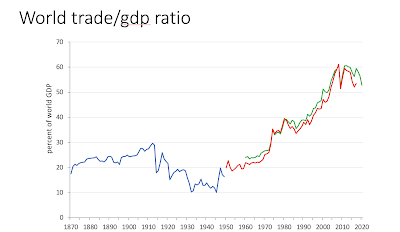
Doug reveals that this story is far too simplistic to understand the closed economies of the 1950s through 1970s, and the great trade liberalization that the world experienced starting in the 1980s -- and which we are very sadly likely to lose in the years ahead. A little reminder of what we gained, and a sad peak: 


The process of liberalization started with money, not tariffs: Countries first devalued overvalued currency, usually to a floating rate. Then they eliminated quantitative restrictions on imports including import licenses. Then they reduced tariffs. 

In turn, how did they get there, and why did they not reform earlier? The standard story pits domestic industry vs. consumers. Domestic industries have concentrated interest in protection, consumers are diffuse. That accounts for status quo bias, but not why they eventually changed. 

The source of the problem, and reason for the change is different. Countries (especially in the "developing" world) were hit with a "terms of trade" shock -- they exported commodities, say, to import goods; the commodity price went down so they could not buy imports. Many countries were financing imports with foreign aid and borrowing, and those transfers dried up. 

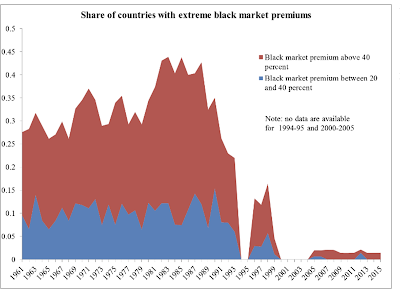
What do they do? They have to choose between deflation, currency depreciation, or import controls.  Deflation at the same exchange rate makes foreign goods more expensive. Depreciation does the same, without changing the domestic price level. Or, stop imports by direct controls, and by rationing foreign exchange leading to a black market. In the early postwar view, consistent with Bretton Woods, they chose the latter. (Why is there so much nostalgia for Bretton Woods? It was a rotten system.) 

Naturally, it didn't work. Eventually they gave up and devalued or floated the exchange rate. Now there is no need to ration foreign exchange or to restrict imports by license. (Tariffs are bad, but quantitative restrictions are worse, since you never know what the cost is, and then imports are allocated by political rather than economic reasons. Just paying a tax is more efficient!) They moved to exports in order to generate foreign exchange to buy imports. 


So, Doug answers the central question: 
Why no reform in 1970s? “foreign exchange reserves kill the will to reform” 
Oil and commodity export countries were flush with cash to buy imports. Foreign aid recipients had cash to buy imports. 

Why reform in 1980s?
Era of scarce foreign exchange – all three BOP shocks.
Goal: increase foreign exchange earnings by increasing exports.
Learning from experience – cost of import controls, benefit of exports

Shift from import repression to export promotion to overcome foreign exchange shortage 

And, later, 
Michael Bruno (World Bank): “We did more for Kenya by cutting off aid for one year than by giving them aid for the previous three decades”

Aid lets a country put off reform. 

I asked one question, about the importance of an open capital account. That also used to be gospel, now under debate. Doug's answer was interesting: In these cases, a free currency market was crucial, but free capital markets less so. 

Ideas matter.

This process did not just play out in standard political economy terms, one interest group gains power over another. The shift of ideas in universities, the IMF, central banks, and countries was crucial. I find this heartwarming as a producer of ideas, and terrifying as I watch these successful ideas crumble around me. 

Doug discusses the process of reform in Mexico, (which first had disaster under some bad ideas, then reform when a new group of economists came in), India, South Korea and others. Listen to the talk! 

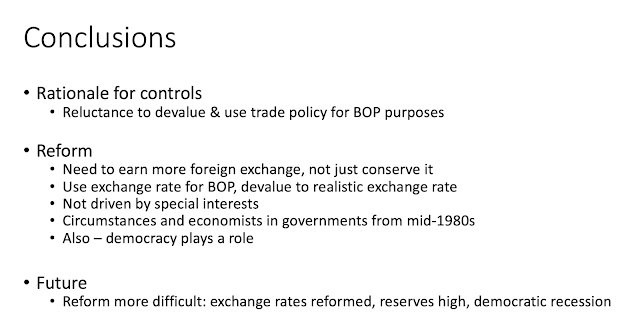
Concluding slide: 


Monday, March 7, 2022

The Biden-Blinken Doctrine

Over the weekend, the U.S. declared a no-fly zone off the table. Secretary Blinken on NBC News with Chuck Todd: 

QUESTION:  ... Why rule out the no-fly zone?  Why not make Putin think it’s possible?

SECRETARY BLINKEN: ...The President’s been very clear... we’re not going to put the United States in direct conflict with Russia, not have American planes flying against Russian planes or our soldiers on the ground in Ukraine, because for everything we’re doing for Ukraine, the President also has a responsibility to not get us into a direct conflict, a direct war, with Russia, a nuclear power, and risk a war that expands even beyond Ukraine to Europe.  That’s clearly not our interest.  What we’re trying to do is end this war in Ukraine, not start a larger one.... 

And by the way, keep in mind what – again, keep in mind what a no-fly zone – just so people understand, too, what a no-fly zone means.  It means that if you declare a space no-fly and a Russian plane flies through it, it means we have to shoot it down.

If country A nakedly invades country B, and country A has the ability to expand to a wider war, especially nuclear, then the US will not fight. Not only we do not fight directly, we do not declare a no-fly zone. If country B has an explicit defense treaty with the US, such as NATO, we might, but otherwise, you're on your own. 

Thursday, March 3, 2022

Time for Supply

At Project Syndicate essay, with Jon Hartley. It's not the first, and it won't be the last on the issue! 

Now that surging inflation has refocused everyone's attention on the long-ignored supply side of the economy, the question is how best to support broad-based growth, efficiency, and innovation. The answer is not necessarily deregulation, but the need for smarter regulation is increasingly apparent – even to progressives.

STANFORD – The return of inflation is an economic cold shower. Governments can no longer hope to solve problems by throwing money at them. Economic policy must now turn its attention to supply and its cousin, economic efficiency. 

The issue is deeper than delayed goods deliveries and a year’s worth of sharp price increases. From the end of World War II to 2000, US real (inflation-adjusted) GDP per capita grew 2.3% per year, from $14,171 to $44,177 (in 2012 dollars). Americans became healthier, lived longer, reduced poverty, and paid for a much cleaner environment and a vast array of social programs. But since 2000, that post-war growth rate has fallen almost by half, to 1.4% per year. And it’s worse in Canada and Europe, where many countries have not grown at all since 2010 on a per capita basis. 

Nothing matters more for human flourishing than long-term economic growth. So, no economic trend is more worrisome than growth falling by half, especially for the well-being of the less fortunate. 

The eruption of inflation settles a long debate. Sclerotic growth is not the result of demand-side “secular stagnation,” fixable only with massive fiscal and monetary stimulus. Sclerotic growth is a supply problem. We need policies to increase the economy’s productive capacity – either directly or by reducing costs. 

How? The simplest and most important thing governments can do is to get out of the way. Byzantine regulations and capricious regulatory authorities stymie business. We do not need thoughtless deregulation, but rather smarter regulation that is simple, effective, avoids disincentives and unintended consequences, and is not distorted to protect current business and prop up regulatory empires. That means adding sunset clauses to regulations, regularly re-evaluating existing measures, and instituting a right to external appeal.