Tuesday, January 10, 2023

Cheers for Powell

 Jay Powell's Stockholm speech lays it out with Gettysburg address clarity and brevity. Relative to usual central-bankerese it's soaring rhetoric too. 

...Decisions about policies to directly address climate change should be made by the elected branches of government and thus reflect the public's will as expressed through elections.

... without explicit congressional legislation, it would be inappropriate for us to use our monetary policy or supervisory tools to promote a greener economy or to achieve other climate-based goals. We are not, and will not be, a "climate policymaker."

Friday, January 6, 2023

Strassel insight, and cheers for a long speaker tussle

I'm a policy wonk, but I care very little about politics, who is up and who is down. The house speaker voting coverage has been largely the latter, with no more than the usual tropes about "normal Republicans" vs. "Radicals" suffused with Trump-loving election-denying fervor.  

The WSJ's Kim Strassel, whose fact-filled columns are always a delight, explains that there actually are important issues at stake here: 

Committees barely function. Members have no ability to debate or amend. Leaders disappear into back rooms to cook up mammoth bills that are dropped on the floor for last-minute take-it-or-leave it votes. Add Mrs. Pelosi’s Covid “proxy” voting rules, and most of the House didn’t even bother to clock in.

Under the proposed new rules package, committees are back in charge of legislation, with rules designed to ensure that bills address single subjects—rather than catch-all legislation. It similarly gives members new power to challenge amendments that aren’t related to the topic at hand. And it revives “Calendar Wednesday,” whereby any committee chairman can bring a bill straight to the floor.

It includes new provisions for accountability and transparency. Proxy voting is history, as are virtual committee meetings. It requires a 72-hour rule to give members time to read legislation. It ends Democrats’ wild experiment with staffer unionization, which threatened to tie the chamber up with crazy demands. 

Wednesday, January 4, 2023

Fun Fisherian Graph

In working on a revision to fiscal theory of the price level chapter 5 on sticky price models, and a revision of "Expectations and the neutrality of interest rates" I came up with this fun impulse-response function. It  has an important lesson about interpreting impulse response functions.


It's a response to the indicated interest rate path, with no change in fiscal policy, in a simple new-Keynesian model with short-term debt. 

Rational expectations new-Keynesian models have the implication that higher interest rates raise inflation in the long run. They also tend to raise inflation in the short run. I've been looking for better mechanisms by which higher interest rates might lower inflation in the short run in these models, without adding a contemporaneous fiscal austerity as standard new-Keynesian models do. Fiscal theory explores a model based on long-term debt that does the trick, but has a lot of shortcomings. So I'm looking for something better. 

This graph has only short term debt. I generate the pretty interest rate response by hand. It follows \(i_t=30e^{-1.2t}-29.5e^{-1.3t}-0.05.\) Then I compute inflation and output in response to that interest rate path. 

Wow! Higher interest rates lead to high real interest rates,  send inflation down, and create a little recession. Once inflation is really lowered, the central bank can lower interest rates. The price level (not shown) falls nearly linearly, as we often see in VARs.   

Doesn't this look a lot like the standard story for the 1980s? A big dose of high real rates lowers inflation, and then the Fed can follow inflation downward and get back to normal at a lower rate. 

That analysis is totally wrong!  In this model, a higher interest rate always leads to higher inflation in both the short and the long run.  Inflation is a two-sided moving average of interest rates with positive coefficients. Inflation declines here in advance of the protracted interest rate decline starting in year 2. Lower future interest rates drag inflation down, despite, not because of the rise in interest rate from year 0 to year 2, and despite, not because of the high real interest rates of that period. Those high real rates add interest costs on the debt and are an inflationary force here.  If the central bank wants a disinflation in this model, it will achieve that sooner by simply lowering interest rates immediately. The Fisherian effect will kick in faster, and it will not be fighting the fiscal consequences of higher interest costs on the debt. 

Beware facile interpretations of impulse-response functions! It would be easy to read this one as saying high interest rates bring down inflation and cause a recession, and then the central bank can normalize. But that intuition is exactly wrong of the model that produces this graph.  

The model is \[ \begin{align*} E_t dx_{t} & =\sigma(i_{t}-\pi_{t})dt\\ E_t d\pi_{t} & =\left( \rho\pi_{t}-\kappa x_{t}\right) dt \\ dv_{t} & =( rv_{t}+i_t-\pi_{t}-\tilde{s}_{t}) dt  \end{align*}\] Parameters are \(\kappa = 0.1, \  \sigma = 0.25,\   \rho = 0.1,\ r = 0.01.\) I used a lot of price stickiness and an unrealistically high \(\rho\) to make the graph prettier.  

Update: For Old Eagle Eye. I'm plotting an impulse response function. Variables start at zero, there is one shock, then we solve the deterministic version of the model. The system has two variables with expectations, and two unstable eigenvalues. So we solve forward to determine the initial conditions uniquely. All explained in FTPL, see especially the new Chapter 5 and pointer to the Online Appendix with formulas. 


Friday, December 30, 2022

Fiscal-monetary interaction


An email correspondent sent the above graph. The title is [Federal Reserve] Liabilities and Capital: Liabilities: Earnings Remittances Due to the U.S. Treasury.

The Treasury pays the Fed interest on the Fed's asset holdings. The Fed pays interest on reserves to banks and to other financial institutions that have, effectively, deposits at the Fed. As long as Treasury interest is greater than interest the Fed pays, the Fed makes money. It spends some, and returns the interest to the Treasury. The Fed also issues cash, which pays no interest, so the Fed makes steady money on the difference between interest bearing assets and the zero return of cash. 

But when short-term rates the Fed pays rise sufficiently above the Fed's interest earnings, the Fed loses money. It stops sending interest earnings to the Treasury. The graph is in essence the amount the Fed owes the Treasury in this scheme. Usually the Fed makes some money -- the graph goes up -- then the Fed pays out to the Treasury and the graph goes back to near zero. When the Fed loses money, the Treasury doesn't send a check. Instead, the Fed accumulates its losses, $16 billion so far. The Fed then will wait to make this amount back again before it starts sending money back to the Treasury. 

Wednesday, December 28, 2022

Calomiris on Gramm Ekelund and Early on Income Distribution.

Charles Calomiris has a splendid WSJ review of a great book, "The Myth of American Inequality" by by Phil Gramm, Robert Ekelund and John Early.

It is a "'a truth universally acknowledged,' according to the Economist magazine in 2020" that 

little progress has been made in raising average American living standards since the 1960s; that poverty has not been substantially reduced over the period; that the median household’s standard of living has not increased in recent years and inequality is currently high and rising 

Most of all the last one. 

All of this is false. Most of all the last one. 

1) Income. The central jaw-dropping, astonishing fact: The statistics you read about income and income inequality ignore taxes and transfers. By doing so, of course, they create a problem that is immune to its purported solution! 

Monday, December 26, 2022

FTPL revised Ch. 5 draft

The book isn't out yet, but I can't help myself... A revised draft of Chapter 5, fiscal theory in sticky price models is up on my website here. Giving talks over the last year and writing some subsequent essays, I see clearer ways to present the sticky price models.  Bottom line, these three graphs provide a nice capsule summary of what fiscal theory is all about: 


Response of inflation, output and price level to a 1% deficit shock, with no change in interest rates. Bondholders lose from a long period of inflation above the nominal interest rate. Inflation goes away eventually on its own. 

Friday, December 23, 2022

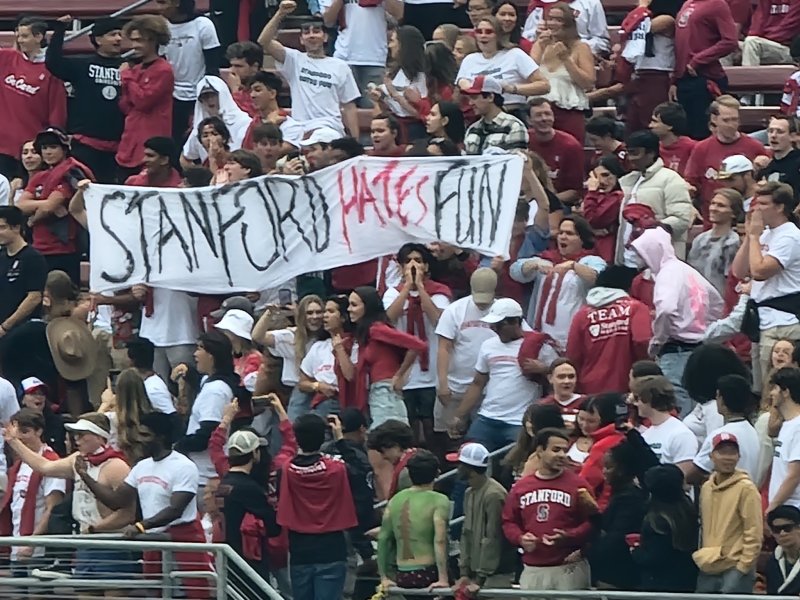
Stanford hates fun

Source: Stanford Daily

Stanford hates fun is the title of the second Stanford article in the Wall Street Journal this week. (On the first, Stanford's guide to acceptable words, enough said already.) 

This has been bubbling up for a while. Last June, Ginevra Davis wrote a powerful article in Palladium, "Stanford's war on social life." She recounted how the slightly transgressive Stanford atmosphere in the 90s, which seeded the slightly transgressive get it done attitude of tech in the early 2000s, is being smothered by the Administration. For example, back in the early 90s, 

...The brothers were winding down from Kappa Alpha’s annual Cabo-themed party on the house lawn.... a day-to-night extravaganza that would start sometime in the morning and continue long after midnight. The girls wore bikini tops and plastic flower leis, and the boys wore their best Hawaiian shirts.

Uh-oh, I can already smell trouble if you tried that today. But the point,  

That year, the brothers had filled the entire main level of Kappa Alpha’s house with a layer of sand six inches deep. The night was almost over; the guests were leaving and the local surf rock band had been paid their customary hundred dollars in beer. The only question was what to do with all the sand.

No one remembers who had the idea to build the island. A group of five or six brothers managed the project. One rented a bulldozer...

Later that year, the brothers installed a zipline from the roof of their house to the center of the island. They also built a barge, which they would paddle around the lake on weekends and between classes.

More generally 

Through the late 1990s, Stanford ... featured a wacky campus culture that combined collegiate prep with West Coast laissez-faire. Stanford was home to a rich patchwork of wild and experimental campus life. Communal living houses (“co-ops”) encouraged casual nudity, while fraternities threw a raucous annual “Greek Week” and lit their houses on fire. Until 2013, Stanford hosted a fully student-run anarchist house, where residents covered the walls with eccentric murals. 

Today, 

The Kappa Alpha boys have been kicked out of their old house. Lake Lagunita was closed to student activities in 2001,...

...In less than a decade, Stanford’s administration eviscerated a hundred years of undergraduate culture and social groups. They ended decades-old traditions. They drove student groups out of their houses. They scraped names off buildings. They went after long-established hubs of student life, like fraternities and cultural theme houses...

Tuesday, December 20, 2022

Expectations and the neutrality of interest rates video

I revised "Expectations and the neutrality of interest rates" and presented at the Hoover Economic Policy workshop. Thanks to the great Hoover team, here it is by video. If the embed doesn't work, here's the Hoover webpage with the video. The updated paper and slides are here


Thursday, December 15, 2022

CDC, more on politicized agencies

Continuing a series on rot and politicization in administrative agencies... "Sure" comments on Marginal Revolution are fascinating. My excerpts:

The reasons you cannot change the CDC have little to do with remote work.  The major issues are:

2. It is overrun with academics....Many look at the CDC as complementary to an academic career and even the lifers have CVs at least compatible with going academic. This means a lot of the work product and setup is geared more toward publication, conference presentation, and deliberative work rather than rapid response.

A similar culture pervades the Fed. Fed researchers primarily regard the Fed as a home to write publications that will advance an academic career, with "policy work" culturally degraded. Both Board and regional Feds have developed into quite good centers for academic economic research, which seems overall a good thing, but one wonders just why the central bank should funnel what is in the end taxpayer money to this endeavor. However it also means that when inflation surges to 8%, nobody saw it coming, and we wonder why.  

3. The place has gone monocultural. ...Since 2015, their political donations have been 99.94% to Democrats. This means that they get bogged down in the latest vanguard concerns of the Democratic base and that they are increasingly ignorant about and isolated from the bulk of the populace. Things that make some sense in dense urban corridors where few people get dirty at work make little sense in sparsely populated areas with significant morbidity burdens from work.

Tuesday, December 13, 2022

Second great experiment second update

The November CPI is in, and inflation continues to moderate despite interest rates that, while rising, are still below current inflation. The great experiment seems to be working out, at least for now. (Previous post, with links to earlier writing.) 

Climate disclosures and politics by bureaucracy

One of the most important and under-reported struggles under the radar is the politicization of administrative agencies, and the effort to cement via those agencies policies that Congress will never vote for, but that once enshrined will be very difficult for any administration or Congress to overturn. 

One central part of that is the "whole of government" climate policy, centered around stopping fossil fuel development and subsidizing electric cars, photovoltaics and windmills. Never mind that large scale storage remains a pipe dream, never mind the lessons of Europe. 

SEC

As reported by James Freeman in the WSJ the courageous Hester Peirce is again clarfying just what the SEC's new climate rules really mean. Background: SEC wants to mandate "disclosure" of carbon emissions and "climate risks," not just by each individual business but also each businesses' suppliers and customers. That is transparently impossible, a lawyer and consultant employment act, and a tremendous opening to harass companies for mis-statements. But Hester goes on insightfully: 

... the climate proposal mandates disclosure about board oversight of climate-related risks, including identifying board members or board committees responsible for overseeing climate-related risks; detailing board member climate expertise; describing the processes and frequency of discussions about climate-related risks; explaining how the board is informed about, and how often it thinks about, climate-related risks and whether it considers climate-related risks as part of its business strategy, risk management, and financial oversight; and describing whether and how the board sets climate-related targets or goals and how it oversees progress in achieving them.The proposal also includes a corresponding set of disclosures related to management: who is responsible for managing climate-related risks, what their climate expertise is, how they get informed about those risks, and how often the managers responsible for climate-related risks report to the board...

Shudder. 

All Federal Contracts

Saturday, December 10, 2022

Twitter and universities

From Rob Wiesenthal at the Wall Street Journal re Elon Musk and Twitter: 

Minutes after closing his purchase of the company, he started a process that reduced the workforce from 7,500 to 2,500 in 10 days....

Mr. Musk is trying to cure a degenerative corporate disease: systemic paralysis. Symptoms include cobwebs of corporate hierarchies with unclear reporting lines and unwieldy teams, along with work groups and positions that have opaque or nonsensical mandates. Paralyzed companies are often led by a career CEO who builds or maintains a level of bureaucracy that leads to declines in innovation, competitive stature and shareholder value....

Mr. Musk set his new tone immediately. He eliminated a 12-member team responsible for artificial-intelligence ethics in machine learning, the entire corporate communications department, and a headquarters commissary that cost $13 million a year (despite prior management’s pandemic decree that Twitter employees would be “remote forever”)....

he knows he doesn’t need five layers between him and the employees who actually do the work. His recent email to the engineering team stating, “Anyone who actually writes software, please report to the 10th floor at 2 pm today,” makes it clear he doesn’t want a membrane of corporate yes-men between him and the people who actually build things....

As sole owner, he can also quickly terminate the members of Twitter’s black hole of middle management, that cold and lonely place where great ideas go to die at big companies....

The days of nap pods, emotional-support dogs, corporate pronoun guides, personal wellness days and email blackouts after 5 p.m. are quickly vanishing....

 Those employees who relish getting things done will thrive.

My thoughts go naturally to my home institution, Stanford. We are self-evidently bloated with administrative staff. Stanford proudly lists 15,750 staff, for 7,645 undergrads, 9,292 graduate, and 2,288 faculty. 

Tuesday, December 6, 2022

Fiscal Theory of the Price Level discount coupon


The Fiscal Theory of the Price Level
is now available from Princeton University Press. The official release date is Jan 17, but both hard cover and ebook are available sooner from Princeton. And for a limited time, 30% off! There is also an e-book sale, see the website. 


Friday, December 2, 2022

Waller courage

While the rest of the Fed climbs on the maybe-anvils-might-fall-from-the sky climate financial risk fantasy, Chris Waller has the courage in Haiku-simple prose to state that the emperor has no clothes. 
I cannot support this issuance of guidance on climate change. Climate change is real, but I disagree with the premise that it poses a serious risk to the safety and soundness of large banks and the financial stability of the United States. The Federal Reserve conducts regular stress tests on large banks that impose extremely severe macroeconomic shocks and they show that the banks are resilient.
Granted, in my view stress tests are a lot less reliable. Stress tests didn't uncover the weakness that led to the pandemic bailout, so there is no hope of them assessing climate risk. The Fed is, let us not forget, fresh off of a second huge bailout in a pandemic their stress testers never considered, and a consequent fiscal-policy inflation that their forecasters never imagined. The "transition risk" crowd got the sign wrong on what happens to oil company profits if you restrict fossil fuel investment. A "how did we screw up so badly" effort seems more important. But we need not fight about this issue. Different logic leads to the same conclusion. 

Chris is right that it is completely obvious that "climate risk" does not conceivably imperil the financial system, or at least not with more than infinitesimal probability and a lot less than other dangers --- war, sovereign debt collapse, pandemic, etc. 

Bravo, Chris. A reckoning of this highly political move will come. Yes, the Biden administration wants a "whole of government" effort to restrict fossil fuels and to subsidize windmills, photovoltaics and electric cars (so long as they are built in the US), but the Fed is supposed to be politically independent. Because, you know, administrations and Congresses change. I suspect caving to this pressure will cost the Fed a lot. 

Monday, November 28, 2022

California homeless math

From WSJ 

California Gov. Gavin Newsom ....recently put a temporary freeze on $1 billion of state grants for city and county homelessness programs....the measures would have reduced homelessness statewide by 2% between 2020 and 2024

[California has] more than 116,000 residents sleeping on the street on any given night.

California has dedicated some $15 billion toward the issue since the start of the pandemic.

$15 billion / 116,000 =  $129,310.34

2% x 116,000 = 2,320. $1 billion / 2,320 = $431,034.48

Thursday, November 10, 2022

The second great experiment update

 Our great experiment in monetary economics continues. 


The news of the moment is that inflation might--might--be peaking. I just present the CPI to make the point, but there seems to be a lot of news suggesting that inflation is easing off. Jason Furman's twitter is a great source of up to the minute detailed data and analysis suggesting this view. 

Of course this could also be a blip like August. And new shocks could come along. But let's explore what peaking might mean. 

Friday, November 4, 2022

Academic Freedom Conference Opening Statement

Opening remarks, Conference on Academic Freedom

John H. Cochrane

Nov 4 2022

Welcome to the Academic Freedom Conference. I’m John Cochrane, one of the co-organizers of this conference.

First, let us offer thanks. Most of all, we thank the Stanford GSB and its dean Jon Levin for sponsoring this conference, and sticking with us through some turbulence. We also thank the institutions listed here for sponsorship, and several generous donors. We thank the organizing committee, which helped to identify and recruit speakers and consulted extensively. We thank all our speakers, and all of you, especially those who have traveled to be here. Most of all, Ivan Marinovic did all the hard work of putting the conference together. Thank you Ivan! 

I am, of course, not going to tell you what to say and not say. But any conversation is more productive if we focus it and try to keep to the point. 

We gather as a group that believes academic freedom is important and under threat. But we don’t fully understand the problem or what to do about it. So, we are here to share experiences in different universities, fields, and from a diversity of viewpoints, to understand and define the problem, and to find practical solutions. 

We are not here to have a philosophical discussion whether academic freedom is important, and whether it is threatened. We here start from the premise that the core mission of the scholarly community is to uncover new knowledge, to debate and refine knowledge, to pass on knowledge to the next generation, and more importantly to pass on the habits and norms of critical inquiry and scholarly debate that produce true knowledge. We here start from the premise that we are losing academic freedom, and that threatens this core scholarly mission. If those of you listening on zoom or the critics of this conference wish to debate these issues, go ahead and run a different conference. Every biology conference does not start with an evolution vs. creationism debate. Time is short, and focus will make us more productive. 

This is a conference on academic freedom, with a lesser emphasis on free speech of political opinions. Cancellation, ostracism, and disciplinary action for political opinions, and canceling outside popular speakers are in the news. But our core question is limitations on the scholarly enterprise of research, teaching, publication, fact-finding, logical analysis, and criticism. This enterprise is damaged when scholars are canceled for political opinions, or opinions on matters like university hiring and admissions. But our focus goes beyond this to emphasize less visible but perhaps more insidious restrictions on academic activity, including direct institutional actions, by self-censorship in fear, or by good people being driven out of the academic enterprise. 

This is a conference on academic freedom, and not free speech and censorship in the media, on twitter, and in the general society. That is an important political problem in our democracy, but it’s not the focus of our conference.  

This is a conference on academic freedom, and not centrally on the substance of contentious issues. We have some noted speakers who have been criticized for their views. But we’re here primarily to learn from their experience of censorship, not to debate the merits of the particular views and research findings that got them in trouble.

Academic freedom is a problem of institutions. Twitter-mob students are visible. But the key restrictions on academic freedom lie with university leaders, university bureaucracies, hiring and promotion procedures; and beyond universities to funding agencies, professional organizations, and journals. I hope we can discuss and remedy dysfunction in all these institutions. 

The nexus between politics and academic freedom is a deep and troublesome question.

We designed this conference to be non-partisan. Truth knows no politics, we thought; it is likely to unsettle verities on all sides, and we know many self-identified leftists as well as rightists and libertarians who are concerned. We don’t know and didn’t ask what your politics are. We did however, make a special effort to invite people who self-identify as politically left or progressive and concerned with academic freedom. We also made a special effort to reach out to many of the people who have criticized some of our speakers; among others Stanford faculty who publicly denounced Jay Bhattacharya and Scott Atlas. 

The non-response and refusals from this group was astounding, and surprising to us. If this group does not seem “balanced” to you it is by refusal to participate, not by lack of invitation. 

One prominent Stanford professor, active in university academic freedom issues, spoke for many, telling us “I can’t be seen on the program with right-wing nutjobs like.…” and named a few of our speakers. At an academic freedom conference. There’s half the problem in a nutshell.

There are now faculty protest letters and demands in the faculty senate that Stanford distance itself from this conference. Critics involved the media. They complain that we are “closed,” for restricting attendance when the room got full, and for restricting media to preserve space for participants, though these are routine for academic conferences. [The Stanford global energy forum of the last two days is explicitly “invitation only” without complaint, and without Bjorn Lomborg or Steve Koonin.] They complain about some of our speakers’s deplorable, to them, views. People with such views should, apparently, never allowed to speak on anything. They cherry pick one or two hated speakers, to declare us “unbalanced.” But have any of them looked up the other 35 speakers on the program?  The Chronicle of Higher Education declared this conference a “threat to democracy.” Even the Hoover Institution declined to support or co-host this conference, deeming it “too political.” 

The attempt failed. Stanford’s leaders have supported us, for which we are grateful, so we are still here. But young untenured faculty figured out they should not be seen here. Several more deregistered from the conference after we decided to stream the proceedings, citing fear of repercussions. 

The irony of trying to censor the free speech conference has not occurred to them. The hypocrisy of labeling this and only this conference “political,” and demanding that this and only this conference include “wider voices,” not the long list of highly one-sided political events at Stanford, [for example, the “Gender Equity and Justice Summit”] likewise escapes them. Well, I guess "logic" is not politically fashionable, but do we have to be so obvious about it?  

We were naive. Just in setting up a conference to talk about academic freedom, we got to experience part of the problem. 

I think we cannot avoid the elephant in the room. The threat to academic freedom is political, as it has always been. Free scholarship undermines narratives that sustain or are used to claim political power.  Though in the past this threat has come from both left and right, and though there are some dumb and illiberal restrictions coming from Republican state legislatures, the main threats to academic freedom inside the university, professional societies, and government agencies predominantly come from a particular far-left authoritarian political ideology, and most of the forbidden subjects today threaten their narrative.  

Well, I think so. Maybe I’m wrong. My point is, we should talk about this too.

Some organizational notes: 

You can say what you want, but you can’t talk as long as you want. Please abide by the time limits. Moderators, please be ruthless in enforcing time limits. Please leave ample time for questions and comments from the floor. That discussion is much of the point of this event. I anticipate there will be far more comments than we can accommodate, so I encourage moderators to take a group of 5 or so comments at a time. Panelists, please keep responses short. 

Each session will start on time, and end on time. At breaks, please return to the room promptly without being nagged, so we can keep to the schedule and everyone gets a chance to be heard.

Be aware that this conference is streamed, and video will be available later as well. We  originally preferred no recording and Chatham house rules. But various pressures make that impossible, and we realized there is no way to ensure privacy. So, we accepted the loss of spontaneity that a record imposes, in return for the transparency that it provides. It proves what is not said here as much as it records what is said. 

Covid still runs among us, and in a group this size there is a good probability that someone is infectious. Let this be a super-spreader event of ideas, but not of disease. If you are not feeling well, please do us all a favor and watch the live stream from out of the room. If you have any doubts, please take a test. (There are a bunch at the sign in desk.) In this tolerant free-speech group, let us respect people’s individual choices to wear a mask.

OK. Tell us what’s going on in your field, your university, your department, your curriculum committee, your classroom, your professional society, your journals, your funding agency, and tell us how we can work together to fix it.


Thursday, November 3, 2022

Academic Freedom Conference

On Friday and Saturday Nov. 4/5, the Stanford GSB Classical Liberalism Initiative will host a two day conference on Academic Freedom. Conference website here, and I copy and paste the schedule below.  The room is beyond full, so we can't issue more in-person invitations. Because of that and the threat of protests (yes, a loud group at Stanford wants to silence the academic freedom / free speech conference),  we will not be able to accommodate walk-ins. 

But the event will be live-streamed. If you want to watch, register here and we'll send you a link. 

This is a separate effort from the academic freedom declaration I blogged  yesterday, though many of the same organizers are involved. 

Academic Freedom Conference

Academic freedom, open inquiry, and freedom of speech are under threat as they have not been for decades. Visibly, academics are “canceled,” fired, or subject to lengthy disciplinary proceedings in response to academic writing or public engagement. Less visibly, funding agencies, university bureaucracies, hiring procedures, promotion committees, professional organizations, and journals censor some kinds of research or demand adherence to political causes. Many parts of universities have become politicized or have turned into ideological monocultures, excluding people, ideas, or kinds of work that challenge their orthodoxy. Younger researchers are afraid to speak and write and don’t investigate promising ideas that they fear will endanger their careers. 

The two-day Academic Freedom Conference, arranged by the organizing committee, aims to identify ways to restore academic freedom, open inquiry, and freedom of speech and expression on campus and in the larger culture and restore the open debate required for new knowledge to flourish. The conference will focus on the organizational structures leading to censorship and stifling debate and how to repair them. 

Schedule

Wednesday, November 2, 2022

Academic Freedom Letter

Some colleagues and I created an open letter on Academic Freedom. If you share our views, you are invited to sign. 

The bottom line: we call for universities and professional associations to adopt and implement the  Chicago Principles of free speech, the Kalven Report requirement for institutional neutrality on political and social matters, and the Shils report making academic contribution the sole basis for hiring and promotion.  

We include professional societies. That means you, American Economic Association and American Finance Association: With all your committees on improving the profession, you need one big one to defend the most important and imperiled part of the scholarly enterprise, academic freedom. 

The letter, below, is not as comprehensive and detailed as you might like, but we worked to keep it short. 

The official letter and list of signatories lives here. If you would like to sign, you can do so by filling out this form. It's moderated so may take a day or two for your signature to show. 

We are up to 626 signatures (11/3). When the number stabilizes we'll try to make a public fuss about the letter. 

Update: A special plea. I have several responses from left/liberal/democrat colleagues who say they would sign, but don't want to have their names on a letter that doesn't have enough other left/liberal/democrat names on it and does have well known deplorables. (How you know 626 people's politics is beyond me, but ok.) That reaction tells us a big part of the problem.  All along we have tried very hard to reach out to self-described left/liberal/democrat colleagues, who privately bemoan what's going on but are too afraid to be seen in public. But why not fix it: if some of you sign perhaps that will give courage for more of you to sign. Take it over, get together with your friends, add lots of signatures, make this your cause, prove that we can stand together for freedom! 

Restoring Academic Freedom

The mission of the university is the pursuit of truth and the advancement and dissemination of knowledge. A robust culture of free speech and academic freedom is essential to that mission: Intellectual progress often threatens the status quo and is resisted. Bad ideas are only weeded out by unfettered critical analysis. 

Unfortunately, academic freedom and freedom of speech are rapidly declining in academic institutions, including universities, professional societies, journals, and funding agencies. Researchers whose findings challenge dominant narratives find it increasingly hard to get published, funded, hired, or promoted. They, and teachers who question current orthodoxies, are harassed in person and online, ostracized, subjected to opaque university disciplinary procedures, fired, or canceled by other means. Employment, promotion, and funding are increasingly subject to implicit or explicit political litmus tests, including approval from bureaucrats seeking to impose a social agenda such as specific views of social justice or DEI principles. Activism is replacing inquiry and debate.  An increasing number of simple facts and ideas cannot even be mentioned without risk of retribution.

We're all supply siders now -- Summers and Poilievre

Larry Summers wrote an interesting oped at the Washington Post. Mostly, he still is of the adaptive-expectations ISLM view that interest rates must exceed current inflation before inflation will decline. (The issue here (blogpost) and here (paper).) But listen to this:

Questions of macroeconomic policy are not about values but judgments about the ultimate effects of various actions. As Fed chair during the early 1980s, Paul Volcker famously tamed out-of-control inflation at the cost of a severe recession. But he did so not because he cared less about unemployment or worker incomes than his predecessors did but because he rightly recognized that delay in containing inflation would only mean more pain down the road.

Would we all recognize common goals, but differences on cause and effect to get there.  

That’s why it’s vital that the Federal Reserve not waver. Chair Jerome H. Powell has vowed to impose sufficiently restrictive monetary policy to return inflation to within range of the Fed’s 2 percent target. The more confident that workers, businesses and markets are that the Fed will follow through on that, the less painful the process will be.

Within the conventional monetary policy community, praise for Volcker and the view, basically, that the Fed should focus on inflation and the labor market will take care of itself is sensible, but remarkably Reaganish. 

The tidbit that I found most interesting

Finally, the crisis of inflation should not be wasted. A bright spot in the dismal inflation period of the 1970s was the collaboration of Stephen G. Breyer (then counsel to the Senate Judiciary Committee), Sen. Edward M. Kennedy (D-Mass.) and the Carter administration on airline deregulation. In this era, high inflation should be a spur to regulatory changes — from addressing Jones Act increases in shipping costs, to strategic tariffs, to rules that force oil and gas to be transported via truck rather than pipeline, to punitive zoning restrictions — that will both reduce prices and make the economy work better.

As you know I've been preaching that "supply side" growth is the central problem and also the key to reducing inflation. Larry hasn't quite gotten to the latter, but this is the economist most identified with "secular stagnation," "hysteresis" and the view that all we need to do is borrow or print more money and hand it out to create growth. Now deregulation and the supply side is the key to growth. 

Larry is starting to sound like a Reagan Republican!  I'm sure he would say circumstances have changed -- that was ZLB (zero lower bound on interest rates), this is inflation. That's a consistent view. But inflation should wake us all up as it has Larry: All the old verities are over, there is only supply now, and that comes mostly from getting out of the way, as Larry recommends, not new "investments" of more borrowed money thrown down ratholes. 

*** 

Pierre Poilievre, the leader of Canada's Conservative party, wrote a great Oped in the National Post. Now that Liz Truss has imploded, perhaps Poilievre will become the international hope for a successful free market libertarian politician. 

Finance Minister Chrystia Freeland wants us to believe she has had an epiphany. After years of ignoring my warnings that Liberal deficit spending would cause inflation to balloon, followed by interest rates, she now claims to agree with me in a leaked letter to fellow ministers. Even her boss, Prime Minister Justin Trudeau, is uttering words unthinkable to him not long ago: “fiscal responsibility.”

The cost of government is driving up the cost of living. A half-trillion dollars of inflationary deficits have sent more dollars chasing fewer goods, which always leads to higher prices. 

We're all FTPLers (fiscal theory of the price level) now, some sooner than others. A clear explanation of how central banks create money and buy treasury debt follows. Then

 the Bank of Canada must pay interest — at the going rate. Because rates are now rising, the central bank is now losing money and will need a bailout from the federal government for the first time in history — something I predicted would happen two years ago. 

Fiscal constraints on monetary policy. Nice. 

Liberals like to say that all this inflation is the result of the Russian invasion of Ukraine. But less than 0.3 per cent of Canada’s trade is with those two countries, and the things that they produce are things we already have — food and energy. In fact, the higher commodity prices should have helped our resource-heavy economy, but for the fact that the Trudeau government has hit farmers with fertilizer tariffs and carbon taxes and blocked or bungled every single pipeline or LNG export terminal proposed in seven years.

Beside my thread, but an important point. His bottom line 

Instead of creating more cash, we need our economy to produce more of what cash buys: more food, energy and homes. That means removing gatekeepers that have made Canada the second slowest country in all the OECD to get a building permit. As prime minister I would challenge all three levels of government to work together to offer the fastest building permits in the OECD. This would mean going from 250 days to 28 days to beat the now first-placed South Korea....We would remove taxes and tariffs on farmers’ fuel and fertilizer....Finally, we would reform our taxes to reward work, savings, and investment so our workers and businesses can produce more of the goods we need. 

Simply put, we would stop creating cash and start creating more of what cash buys: food, homes, energy, manufactured goods and more. That is the only path to bigger buying power for paycheques and savings.

FTPL and deregulation-focused supply side growth. Well, us free market libertarians are like Chicago Cubs fans, there's always hope!